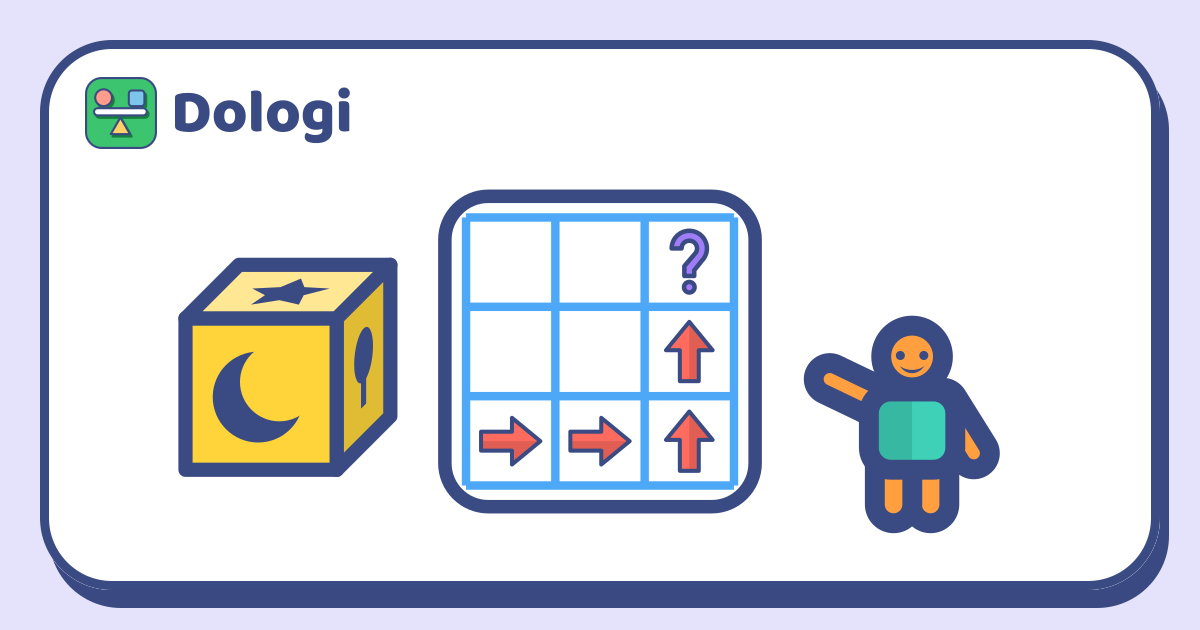
A die rolls one square to the right, then one square away from you. Which face is on top now? Many children simply guess, because they can't see the faces that are hidden. The puzzle becomes easy only when they learn to follow the faces one roll at a time.
This post shows how to turn that into a game for children of around 8 to 12: make a box with a picture on each face, roll it along a path drawn on paper, and always say the answer before rolling. Then take the box away and solve paths only by looking, and finally only by listening. The answers are at the end. Ages are only a guide; younger children can enjoy the first level.
Make a picture box and a rolling path
You need:
- A cube-shaped box, about 6 to 8 cm on each side. A small gift box works, or fold one from card (see the post on cube nets below).
- Six pictures, drawn or cut out, one per face. This post uses a star, a fish, a moon, a house, a tree and a cat.
- A large sheet of paper with a grid of squares exactly as big as one face of the box. Then one roll moves the box exactly one square.
Stick the pictures on in opposite pairs, and write the pairs down so your child can check them:
| Face | Picture | Opposite face |
|---|---|---|
| Top | star | fish (bottom) |
| Front, facing your child | moon | house (back) |
| Right | tree | cat (left) |
The star and the fish are a handy pair to remember: one is up in the sky, one is down in the water.
Your child sits at the bottom edge of the paper and stays there. An arrow pointing up on the paper means "roll away from you", an arrow pointing down means "roll towards you". The start position in every puzzle below is the one in the table: star on top, moon facing you, tree on the right.
What happens in one roll
When the box tips over one edge, four faces move and two stay put.
- Roll right: the left face comes up, the old top goes to the right, the right face goes to the bottom. The front and back stay where they are.
- Roll left: the right face comes up.
- Roll away: the front face comes up, and the old top goes to the back.
- Roll towards you: the back face comes up.
Two things are worth noticing. After one roll, the old top is never at the bottom: it is always on a side. And opposite faces stay opposite forever, because they are glued to the box. That second fact means you only need to keep track of three faces, top, front and right; the other three are their opposites.
Level 1: say it, then roll it
Put the box on a corner square in the start position. Before every roll your child says what will be on top. Then they roll and check. Puzzles to try:
- Roll right once. What is on top?
- Start again. Roll towards you once.
- Start again. Roll right, then away from you.
Give a tick for every correct prediction. After a wrong one, roll back slowly and watch where the face went.
Two small discoveries children often enjoy: rolling right and then left brings the box back to how it started, and rolling four times in the same direction brings the star back on top.
Level 2: just the path on paper
Now put the box aside. Draw paths with arrows on paper, as on the cover: start in the bottom-left square, then right, right, up, up. Your child follows the path with a finger and writes down the three faces after each roll.
| After roll | Top | Front | Right |
|---|---|---|---|
| Start | star | moon | tree |
| 1. right | ? | ? | ? |
| 2. right | ? | ? | ? |
| 3. away | ? | ? | ? |
| 4. away | ? | ? | ? |
A short rule helps: rolling right, the new top is the face opposite the right one, and the old top becomes the right face. Rolling away, the old front comes up and the new front is opposite the old top.
Only when the table is full do you bring the box back and roll the path to check. Then try two more paths: left, left, away; and away, away, right.
Level 3: riddles in words
The last level is just talking, on a walk or in the car. "Star on top, moon facing you. Roll left, then towards you. What's on top?" Your child answers in their head, then checks with the box at home.
After a few riddles, swap roles: your child makes up a path for you and has to know the answer first. A good challenge to finish: what is the smallest number of rolls that brings the fish to the top?
Children who are ready for more can use a normal die with dots. On a die, opposite faces add up to 7, so the bottom is always 7 minus the top.
When your child gets stuck
- Directions get mixed up. Keep your child at the same edge of the paper, and say "away from you" rather than "forward".
- "The top goes to the bottom." It never does after one roll. Roll it slowly and watch the old top land on a side.
- Too much to hold in the head. Write three faces after every roll, as in the table.
- Long paths. Start with one or two rolls and add one at a time.
In Dologi, the Space topic has "Roll the die" puzzles: arrows show where a die rolls, one step at a time, and children work out how many dots end up on top. The hint reminds them that opposite faces add up to 7.
Answers
- Level 1: 1. cat. 2. house. 3. moon.
- Level 2, right, right, away, away: after roll 1, top cat, front moon, right star; after roll 2, fish, moon, cat; after roll 3, moon, star, cat; after roll 4, star, house, cat. The star is back on top.
- Left, left, away: moon. Away, away, right: cat.
- Riddle (left, then towards you): house.
- Fish to the top: two rolls, both in the same direction, for example right, right. One roll is never enough, because one roll never brings the bottom face up.
In short
- In one roll, the face on the opposite side to the direction comes up, and the old top goes to a side, never straight to the bottom.
- Opposite faces stay opposite, so tracking the top, front and right is enough.
- Go from rolling a real box, to reading a path on paper, to riddles in words, and always say the answer before checking.
- Mistakes are a reason to roll slowly and look, not a reason to stop.
Read more: From flat shape to box: cube nets for children · Turning shapes in your head: building children's spatial thinking