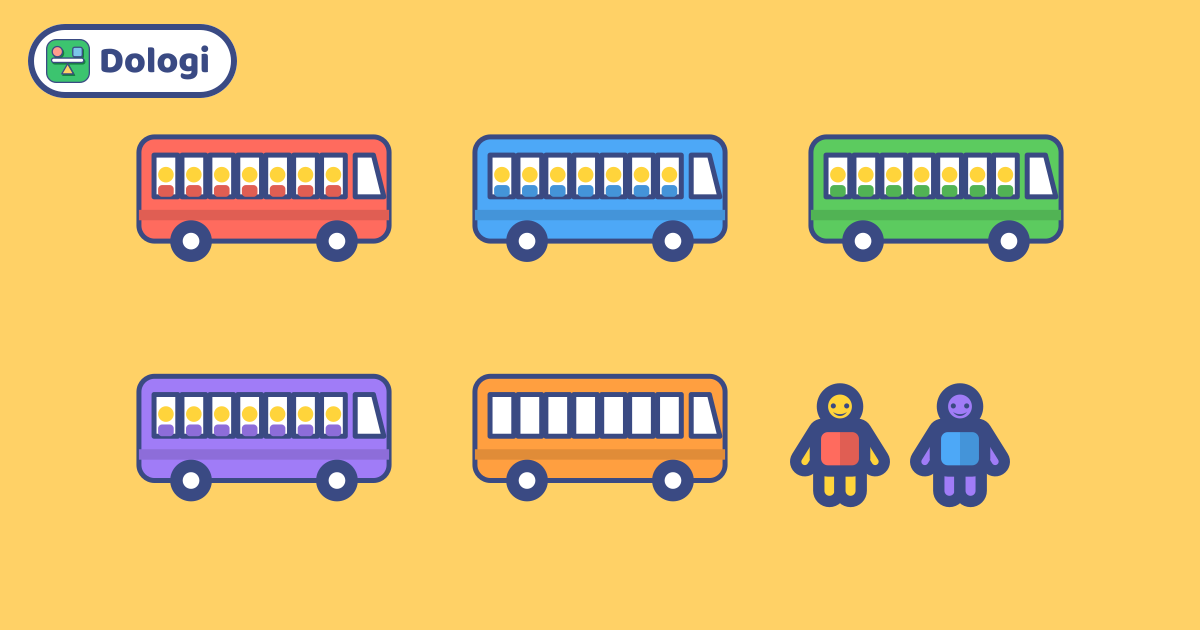
Your child's class is going on a field trip. There are 30 kids, and each minivan seats 7. How many minivans? Your child works it out correctly: 30 ÷ 7 = 4 R 2, and writes the answer "4 minivans". So two kids stay at school! The division is right; what is missing is one more question: what does the remainder mean in this story? This post is for parents of 8–11 year olds.
One division, three answers
The division is the same, 30 ÷ 7 = 4 R 2, but different questions have different answers:
| Question | Answer | Why |
|---|---|---|
| 30 kids, minivans seat 7. How many minivans? | 5 minivans | 4 are full, and the last 2 kids still need a ride |
| 30 cupcakes, boxes of 7. How many full boxes? | 4 boxes | the last 2 are not enough for a box |
| 30 cupcakes, boxes of 7. How many are left to eat at home? | 2 cupcakes | the answer is the remainder itself |
The first kind rounds up: the leftover still needs one more place. The second kind rounds down: the leftover is set aside. The third kind is the remainder.
Act it out with toys and boxes
Don't explain yet. Take 30 small things (beans, building bricks, bottle caps) and a few boxes or an egg carton:
- Your child puts exactly 7 things in each box. Four boxes fill up, and 2 things are left on the table.
- Ask: "If each thing is a kid and each box is a minivan, how do these 2 kids get there?" Your child will see that one more minivan is needed.
- Then ask: "If each thing is a cupcake and the bake sale only sells full boxes, how many boxes can we sell?" Your child sees that 2 loose cupcakes can't make a fifth box.
The toys show that the remainder is the things still lying on the table, not a meaningless number after an R.
A few to practice
- 23 kids sit at tables for 4. How many tables? 23 ÷ 4 = 5 R 3. You need 6 tables, because the last 3 kids need seats too.
- A ribbon 50 cm long is cut into 8 cm pieces. How many pieces? 50 ÷ 8 = 6 R 2. 6 pieces, with a 2 cm scrap.
- 17 candies are shared fairly among 5 kids. How many each, and how many left? 17 ÷ 5 = 3 R 2. 3 each, 2 left.
- 7 sandwiches shared between 2 people. Here the leftover can be split too: three and a half sandwiches each.
Checking a division with a remainder
Two things your child can check every time:
- The remainder must be smaller than the divisor. If your child writes 30 ÷ 7 = 3 R 9, the 9 left over is still enough for another box of 7, so the quotient is too small.
- Check backwards: quotient times divisor, plus the remainder, must give the number you started with. 4 × 7 + 2 = 30.
Your child writes three questions
This is the step that builds the deepest understanding. Give your child one division, for example 26 ÷ 6 = 4 R 2, and ask for three stories:
- One whose answer is 5 (round up), such as 26 balls in bags of 6: how many bags do we need?
- One whose answer is 4 (round down), such as how many full bags of 6 can we make?
- One whose answer is 2 (the remainder), such as how many balls are left to play with?
Once your child can invent all three kinds, they will never again forget to reread the question before writing the answer.
The Math topic in Dologi has a puzzle called Fill the jug: "How many full cups fill the jug to the top?" Counting how many cups the jug holds is a division question: how many cups fit in the jug. In real life the water doesn't always come out even, and then the same question comes back: what do you do with the leftover?
In short
- The same division with a remainder can round up, round down, or be the remainder itself, depending on the question.
- Act it out with toys and boxes so the remainder becomes the things left on the table.
- Check: the remainder is smaller than the divisor; quotient times divisor plus remainder gives the starting number.
- Have your child write three questions, one for each kind of answer.
Read more: Division for kids: sharing equally and making groups, Long division: why kids forget the zero in the quotient