Try asking your child: 3 + 4 = … + 2, what goes in the blank? Lots of children aged 6 to 9 write 7, and some write 9. The right answer is 5. Your child isn't bad at adding: they get 3 plus 4 right. They've just misunderstood the equals sign.
Two common wrong answers
- Writing 7: they work out 3 + 4 = 7 and put it straight in the blank, ignoring the "+ 2" after it.
- Writing 9: they add up every number they can see, 3 + 4 + 2 = 9.
The right answer is 5, because 3 + 4 makes 7 and 5 + 2 also makes 7. Both sides of the equals sign have the same value.
Why children misunderstand
In nearly all early exercises, the equals sign comes just before a blank at the end: 2 + 3 = …, 5 + 1 = … After hundreds of these, children read the equals sign as "now write the answer," like the equals button on a calculator. That reading works for all the old exercises, so nobody notices, until a problem is written differently.
In fact, the equals sign means both sides have the same value, like the two pans of a balanced scale.
A coat hanger with two bags: seeing "the same as"
- Hang a coat hanger from a door handle or towel rail.
- Tie two identical small bags to the two ends, the same distance from the hook.
- Gather a handful of identical objects: paper clips, same-size building blocks, or coins of one kind.
- Put 3 of one color and 4 of another in the left bag. Put 2 in the right bag. Ask: "How many do we need to add to the right bag so the hanger hangs level again?"
- Your child adds them one at a time, counting, until it balances: 5 more.
A homemade hanger isn't as precise as a real scale, so use truly identical objects and watch whether the hanger hangs level. The point is for your child to see that both sides must match, not to weigh precisely.
Then write down what you did: 3 + 4 = 5 + 2. The two sides of the equals sign are the two bags.
Reading backwards sentences and judging true or false
Write a few sentences and ask "Is this true or false?":
- 7 = 3 + 4 (true: the equals sign doesn't have to come before the answer)
- 4 + 5 = 5 + 4 (true)
- 10 = 2 + 8 (true)
- 6 + 3 = 9 + 1 (false: the left side is 9, the right side is 10)
- 3 + 7 = 7 (false: the left side is 10)
- 7 = 7 (true, even though it looks odd)
At first, many kids say "7 = 3 + 4 is wrong because it's backwards." That's a sign they read the equals sign as "here comes the answer." Don't correct it straight away: bring back the hanger, put 7 objects in one bag and 3 and 4 in the other, and ask again.
Moving the blank around
Once your child is comfortable, move the blank so they can't just "work it out and write it down":
| Problem | Blank | Why |
|---|---|---|
| … = 3 + 4 | 7 | The right side is 7 |
| 3 + … = 7 | 4 | 3 plus 4 makes 7 |
| 3 + 4 = … + 2 | 5 | The left side is 7, and 5 + 2 = 7 |
| 8 + 6 = 7 + … | 7 | The left side is 14, and 7 + 7 = 14 |
| 9 − 3 = … + 2 | 4 | The left side is 6, and 4 + 2 = 6 |
A tip for your child: work out the side you know completely first, then ask "what does the other side need to match?"
Changing how you read the equals sign
At home, instead of reading "3 plus 4 makes 7," try "3 plus 4 is the same as 7." This small change helps children get used to the equals sign joining two things of equal value, not an arrow pointing to the answer. Getting this right early makes finding unknown numbers, and later equations, much easier.
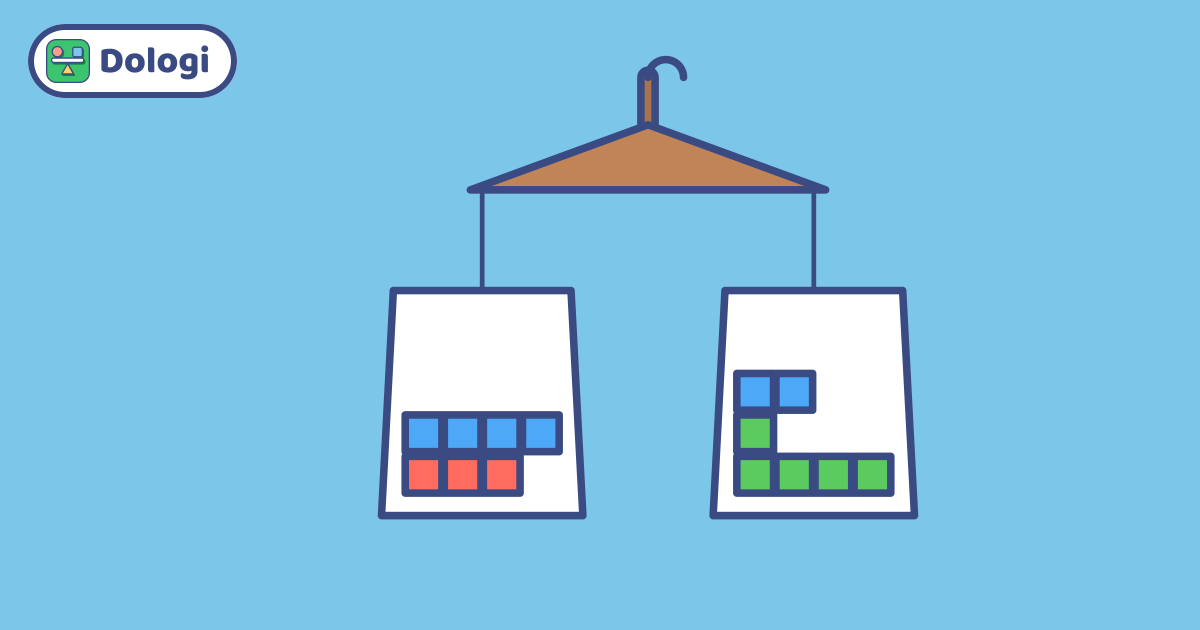
The Logic topic in Dologi has a puzzle called Balance scales: "Which block is heavier?" Your child looks at which pan goes down to work out which block is heavier, the same idea as the coat hanger: when both sides are equal, the scale hangs level.
In short
- For 3 + 4 = … + 2, children often write 7 (the answer straight away) or 9 (adding everything); the answer is 5.
- The root of the mistake is reading the equals sign as "here comes the answer"; it really means both sides are the same.
- Use a coat hanger with two bags of identical objects so your child can see both sides must balance.
- Practice backwards sentences, true-or-false statements, blanks in different places, and read the sign as "is the same as."
Read more: Balance puzzles for children, Mental math to 20