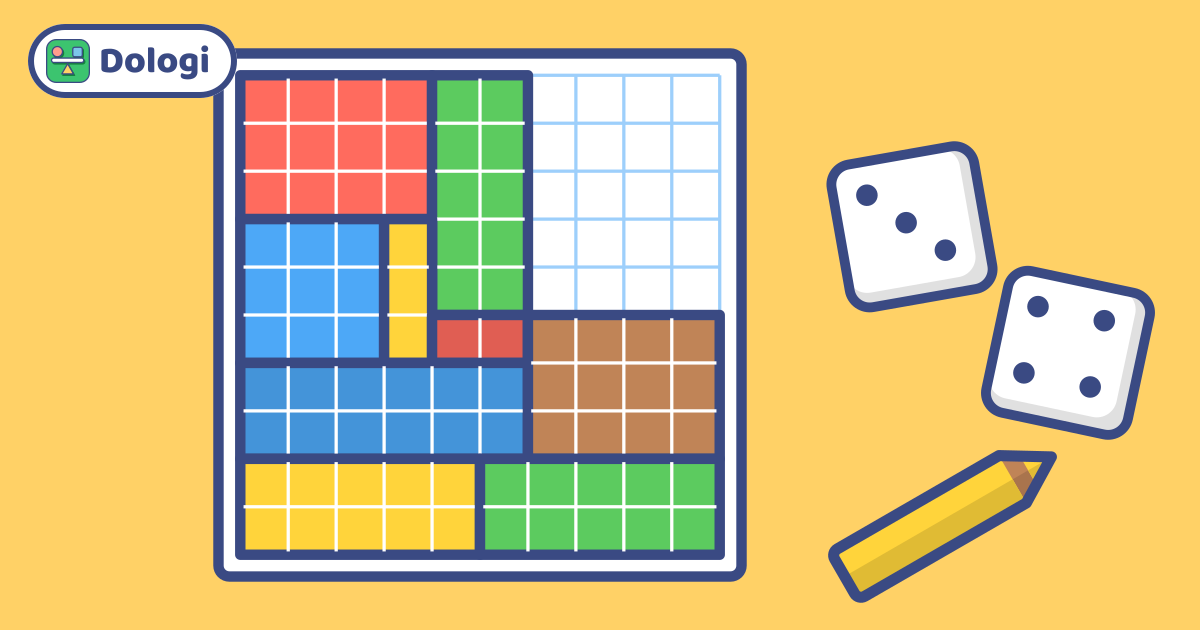
Roll two dice: a 3 and a 4. Your child draws a rectangle on squared paper 3 squares wide and 4 squares tall, colors it in, and writes in the middle: "3 × 4 = 12." Next turn it's a 6 and a 2, so they find an empty spot for a 6 × 2 rectangle. Keep going until there's no room left on the page.
The game suits kids aged 7 to 10, while they're learning their times tables or just after. Every rectangle is a multiplication fact your child can see: 3 rows of 4 squares, 12 squares in all. And because the rectangles have to fit, your child also practices spatial thinking and a bit of strategy.
What you need
- Squared paper or graph paper. Each player draws a 10 × 10 frame (100 squares).
- Two six-sided dice.
- A pencil and colored pens, a different color for each player.
How to play
- On your turn, roll both dice. The two numbers are the sides of your rectangle.
- Draw that rectangle inside your frame, along the grid lines. You can turn it: 3 × 4 or 4 × 3 are both fine.
- Color it in and write the multiplication inside: "3 × 4 = 12."
- A new rectangle can't overlap an old one or stick out of the frame.
- If there's no room for the rectangle you rolled, you miss that turn. After three missed turns in a row, you stop.
- When everyone has stopped, add up the squares you've colored. The most squares wins.
Rolling doubles (2 and 2, 5 and 5) gives you a square, and kids love those turns.
Why it helps kids understand multiplication
- Multiplying is counting in rows: 3 × 4 is 3 rows with 4 squares each. Counting row by row, "4, 8, 12," is skip counting, the first step toward the times tables.
- Turning it around doesn't change the answer: a 3 × 4 rectangle turned sideways becomes 4 × 3 and still has 12 squares. Kids discover that the order doesn't matter without anyone explaining it.
- Big numbers take up big space: 6 × 6 = 36 squares, more than a third of the page. Your child gets a feel for how big a product is, not just the number.
- They can check their work: after writing the multiplication, they count the squares to make sure it's right.
If your child is learning their tables, Times tables: should children memorize them or understand them first? looks more closely at understanding before memorizing.
Placement tips
A 100-square frame sounds roomy, but it fills up faster than kids expect. Each turn adds about 12 squares on average, and the leftover gaps often won't fit anything. Players usually manage around 80 to 90 squares; filling all 100 is very rare.
- Start from the corners and edges: that keeps the empty space in one solid block.
- Avoid leaving one-square-wide gaps: a one-square gap can only be filled when one of the dice shows a 1.
- Choose which way to turn it: should 2 × 5 lie flat or stand up? Which way leaves a neater gap?
- Near the end, save a big square space: an empty 6 × 6 area fits almost any roll.
A shared-sheet version (ages 9 to 10)
Two players share one sheet of 15 × 15 squares, each with their own color. Now there's competition for space too: place rectangles so you keep room for yourself and squeeze out your opponent. Games get tense, and older kids start thinking one or two turns ahead.
Variations
- For 7-year-olds: use a smaller 6 × 6 frame, or roll just one die and always draw a 2 × whatever-you-rolled rectangle (the 2 times table).
- Splitting rectangles (ages 8 to 10): you may split a rectangle into two smaller ones, for example 6 × 4 into 6 × 2 and 6 × 2, as long as the total number of squares stays the same. Kids touch on the idea of multiplying a number by a sum without needing the name.
- Guess first: before drawing, your child says "Will this cover more or less than one row of 10?" and then checks.
- Play as a team: the whole family fills one 10 × 10 frame together, counts how many turns it takes, and tries to use fewer next time.
If you've got dice out already, try roll again or stop?, another dice game about numbers and decisions.
The Math topic in Dologi has a puzzle called Count the squares: "How many small squares are there in all?" Its hint is exactly how to count a rectangle in this game: count row by row from the top, keep counting on, and count each square once.
In short
- Roll two dice, draw a rectangle with those side lengths and write the multiplication; no overlapping and no going outside the frame.
- If there's no room, miss the turn; whoever colors the most squares wins.
- Every rectangle is a multiplication you can see: count in rows, and turning it doesn't change the number of squares.
- Start from the corners and avoid narrow gaps; older kids share one sheet or try splitting rectangles.
Read more: Times tables: memorize or understand?, Roll again or stop?