Sometimes all you've got is two hands: sitting in the waiting room, waiting for food at a restaurant, on a long car ride. The finger tap game (some families know it as Chopsticks) works right then, no pen or paper needed. Children aged 6 to 10 practice adding within ten and learn to think one move ahead: if I do this, how will you answer?
How to play
- Two players sit facing each other. Each holds up one finger on each hand.
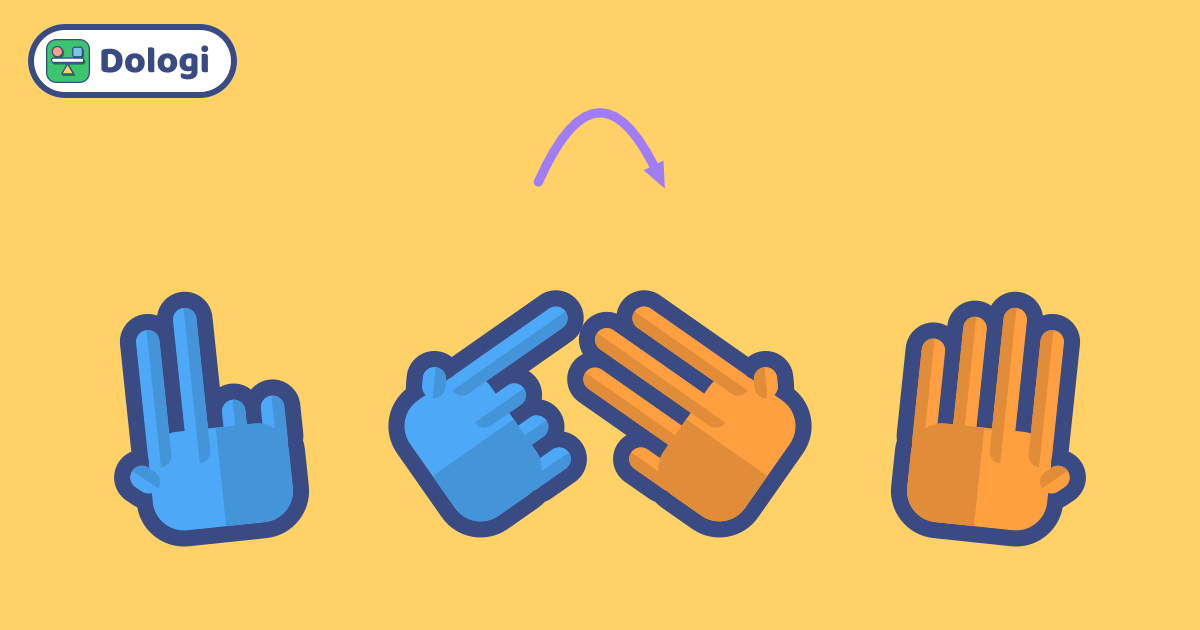
- On your turn, tap one of your hands onto one of your opponent's hands. The tapped hand adds as many fingers as the hand that tapped it. Your own hand stays the same.
- A hand with five or more fingers is out: make a fist and put it behind your back. It can't tap or be tapped anymore.
- Whoever loses both hands loses the game.
Here's how a game might start:
- Dad has 1 and 1, the child has 1 and 1. The child taps a one-finger hand onto one of Dad's: that hand becomes 2. Dad has 1 and 2.
- Dad taps his two-finger hand onto one of the child's hands: it becomes 3. The child has 1 and 3.
- The child taps the three-finger hand onto Dad's two-finger hand: 2 + 3 = 5, so that hand of Dad's is out. Dad has only one hand left.
On his second turn, Dad made a slip: the three-finger hand he gave the child was exactly what the child needed to knock out his two-finger hand.
The math inside every turn
Every tap is a small addition. But the better question is "how many more until five?", because it tells you which hands are in danger:
| Your hand shows | Short of five by | In danger if your opponent has a hand with |
|---|---|---|
| 1 finger | 4 | 4 fingers |
| 2 fingers | 3 | 3 or more fingers |
| 3 fingers | 2 | 2 or more fingers |
| 4 fingers | 1 | any number |
After a few games, kids know the pairs that make five (1 and 4, 2 and 3) without anyone teaching them.
The question after a few games: which hand should I tap so I'm not knocked out next turn?
Each turn has at most four ways to tap. Once your child knows the rules, pause on one turn and try them all together. For example: your child has 1 and 2, you also have 1 and 2, and it's your child's turn.
| Child taps | Parent's hands become | Can the parent knock out a hand next turn? |
|---|---|---|
| 1 onto 1 | 2 and 2 | No: 2 + 2 = 4 and 2 + 1 = 3, not five yet |
| 1 onto 2 | 1 and 3 | Yes: the parent's 3 onto the child's 2 makes 5 |
| 2 onto 1 | 3 and 2 | Yes: the parent's 3 onto the child's 2 makes 5 |
| 2 onto 2 | 1 and 4 | Yes: the parent's 4 makes 5 with either of the child's hands |
Only one of the four moves is safe. Ask the question and let your child check each row; don't give away the answer first.
Something fun for the family to discover: with exactly these rules, if neither player ever makes a mistake, the second player always wins. So remember to swap who goes first after each game. Older kids can try to work out how the second player should answer on the first turn.
Variations for older kids
- Roll over past five: a hand is out only at exactly five; above five, subtract five (3 + 4 = 7, leaving 2). That adds a mental subtraction step.
- Splitting: instead of tapping, you can use your turn to share your fingers differently between your two hands, for example 4 and 1 becomes 3 and 2. Agree beforehand whether a hand that's out can be "brought back" by splitting.
- Three players: sit in a circle; on your turn you may tap anyone's hand.
Tips for parents
- Think out loud: "If I tap my three onto your two, that makes five and your hand is out." Your child hears you working it out and starts doing the same.
- Have your child say the sum aloud after each tap, before holding up the fingers.
- Keep games short, a minute or two. If your child loses several in a row, switch to an easier version or let them go second.
The Math topic in Dologi has a puzzle called Add and answer: "How many dots are there on the dice altogether?" Just like adding fingers, your child starts with the dots on one die and counts on with the next, until they can add without counting at all.
In short
- One finger up on each hand; tap your hand onto your opponent's, and their hand adds that many fingers; five or more is out; lose both hands and you lose.
- The key question, "how many more until five?", helps kids learn the pairs that make five.
- After a few games, try every possible tap together to find the move that doesn't get knocked out.
- With these rules the second player always wins with perfect play, so swap who starts; older kids can try rolling over and splitting.
Read more: Is it OK for children to count on their fingers?, Mental math to 20