Many children hum tunes they make up themselves, in the bath or on the way to school. Ask them to "compose a song", though, and it suddenly sounds like something only real musicians do.
A melody is simply a pattern of sounds: a few notes, put in an order, repeated and changed a little. Making one uses the same thinking as a pattern puzzle: choose a small set of pieces, arrange them, spot what repeats and decide what to change. This article shows a simple way for children aged roughly 6 to 12 to write their first tune with three notes, a steady beat and one clear rule, and to share it with the family as a guessing game.
Pick three sounds
Fewer choices make composing easier. With only three notes, your child can hear each one clearly, remember the tune and notice when something changes.
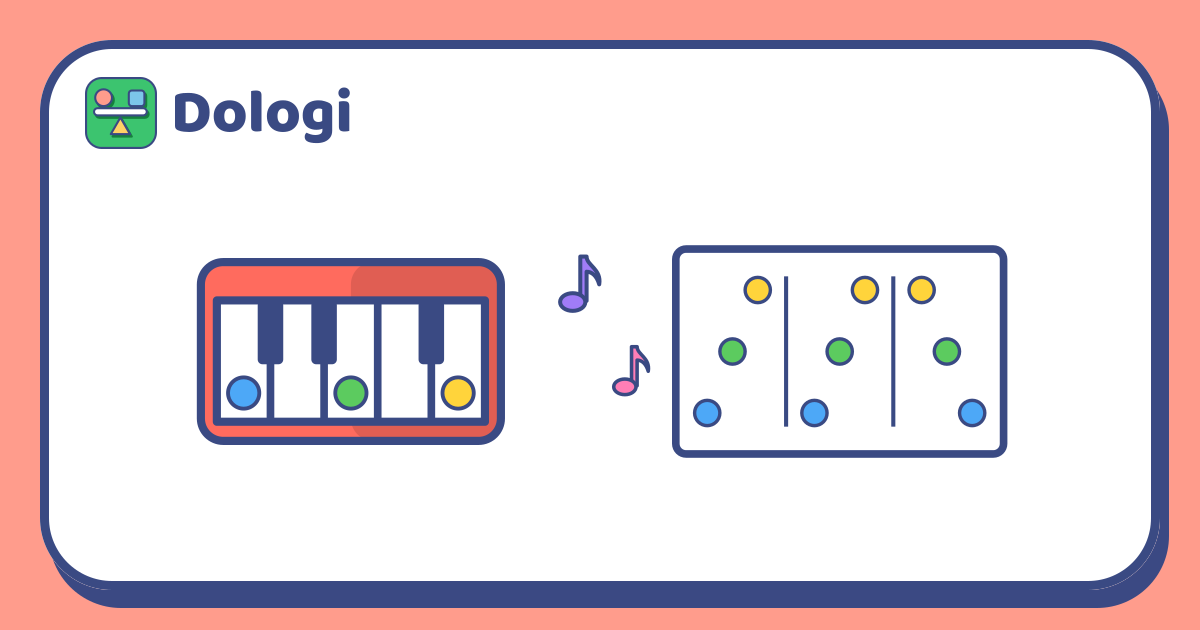
- A toy keyboard or xylophone: choose three keys with a gap between them, for example every other white key, so they sound clearly different. Stick a colored paper dot on each one: blue for the lowest, green for the middle, yellow for the highest.
- No instrument at home? Line up three sturdy glass jars with different amounts of water and tap them gently with a wooden spoon. The more water, the lower the sound. Three pots or cans of different sizes work too.
Let your child play the three sounds and put them in order from low to high. "Which one is the lowest? Which one is in the middle?" Sorting the sounds is the first small piece of thinking, and it makes the next steps much easier.
Keep a steady beat
A tune needs a beat, like a song needs a walking pace. Before playing any notes, clap slowly together or tap your knees: one, two, three, four, one, two, three, four.
Now your child plays one note on each beat while you keep tapping quietly. Four beats make a short phrase, a little musical sentence. A beat with no note, a rest, is allowed too. Silence is part of music, just like a pause in a sentence.
If the beat keeps speeding up, that is normal. Slow down together, or count out loud for a while.
Make a phrase, repeat it, change one thing
Ask your child to make a phrase with their three notes, for example low, middle, high, high. Then play it again in exactly the same way. Repeating is what turns a few random notes into a tune you can remember.
Next comes the interesting part: change just one thing, and listen to what happens.
| Change | Example | How it sounds |
|---|---|---|
| Go the other way | low, middle, high becomes high, middle, low | The tune climbs up, then comes back down |
| Swap one note | low, middle, high becomes low, middle, low | The ending turns around |
| Make a note longer | hold the last note for two beats | Sounds like a full stop at the end |
| Add a rest | a silent beat before the last note | Sounds like waiting for something |
A shape you will hear in many simple songs is "the same, the same, then different": the phrase twice, then a third phrase that answers it. Your child can try exactly this: two identical phrases, then one with a single change. Ask, "Which version do you like best? Why?" There is no right answer, only reasons.
Write it down with colored dots
A tune is easy to forget, so give your child a sheet of paper and crayons in the same three colors as the stickers. Each note becomes a dot of its color, drawn from left to right, one dot per beat:
- Higher notes are drawn higher on the page, lower notes lower. A tune that goes low, middle, high looks like a small staircase.
- Draw a thin line after every four beats to show where each phrase ends.
- A long note becomes a stretched dot, like a short dash. A rest becomes a small gap.
Now the tune is written down. Anyone in the family can play it from the paper, even a grandparent who has never played the keyboard. Swap roles too: you write a short tune in dots, and your child plays it. Older children can later add the numbers 1, 2, 3 under the dots, or learn the real names of the notes.
Guess the pattern: a family game
Once the tune is ready, your child plays it to the family, or shows the dot sheet, and everyone tries to find the rule. "It goes up three times and then comes down." "The second part is the same as the first." The composer can give hints: "Listen to the last note."
Then turn the game around. A parent makes a tune that follows a rule, plays the first two phrases, and your child guesses what comes next and plays it. Finding the rule, then continuing it, is exactly what children do with picture and number patterns, only this time with their ears.
| Age (rough guide) | What to try |
|---|---|
| 6–7 | Three notes, four beats, play the phrase twice the same way; draw the dots together with a grown-up |
| 8–9 | Change one thing; the "same, same, different" shape; lines between phrases; the family guessing game |
| 10–12 | Five notes, long notes and rests; a tune in two parts; make a tune with a rule for others to continue; start the same pattern on a different note |
In Dologi, the Listening topic includes a puzzle called Shape of the tune: your child hears a short tune and picks the picture with the same ups and downs, note by note, much like reading the dot sheet. In the Creative corner, the Music workshop lets your child place notes on a grid and hear the tune loop, a handy place to try repeating a phrase and changing one note.
In short
- A melody is a pattern of sounds, so writing one exercises the same thinking as a pattern puzzle.
- Start small: three sounds sorted from low to high and a steady beat of four.
- Make a phrase, repeat it, then change just one thing and listen to what happens.
- Write the tune down with colored dots, higher notes drawn higher, and let the family guess the rule.
Read more: Does learning music help children with math? Rhythm, patterns and counting, Clap it back: rhythm echo games for children, Homemade instruments from recycling: a drum, a shaker and a rubber band guitar