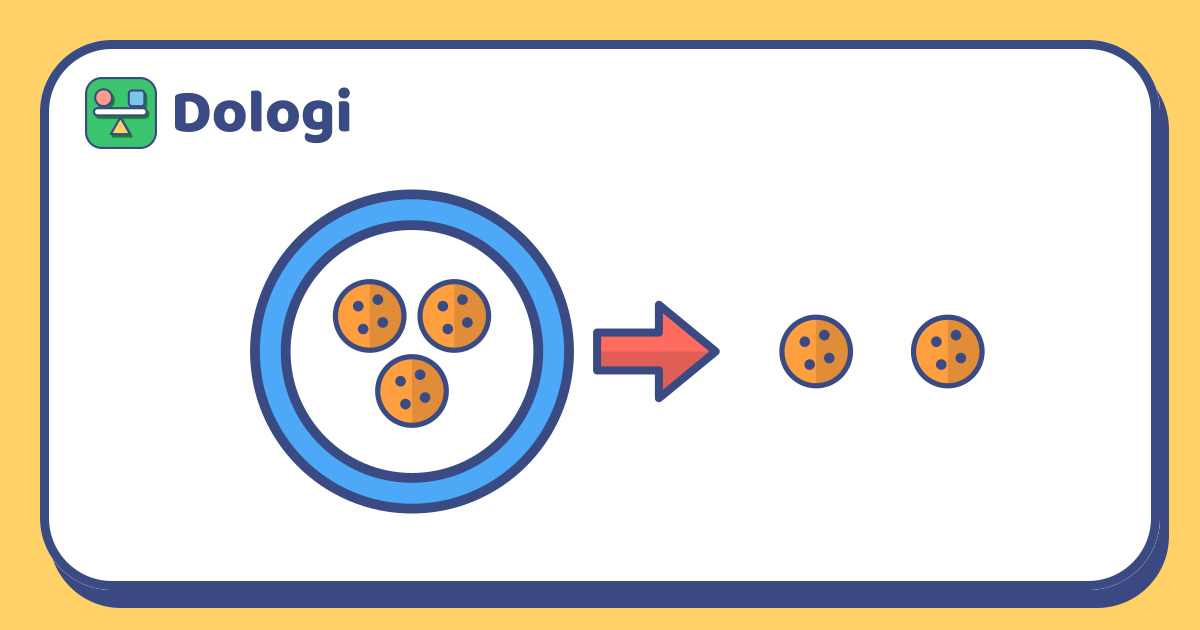
There are five cookies on the plate and your child eats two. Ask "how many are left?" and some children count the plate again and say "three" at once, some count the two in their hand as well and say "five", and some look at you and wait for a hint. All three are normal. Subtraction is a little harder than addition, because the thing you need to count is the thing that is no longer there.
For children aged roughly 5 to 7, the easiest way in is to take away real things, say what happened as a sentence, and only then write the minus sign. This post walks through that, with three ways children find what is left, a game that shows subtraction is just addition backwards, and the places where children usually stumble. Ages are only a rough guide.
Subtraction starts with taking away
For young children, subtraction happens to objects before it happens to numbers. Three kinds of story lead to it:
- Taking away: two cookies get eaten, three cars go back in the box, two birds fly off. The group gets smaller.
- How many are missing: the family needs five plates and there are three on the table. How many more?
- How many more than: your child has six marbles, their sister has four. How many more does your child have?
Start with taking away, because your child can see it: the group had five, now it has three. The other two kinds come later, once "what is left" feels familiar.
One small but important trick: the things taken away must really leave the group. Cookies get eaten or moved to another plate; cars go into a box with a lid. If the two "taken away" cookies are still sitting right next to the plate, many children will count them too.
Say it as a sentence before you write it
Before any minus sign, let your child get used to a three-part sentence: "There were five cookies. Two got eaten. Three are left." Say it a few times while doing it, then let your child say it while you do it, then swap.
Use the everyday words interchangeably so your child learns they mean the same thing: take away, eat up, put away, fly off, and the result is "left". Once the sentence comes easily with real things, write the sum right under it, 5 − 2 = 3, and read the minus sign as "take away" for a while. Your child sees that the sum is just a short way of writing the sentence they already said.
Three ways children find what is left
Children usually move through three methods, each faster than the last. There is no need to push them to skip one.
| Method | What your child does (5 cookies, 2 eaten) | What you can say |
|---|---|---|
| Count what is left | Looks at the plate and counts from the start: "1, 2, 3" | Let them count freely; praise touching each cookie once |
| Count back | Remembers there were 5, says a number for each cookie removed: "4, 3" | "There are 5. Take one off, how many now? And one more?" |
| Think of the addition | "2 and how many more make 5?" | "Remember when we put 2 and 3 together? What did we get?" |
Counting back often slips by one: your child picks up the first cookie and says "5", picks up the second and says "4", and concludes that 4 are left. The fix is to tie each number to a cookie that has just left the plate: pick it up first, then say what is left, "4 left", "3 left".
Subtraction is addition backwards
A cup game shows this better than any explanation. Put five pebbles or beans on the table and count them together. Your child closes their eyes while you cover some with a cup. They open their eyes and see three outside: "How many are under the cup?" They guess, then lift the cup to check.
"Three and how many more make five?" and "five take away three leaves how many?" are the same question about the same pile. After a few rounds, write all four sums for the number trio 2, 3 and 5 on one sheet:
- 2 + 3 = 5
- 3 + 2 = 5
- 5 − 2 = 3
- 5 − 3 = 2
Many parents call these four sums a "fact family". Knowing one addition means knowing the two subtractions that go with it, so there is no separate subtraction table to memorize. Move the cup game to other trios (1, 4, 5, then 2, 4, 6) and let your child write the four lines.
Take-away games around the house
- At meals: count the cookies or melon pieces before eating, eat some, ask how many are left. One question per meal is plenty.
- Tidying up: six cars on the floor, your child puts two in the box. How many are still out?
- Dice countdown: each player starts with ten beans. On your turn, roll the die and take away that many. The first to reach zero wins. When your child has three beans and rolls a five, they discover that you cannot take away more than you have: skip the turn, or require an exact three to finish.
- Stairs countdown: your child stands on the eighth step and comes down three. Which step are they on? Say the numbers while stepping.
- How many missing: the family needs five spoons and your child has fetched three. How many more? This is the "missing" kind, for when taking away feels easy.
Where children usually stumble
| Stumble | What it looks like | How to help |
|---|---|---|
| Swapping the numbers | Writes 2 − 5 and says "it's 3" | Put out two cookies and ask "can you eat five of them?"; with real things, your child sees you cannot take away more than you have |
| Reading the sum backwards | Sees 5 − 2 and says "two take away five" | Read left to right, pointing at each symbol: "five, take away, two" |
| Taking away all, or none | Puzzled by 4 − 4 and 4 − 0 | Put out four cookies: eat all four and none are left; eat none and four are still there |
| Counting what was taken | Counts the two cookies in their hand as well | Get the taken-away things out of sight: into a box, into a mouth, into another room |
None of these mean your child is bad at math. They are places where the numbers have not yet connected to the real story, and the fix is always to go back to the objects.
In Dologi, the "Number line hops" puzzle in the Math topic has a rabbit hopping along arrows while your child works out which number it stops on. It is the same way of seeing numbers as the stairs game above: every hop is one unit, and your child keeps track of where they are.
In short
- Subtraction starts with taking real things away, and the things taken away must really leave the group.
- Practice the three-part sentence "there were, take away, left" before writing the minus sign under it.
- Children find what is left by counting again, counting back or thinking of the addition; let them move at their own pace.
- The cup game and "fact families" show your child that subtraction is addition backwards.
Read more: First steps in addition: teaching your child to put two groups together and count · Is it OK for children to count on their fingers? Helping them move from counting to understanding numbers