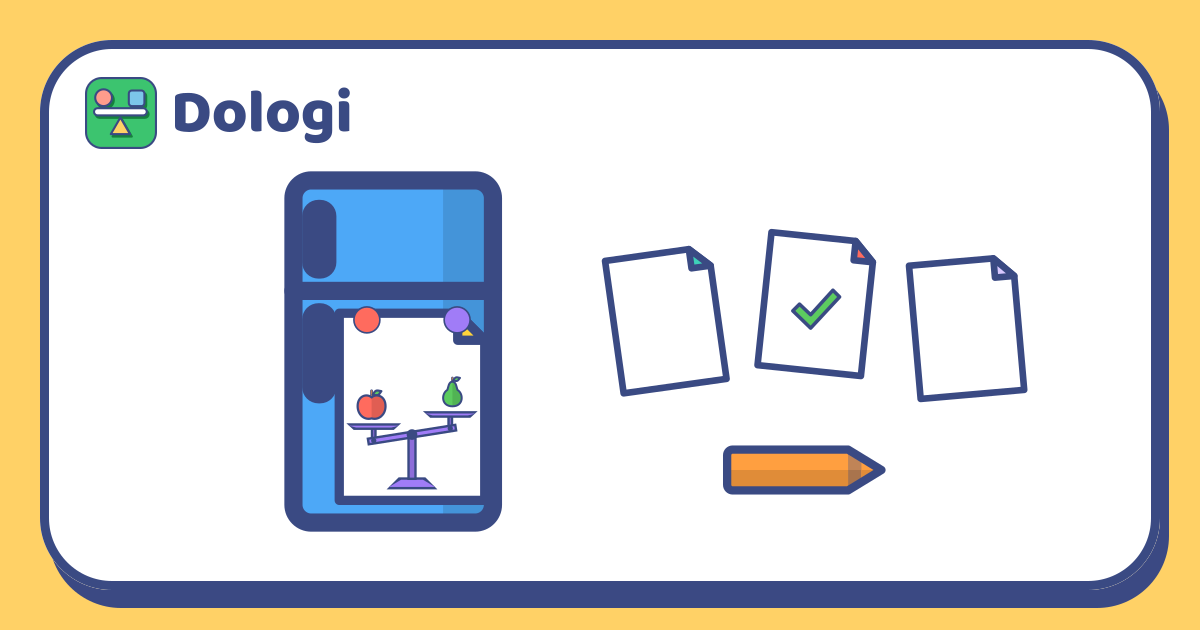
Some habits do not need a fixed time, only a fixed place. The fridge door is that kind of place: everyone in the house walks past it several times a day. Stick a small puzzle on it each morning and the family gets a few scattered minutes of thinking during the day, and a story to tell at dinner.
This post shows how to start with children aged roughly 5 to 12: what to prepare, four short rules, six hand-drawn puzzles that need no words for the first week with hints and answers, how to talk in the evening so your child explains their thinking, and when to swap roles so your child sets the puzzle. Ages are only a rough guide.
Why the fridge door
A puzzle stuck where everyone can see it has a few things going for it:
- Nobody has to remind anyone. Your child sees it when fetching a drink; you see it while cooking. The habit is tied to a place, not a timetable.
- Thinking can happen in bits. Someone can look in the morning and get it in the afternoon. There is no pressure to answer on the spot.
- The whole family plays. Adults have to solve it too, so your child sees that thinking is not just a children's job.
- No screen needed. Paper, a pencil and a magnet.
What to prepare, and the rules
You need a stack of small paper slips (sticky notes or scrap paper cut up), one or two magnets, a pencil hanging nearby, and a small box or envelope for answers.
Write the rules on one sheet and stick it next to the puzzle so everyone remembers:
- Every morning there is a new puzzle on the fridge door.
- When you have the answer, draw or write it on your own slip and put it in the box. Do not say the answer out loud.
- You can look at the puzzle as many times as you like during the day.
- In the evening, the family opens the box, compares answers and explains how they thought.
Rule 2 matters most. If the first solver blurts out the answer, everyone else loses the chance to think. A private slip keeps a piece of the work for each person.
Six hand-drawn puzzles for the first week
Hand-drawn puzzles should work without words, so children who cannot read well yet can join in, and so you can draw one quickly before work. The six below cover six days; the seventh day is your child's turn to set the puzzle (see below). Give hints one step at a time, and only move to the next step if the solver is still stuck. Answers are in the last section.
| Day | The puzzle (draw it on the slip) | The question |
|---|---|---|
| 1 | A row of shapes: circle, triangle, square, circle, triangle, then an empty box. | Which shape goes in the empty box? |
| 2 | A level balance scale: one apple on the left, two plums on the right. | How many plums weigh the same as two apples? |
| 3 | Two rows: apple + apple = six dots; apple + pear = five dots. | How many dots is the pear? |
| 4 | One large triangle, with a line drawn from the top corner down to the base. | How many triangles are in the picture? |
| 5 | Ten dots in a row, with a slip of paper covering part of the row so that six dots show. | How many dots are hidden? |
| 6 | Four pictures: an apple, a pear, a banana, a carrot. | Which one does not belong? Why? |
| Day | Hint 1 | Hint 2 |
|---|---|---|
| 1 | Say the shape names out loud in order, like a chant. | What came after the triangle last time? |
| 2 | One apple can be swapped for two plums. | Two apples means doing that twice. |
| 3 | The top row has only apples. Two identical apples make six dots, so what is one apple? | Put the apple's number into the bottom row. |
| 4 | Count the two small triangles first. | Is there another, bigger shape that is also a triangle? |
| 5 | Count the dots you can see. | Count on from six up to ten to see how many more there are. |
| 6 | Look for the one that is not a fruit. | A different answer with a clear reason counts too. |
Day 6 deliberately has more than one answer: the banana could be the odd one out because it is yellow, or because it is long. For puzzles like this, the rule is that any answer with a clear reason counts. Children learn that "different" depends on which feature you are looking at.
In the evening: explain the thinking, not just the answer
When the box is opened, the best part is not who was right but how each person thought. A few questions help your child tell it:
- "Where did you look first?"
- "When did you know for sure?"
- "Did you nearly answer something else? What made you change?"
Share your own thinking too, including when you were wrong. A child who hears "I missed a dot because I counted too fast" learns that being wrong and fixing it is normal. If two people have different answers, try the puzzle again together rather than deciding who wins.
Answers drawn as pictures (a square, four plums) are worth encouraging for younger children: a child who cannot write numbers yet can still answer.
Your child's turn to set the puzzle
After a few weeks, give your child one day a week to set the puzzle. They draw it the night before, and you solve it and drop your answer in the box like everyone else. Their first puzzles may be missing information or have several answers; look at them together with two questions: "Does the solver have enough to work it out?" and "Is there exactly one answer?" Setting a puzzle is also when you see how well your child has understood that type of puzzle.
In Dologi, the Math topic has a puzzle called "Fruit numbers": each row is a few pieces of fruit with the result at the end, and your child finds the number behind the question mark. It is the same kind of puzzle as Day 3, so after your child has played a few in the app, ask them to draw one like it on the fridge door for the family.
Keeping the habit going
- A missed day is fine. Because the habit is tied to a place, it is easy to pick up again: just stick a new slip on the door tomorrow.
- Change the type every day, as in the table above, so nobody gets bored.
- Keep the solved slips in a box. After a month, look back together at which puzzles were hardest and which ones your child invented.
Answers
- A square. The row repeats in groups of three: circle, triangle, square. After a triangle always comes a square.
- Four plums. One apple equals two plums, so two apples equal two lots of two, which is four plums.
- Two dots. Two apples make six dots, so one apple is three dots. Apple plus pear is five dots, so the pear is five minus three, which is two dots.
- Three triangles. The two small triangles on either side of the line, plus the large triangle around them.
- Four dots. There are ten dots and six are showing, so ten minus six, which is four, are hidden.
- The carrot, because the other three are fruit. The banana, with the reason "it is yellow" or "it is long", is also a good answer.
In short
- One puzzle each morning on the fridge door: a habit tied to a place everyone passes, with no reminders needed.
- Everyone solves alone and drops an answer slip in the box; the box opens in the evening and everyone explains their thinking.
- Hand-drawn puzzles need no words, and the type changes daily: missing shape, balance scale, fruit numbers, counting shapes, hidden dots, odd one out.
- Give your child one day a week to set the puzzle, and check together that it has enough information and only one answer.
Read more: Fruit math puzzles for children aged 7–10: what number is each fruit, solved step by step · Balance puzzles for children: reasoning about heavy and light