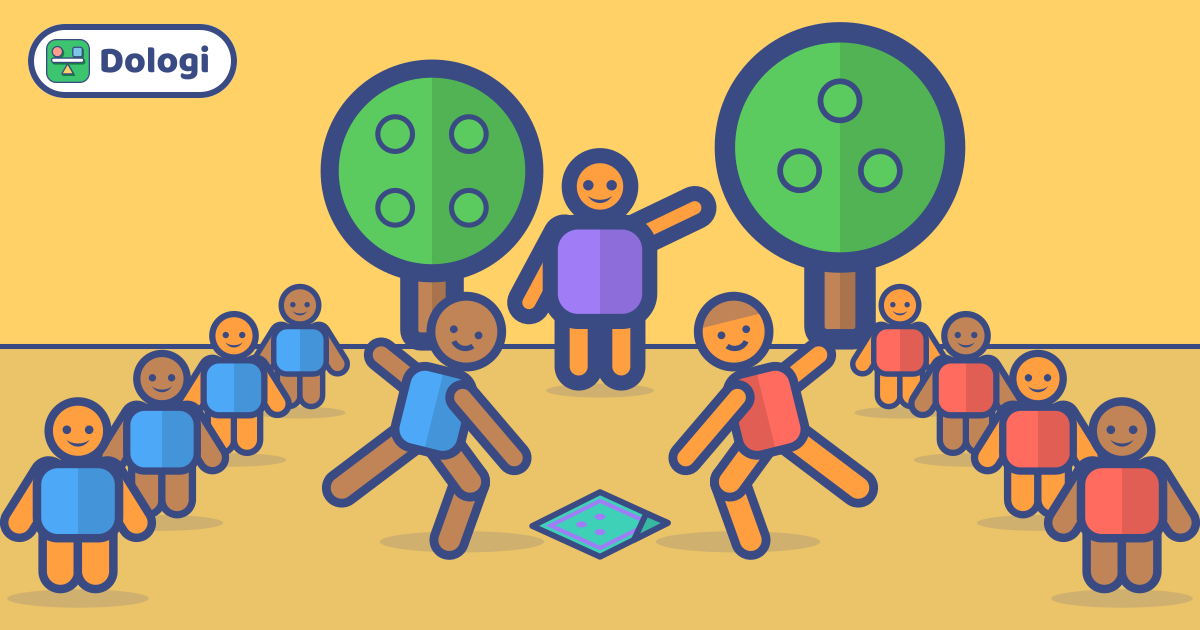
Many parents remember a gym class game often called steal the bacon: two teams face each other, everyone gets a number, and when the teacher calls a number, the two players with that number race for an object in the middle. Versions of it are played in many countries, with a flag, a scarf or a hat as the prize.
Here's a version with a bit of math added: the caller doesn't say the number, they read out a problem. "Three plus two!" Whoever is number 5 runs. To know whether it's their turn, every child has to work it out, and fast. It's a great fit for a birthday party, a class field day or an afternoon at the park.
Getting ready
- Players: six or more children, roughly ages 5 to 11, split into two equal teams, plus one adult as the caller.
- What you need: something soft to grab, like a bandana, scarf or clean dish towel. A soft hat or small ball works too.
- Where: a lawn, a big yard or a cleared room. The two lines stand about eight to ten adult steps apart.
The teams line up facing each other. Each team numbers off from 1: a team of five goes 1 to 5. The other team does the same, but it helps to number in the opposite direction, so players with the same number stand diagonally across from each other rather than face to face. The scarf goes on the ground right in the middle.
How to play
- The caller reads a problem out loud, such as "four minus one."
- The two players whose number is the answer (here, number 3) run out.
- Whoever grabs the scarf runs back to their own line. The other player chases and tries to tag them with a light touch on the shoulder.
- Getting the scarf home without being tagged earns a point for your team. If you're tagged first, the other team gets the point.
- The scarf goes back in the middle and the caller reads the next problem.
With younger kids, skip the chasing: whoever picks up the scarf first scores. Rounds are shorter, there's less bumping, and the rules are easier to follow.
Problems for different ages
| Age (roughly) | The caller says | Examples |
|---|---|---|
| 5–6 | Plain numbers, or holds up fingers for kids to count | "Four!", three fingers up |
| 6–7 | Adding and subtracting within 10 | "Two plus three," "eight minus four" |
| 7–9 | Adding and subtracting across 10, with answers still within the team's numbers | "Twelve minus seven," "nine plus one minus five" |
| 9–11 | Multiplying, dividing or short riddles | "Two times two," "twelve divided by four," "the number after four" |
Two things for the caller to keep in mind: the answer must always be one of the numbers in play (with teams of five, 1 to 5), and every number should come up, so nobody spends the whole game waiting. Once kids get the hang of it, try calling two problems back to back: two pairs run out at once, which is twice the fun and twice the chaos.
Giving everyone a chance to shine
This game has two parts: working out the answer and running. Quick thinkers aren't always quick runners, so a few tweaks keep it fair:
- Read the problem, then shout "Go!" After reading the problem, the caller waits about two seconds before saying go. Everyone gets time to think, and the win doesn't just go to whoever blurts first.
- Shuffle numbers every few rounds. Each team mixes up its numbers so kids face different opponents.
- The whole team does the math. Nobody knows whose number comes next, so everyone has to solve every problem. After each round, you can ask someone in line, "What was the answer?"
- Nobody is out. Lose a round and you stay in line for the next problem.
Now and then, someone runs on the wrong number. Laugh it off, work out that problem together, and carry on. A wrong dash is a chance for the whole team to go over that problem again.
Keeping it safe
- Play on grass or a non-slip floor, and clear water bottles and hard objects out of the running area.
- Tag with a light touch on the shoulder only. No pulling shirts, no pushing.
- Nobody may touch the other player until someone has picked up the scarf. This keeps the two runners from crashing into each other in the middle.
- Playing indoors? Skip the running: the two lines sit facing each other with the scarf on a stool in the middle, and whoever hears their number stands up and steps over to take it.
What children practice
This game turns arithmetic into something you need to do right now, for a clear reason: only by working out the answer do you know whether to run. Children practice listening to the whole problem before solving, holding a number in their head, and working with problems they hear rather than see on paper. For kids who love to move, it's a way to practice mental math without sitting still.
In Dologi's Math topic, the "Number line hops" puzzles ask: "From the dot, the rabbit hops along the arrows. Which number does it stop on?" Each hop forward or back is an addition or subtraction, the same kind of mental math your child does when the caller reads out a problem in the yard.
In short
- Two teams line up, each player has a number, and the caller reads a math problem; the two players whose number is the answer race for the scarf.
- Ages 5–6 hear plain numbers or count fingers; older kids hear subtraction, multiplication and division, with answers always within the numbers in play.
- Read the problem, wait two seconds, then say go; shuffle numbers every few rounds; nobody is out.
- Tag with a light touch only; indoors, sit and step over to take the scarf instead of running.
Read more: Mental math to 20: simple strategies for adding and subtracting in your head · Drop the handkerchief: a circle game from many countries that trains attention