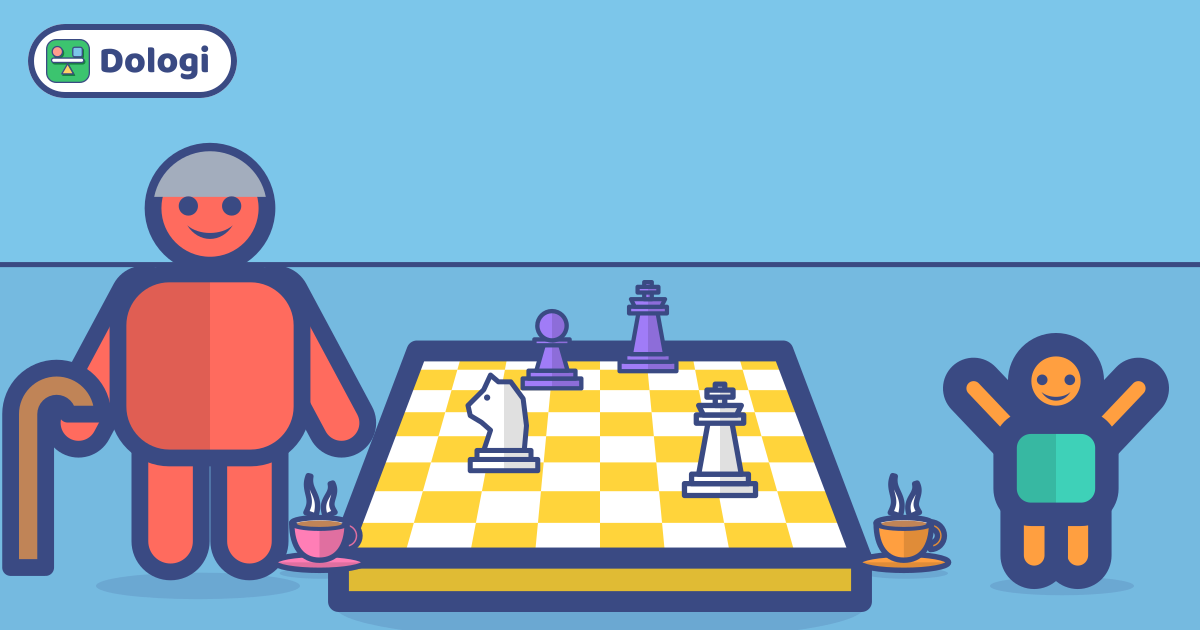
At Grandma's house on Sunday afternoon, Grandpa pulls out the old checkerboard and asks your child to play. Your child shrugs: "I only know chess." For a moment it looks like each of them has their own game and no way to share it.
That moment is actually a great opportunity. A game board is one of the few places where a grandparent and a young child sit as equals: each has something to teach and something to learn. Here are some ideas for making chess between grandparents and grandkids relaxed, fun and, with luck, a family habit.
Grandparents teach their game, kids teach theirs
Let each side be the teacher for a while.
- Grandparents teach a game they grew up with. Checkers is a natural one, since it uses the same 8-by-8 board. Your child will notice what's shared and what's different: in both games pieces capture, but in checkers you jump over a piece to take it, and you have to keep jumping when you can. Comparing two games helps kids remember the rules of both.
- Kids teach chess back. Explaining how a bishop moves or how castling works means your child has to speak clearly, go slowly and check whether their "student" got it. That's a great way to learn, and it feels good to be the expert.
- Start small. If a grandparent is new to chess, play a pawn race: only pawns on the board, and the first to get one to the far side wins. The rules take a minute, and every game is short.
You can sit in at first to "translate" the rules, then step back and let the two of them play.
Keep games short, with breaks
Games between grandparents and grandkids don't need to be long:
- A game of about fifteen or twenty minutes (a rough guide that depends on your child's age) is plenty. When it's over, take a break; there's no need to play a fifth one.
- Pour a cup of tea or coffee for Grandma and a cocoa for your child, and talk about the game you just played: "Which of your moves did you like best?"
- Nobody needs to lose on purpose. If one side is much stronger, they can play with a few pieces fewer.
Solve puzzles on the same team
Not every game has to be a match. Grandparent and grandchild can sit on the same side and solve one small position together: "White to move and checkmate in one. Which move?" Grandparents bring experience, kids bring fresh eyes, and the two of them point at squares, try moves and put pieces back. On the same team nobody loses; you just figure it out together.
Ask about games from long ago
A game of chess is a great excuse for stories. Try asking:
- "Where did you play games when you were a kid? Who taught you?"
- "Is there a game you still remember?"
- "What were your board and pieces like back then?"
Maybe Grandpa played checkers on a bottle-cap board on the front porch, or Grandma learned chess from an uncle at summer camp. Stories like these help kids see that their grandparents were once kids who loved to play, and the board becomes part of the family's shared memories.
Grandparents far away: two boards and a phone
Grandparents in another state can still play chess with your child:
- Each side sets up a real board facing the same way: the corner square on White's left is a1.
- Name squares with a letter and a number: columns a to h from White's left to right, rows 1 to 8. Read moves like "pawn from e2 to e4" or "knight from g1 to f3."
- The other side repeats the move before playing it on their own board, so both boards stay the same.
- Write the moves down. If the boards stop matching, replay from the start together.
A phone game is slower, so you can play a few moves a day, like a story told in installments. Your child also gets practice with square names, which helps with picturing the board in their head (more in Knights jump in an L, bishops slide diagonally).
When grandparents are right there with your child, the Chess room in Dologi's Creative corner has Two players so two people can play on one device; turn on Sit face to face and the board stays put, which works well for a tablet lying between grandparent and grandchild. In Challenges, your child can also Make a challenge: set up a position, choose a goal like check or a capture, and once the app confirms it can be solved, save it and tap Challenge a parent so Grandma or Grandpa can solve it right there.
In short
- Let each side be the teacher: grandparents teach a game they know, kids teach chess back, starting with small games with few pieces.
- Keep games short, with breaks for a drink and a chat, and solve puzzles on the same team when nobody feels like a match.
- Ask grandparents about games from their childhood so chess becomes a shared family memory.
- When grandparents live far away, set up two boards and read moves over the phone using square names, writing each move down.
Read more: Siblings playing chess with a big age gap, Big family gathering? Games that grandparents, parents and grandchildren can all play