You moved to Germany, Japan, Spain or Brazil for work, and your child now spends most of the day at a local school. At first English is simply the family language. Then one evening your seven-year-old answers you in German, or asks how to say "pencil case" in English. Many parents living abroad know this moment.
It's a common worry, and it doesn't mean English is lost. A language your child doesn't need outside your home simply needs a bit more help inside it. This article is about families where English is the home language in a country that speaks something else. If your household uses two languages, for example because each parent speaks a different one, the article on raising bilingual kids covers that situation.
Why the home language slips
- School is in the local language. Your child learns new words for math, science and friendships in that language, so it gets stronger every day.
- Friends set the tone. Kids want to sound like the people they play with.
- Siblings switch. Brothers and sisters often talk to each other in the school language, even at home.
- English seems to be "everywhere." Shows and games in English help with listening, but they rarely give your child the everyday family talk, the stories and the age-appropriate reading of a child growing up in an English-speaking country.
None of this is anyone's fault. It just means English needs real reasons to be used.
Give English a place in the day
A steady routine works better than big plans you can't keep.
- Speak English yourself, naturally and a lot. Not just "Put your shoes on," but stories about your day, questions, jokes and explanations. Rich talk teaches more words than instructions.
- Pick English moments. Dinner, the drive to school, bath time, bedtime. Your child learns that these moments belong to English.
- Keep going when your child answers in the local language. Understanding usually comes first and speaking follows. The bilingual article has ideas for gently nudging a reply in English.
- Talk about local life in English, too. Words for what happens at school and in your new town keep English useful for everything, not only family matters.
Stories, songs and games
This is the easiest and warmest part.
- Read aloud every day, even after your child can read alone. Older kids enjoy chapter books read aloud, and it brings vocabulary they wouldn't meet otherwise. See reading aloud to older kids.
- Sing the songs you grew up with: nursery rhymes, clapping games, silly car songs.
- Play word games: I spy, twenty questions, rhyming games at the dinner table.
- Bring books back from visits home, swap books with other English-speaking families, and check whether your local library has a section in English; some do.
- Watch together sometimes, and talk about what you watched afterward. Talking turns passive listening into practice.
Grandparents, relatives and visits home
People make a language matter more than any lesson.
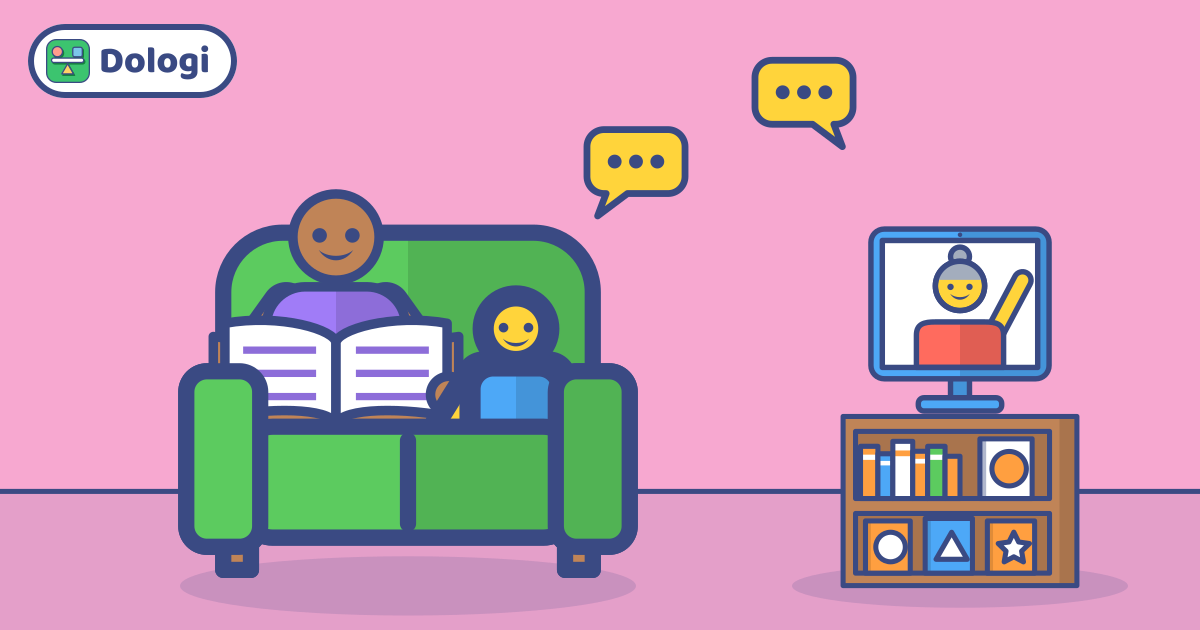
- Regular video calls with something to do. Grandma reads a picture book on screen, Grandpa asks about a drawing, cousins play a guessing game. A short call with an activity beats a long call of "How was school?"
- Voice messages and letters. Your child records a song or sends a postcard; the reply comes in English.
- Trips home are a real boost: a few weeks surrounded by English, at the grocery store, the playground, a summer camp.
- Find English speakers nearby. Families from home, a weekend playgroup or a community class give your child friends who speak English, which matters more as they get older.
Reading and spelling in English
Your child may speak English well but read and write it far below their age. English spelling is irregular, so it needs some practice.
- Little and often. Ten minutes of reading together most days helps more than a long session once a week.
- Read and write for real reasons: a shopping list, a birthday card for a cousin, a message to Grandpa, a comic you make together.
- Learning new words: keep a small stack of word cards and review them over several days; the article on remembering new words explains how.
- Don't compare your child with kids at school in an English-speaking country. Comparing to their own progress last month is fairer and more encouraging.
Keep it a language of warmth
- Avoid shame and pressure. "Say it in English!" in front of others often makes a child go silent. Praise effort instead.
- Show pride: "You can talk to Grandma and to your teacher, that's amazing."
- Expect phases. Many kids push back around school age or in the preteen years. Keep speaking English, keep it pleasant, and leave the door open.
- If you're worried about speech, for example if your child understands or says very little in both languages for their age, talk to your pediatrician or a speech-language therapist, and mention that your child is growing up with two languages.
In Dologi you can set the app's language in the Parent area, choosing among ten languages, so your child can play in English at home. In the Listening topic, a puzzle called Listen and play back plays a few notes, and your child taps the same white keys in the same order. It's a short, fun way to practice careful listening, the kind kids use when they pick up sounds in any language.
In short
- A home language abroad fades when it has few uses; give English clear moments and real reasons every day.
- Talk a lot, read aloud, sing and play in English, even when your child answers in the local language.
- Grandparents, visits home and English-speaking friends make the language matter.
- Practice reading and spelling a little and often, without comparisons or pressure; if speech worries you, ask a professional.
Read more: Raising bilingual kids: how families with two languages at home can keep both alive, Making a family tree with your child: relatives, cousins and grandparents' stories, When should children start learning another language? Simple games to try at home