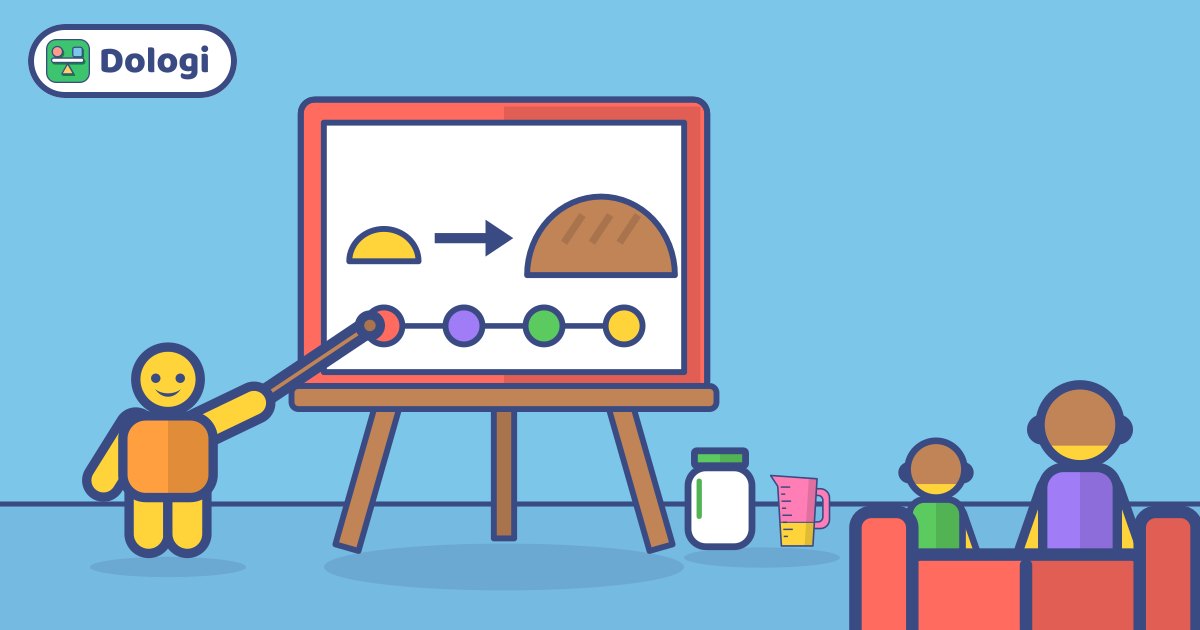
"Mom, why does bread get so puffy?" Kids ask questions like this all week, and we usually answer fast so we can get dinner going. But a good question can become a whole week of learning if your child goes looking for the answer.
That's the idea behind project-based learning at home: start with your child's own question, not an assignment. Here's how to run a small one-week project with a child of roughly 7 to 12, and what your job is along the way.
Pick a question that fits
A good question for a one-week project has four things going for it:
- Your child really wants to know. It's their question, not the one you think they "should" study.
- It can be answered in a week, with no special equipment.
- It can be tested at home, so your child sees the answer, not just reads it.
- It's safe. Anything with the stove, knives or boiling water is your part; your child watches.
A few starters if your child is stuck:
| Around 7–9 | Around 10–12 |
|---|---|
| Why does bread rise? | Does dough rise faster somewhere warm or somewhere cool? |
| Where does the water go after you water a plant? | How much water does a seedling need each day? |
| Do ants like sugar or salt better? | How do ants find their way to food? |
| Why do bananas turn brown? | How should you store a banana so it stays yellow longest? |
| Where does an ice cube melt fastest? | What can you wrap ice in so it melts slowest? |
If the question is too big, like "Why does it rain?", help shrink it: "Want to see if steam turns into drops on a pot lid?" There are more ideas in teaching kids to ask good questions.
Four steps in one week
No strict schedule needed, but splitting the week keeps it from piling up on the last day. For "Why does bread rise?":
| Day | Step | What your child does |
|---|---|---|
| Day 1 | Ask | Writes the question at the top of a sheet of paper. Makes a guess first: "I think… because…" |
| Days 2–3 | Find out | Reads books at home or at the public library, asks a baker at the grocery store bakery, looks things up online with you. Writes down three new things they learned. |
| Days 4–5 | Test | With you, mixes two identical bowls of dough with yeast. One goes somewhere warm, one goes in the fridge. Checks once an hour and draws each bowl. |
| Days 6–7 | Present | Makes a poster, a model or gets ready for a five-minute talk, then presents to the family. |
During the test, remind your child to change only one thing between the bowls (here, the temperature) so they can tell what caused the difference. Fair test experiments explains this in more detail, and kitchen science has more ways to play with dough together.
Ask, don't do it for them
This is the hardest part. When your child is stuck, it's tempting to give the answer or grab the marker yourself. But the project is theirs. A lopsided poster they made themselves is worth more than a neat one you made.
| Instead of | Try asking |
|---|---|
| "It's the yeast that makes it rise." | "What do you think is in the dough that makes it puff up?" |
| "Let me draw that so it looks nice." | "What do you want people to notice first?" |
| "That's wrong, do it again." | "Did it turn out the way you guessed? Why might it be different?" |
| "Let's just finish tomorrow." | "Which part do you want to finish today before we stop?" |
You still help with what your child can't do yet: the stove, the knife, driving to the library. The line is simple: your child thinks and decides, you lend a hand.
Family presentation night
Pick an evening at the end of the week and sit down like a real audience. Grandparents who live far away can join on a video call. The final product can be:
- A poster: the question at the top, drawings of the dough before and after, the result at the bottom.
- A model: the two real bowls of dough side by side, or a paper model of a plant.
- A five-minute talk: no paper needed, just telling it in order.
Suggest your child cover five things: what the question was, what they guessed, what they did, what they saw, and what they still wonder about. Then everyone asks one question and gives one specific compliment ("I liked how you drew the dough every hour"). No grades, and no comparing with brothers or sisters.
When the project doesn't go as planned
The dough doesn't rise, the ants never show up, your child is bored by day three: all normal. A "failed" experiment is still a result. Ask: "If you did it again, what would you change?" It's how scientists work too: guess, test, then rethink the guess. More on that in making a hypothesis.
If your child runs out of steam, shorten the project instead of pushing: drop a part and present what they have. Keep the first project light, so they want to do a second one.
In the Logic topic in Dologi there's a puzzle called Guess the rule: every object with a check mark shares one feature that none of the objects with an X have, and your child has to figure out what it is. The puzzle's hint works just like the test step in a project: try your idea on the X objects, and if it doesn't fit, change it.
In short
- Start with your child's real question, one that fits a week, can be tested at home and is safe.
- Split the week into four steps: ask, find out, test, present.
- You ask questions and lend a hand; the thinking and deciding belong to your child.
- Presentation night is for listening and asking, not grading, and a "failed" experiment is still a result.
Read more: Teaching kids to ask good questions, Fair test experiments, Making a hypothesis