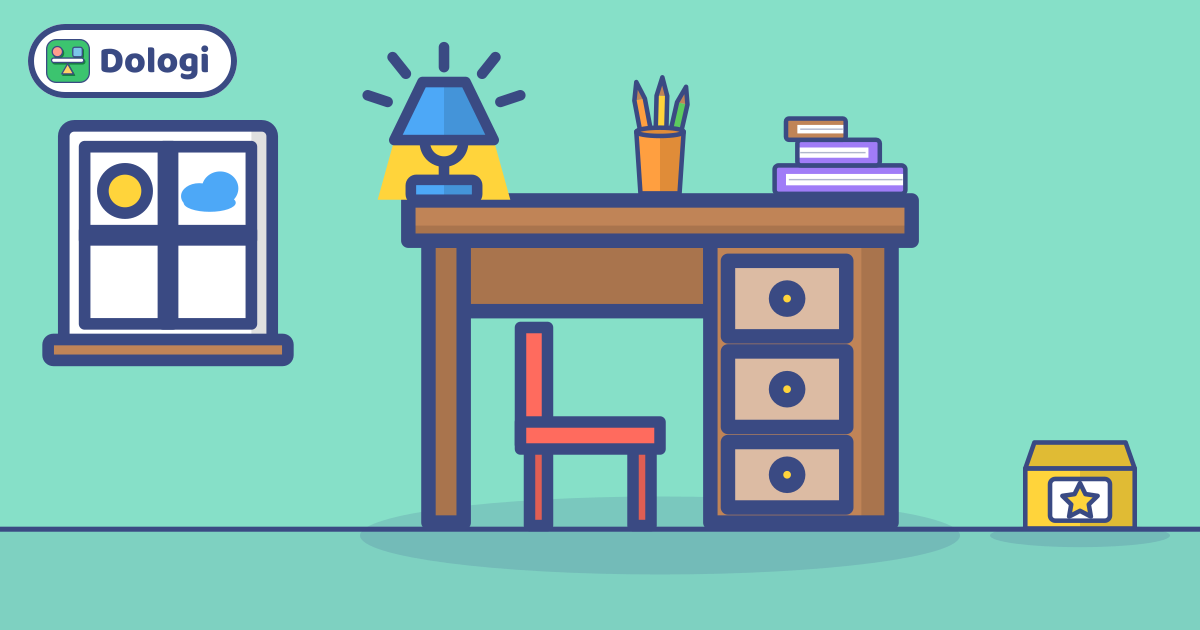
Homework often starts with a search: for a pencil, for a clear patch of table, for a spot where the TV isn't on. By the time your child sits down, ten minutes have gone and the mood is already tense. A small, well set up study corner won't make homework fun, but it removes a lot of the friction before the first question.
You don't need a separate room or new furniture. This article covers where to put the corner, how to light it, how to make the desk and chair fit your child, and how to keep distractions out of reach.
Pick one regular spot
- The same place every day. When homework always happens in one spot, sitting down there becomes a signal that it's time to work. It also means supplies have a home.
- Away from the TV and the busiest part of the house. A corner of the bedroom, the end of the dining table or a desk in the hallway all work, as long as the television isn't in view.
- Near you, for younger children. Many 6- and 7-year-olds work better when a parent is close by, cooking or reading. The kitchen table is a perfectly good study corner at that age. Older kids often prefer a bit more privacy.
- Near a window if you can. Daylight is pleasant to work in. Just avoid spots where strong sun lands directly on the page.
Get the light right
Good light makes reading and writing less tiring. A few simple rules:
- Light from the side. A window to the side of the desk is ideal. A window directly behind your child casts their shadow on the page; a bright window straight ahead can be dazzling.
- Lamp on the side opposite the writing hand. For a right-handed child, put the desk lamp on the left; for a left-handed child, on the right. That way the hand doesn't throw a shadow over what they're writing.
- Don't light only the desk. A bright lamp in a dark room makes eyes keep adjusting between the page and the room. Keep the room light on in the evening too.
- Check for glare. Shiny pages or a tablet screen can reflect the lamp. Tilt the lamp or move it a little until the reflection disappears.
If your child often squints, rubs their eyes, holds books very close or complains of headaches after reading, mention it to your doctor or have their eyes checked.
A desk and chair that fit
Children grow fast, so the aim is a setup you can adjust, not the perfect piece of furniture.
- Feet supported. Your child's feet should rest flat on the floor. If they dangle, put a sturdy box or a stack of old catalogs under them.
- Desk at about elbow height. Sitting upright with shoulders relaxed, your child's forearms should rest on the desk without hunching up or leaning far down.
- At an adult table, a firm cushion raises the seat and a footrest supports the feet. That's often all it takes to make the dining table work.
- Recheck every few months. What fit at the start of the school year may be too low by spring.
- Movement is fine. Standing up between tasks, stretching or changing position is normal. Nobody needs to sit perfectly still for a whole homework session.
If you have questions about your child's posture or back, ask your doctor rather than relying on furniture marketing.
A clear desk with only what's needed
The fewer things on the desk, the fewer things to fiddle with.
- Out: toys, collections, the tablet, your phone, yesterday's crafts.
- In: today's book or worksheet, a few sharpened pencils, an eraser, a ruler, colored pencils if needed.
- Supplies in one place. A cup of pencils on the desk and a drawer, box or caddy for the rest. Your child should be able to find everything without getting up.
- Two minutes of tidying at the end. Clearing the desk when homework is done means tomorrow starts with an empty table, not a pile to move first.
Fewer distractions around the desk
- TV off, phones away. A screen that's on in the same room pulls attention even when your child isn't looking at it. If you want to test this together, see our article on doing homework with the TV on.
- Siblings busy with something quiet, or playing in another room for a while.
- A predictable time. Homework at roughly the same time each day, after a snack and a short break, is easier to start than homework "whenever."
- Let your child set up part of it. Choosing the pencil cup, the spot for the lamp or a small plant makes the corner feel like theirs. After a week, ask, "What bothers you when you're working here?" and adjust.
In Dologi's Focus topic, Follow the string puzzles show several strings tangled together, and your child traces one from an animal to its balloon without being thrown off by the others. Keeping your eyes on one line while other things compete for attention is the same habit a clear desk makes easier.
In short
- Choose one regular spot away from the TV, near a window, and close to you if your child is young.
- Light from the side, with the lamp opposite the writing hand and the room light on.
- Support your child's feet, keep the desk at about elbow height, and recheck as they grow.
- Keep only today's things on the desk, tidy for two minutes at the end, and keep screens out of the room.
Read more: How to set up a reading nook at home that makes your child want to read, Homework without the shouting: how much should parents help?, Homework with the TV on: a home experiment to test doing two things at once