Reversi is an old two-player game: each disc is light on one side and dark on the other, and when you trap your opponent's discs between two of yours, they flip to your color. There's really just one rule, and kids pick it up in minutes, but winning means looking at the board in every direction and thinking ahead. Kids around 7 can play, and 10 to 12 year olds still find it tricky enough to get hooked.
This post shows how to make your own set from cardboard or coins, the rules with pictures, the habit of "checking all eight directions," and a few strategy tips you can share with your child over time.
Making the set
- Board: draw a 6 × 6 grid (for beginners) or an 8 × 8 grid on a piece of cardboard, with squares about 1½ to 2 inches wide. Color the whole board if you like.
- Discs: cut circles from stiff cardboard, slightly smaller than a square. Color one side dark and leave the other white or color it light. A 6 × 6 board needs up to 36 discs and an 8 × 8 board up to 64, though you'll rarely use them all.
- A faster option: use coins, heads for one player and tails for the other. Or stick two colored dots on the top and bottom of bottle caps.
- Let your child cut and color the pieces. Kids can't wait to play with a set they made themselves.
Setup and rules
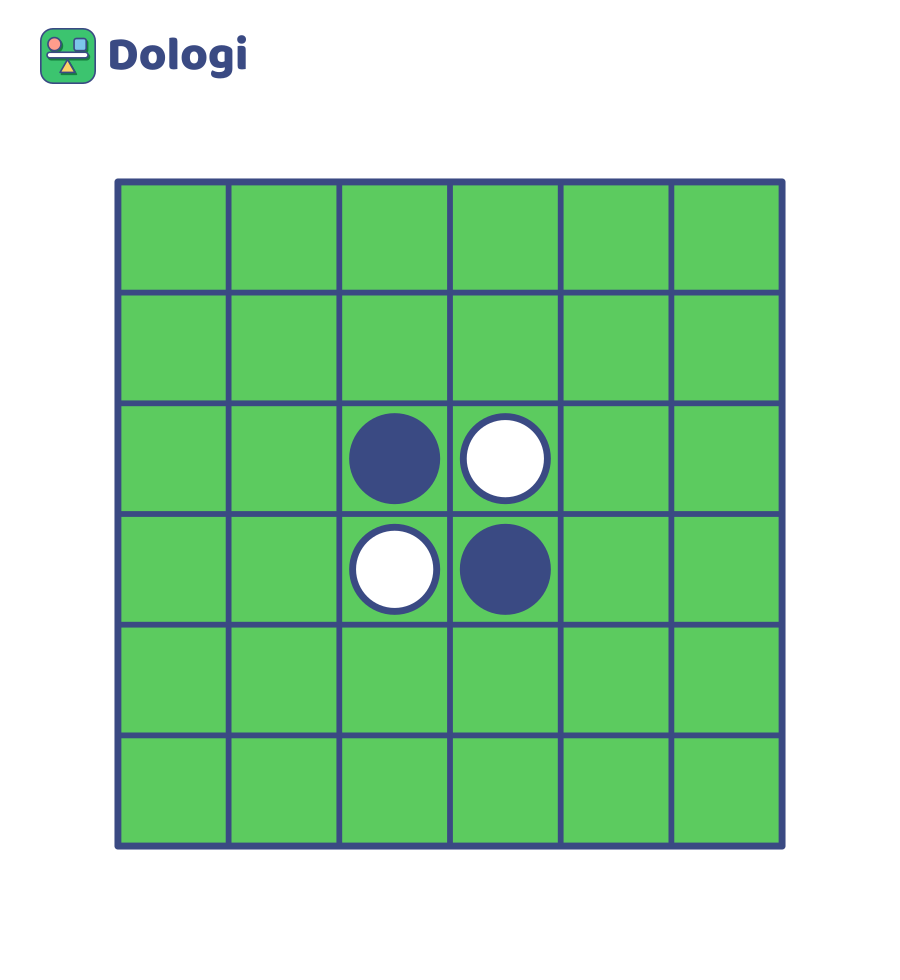
Start with four discs on the four center squares, with matching colors placed diagonally. Dark goes first.
- On your turn, place a disc on an empty square so that it traps at least one of your opponent's discs: their discs must form a straight line (across, up and down, or diagonal) between your new disc and a disc you already have, with no empty squares in between.
- Flip every trapped disc to your color, in every direction where you trapped some.
- If no square lets you trap anything, you pass. If you have a move, you have to take it.
- When the board is full, or neither player can move, count the discs: whoever has more wins.
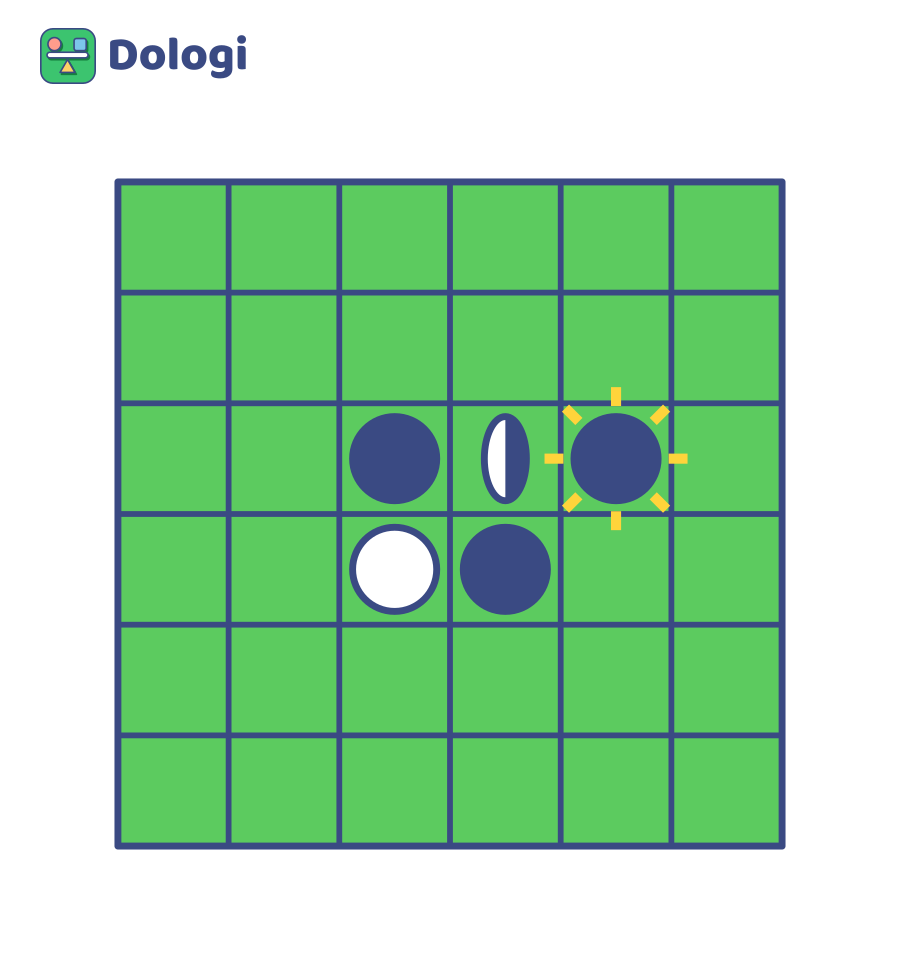
Example: on the first move, Dark places a disc just to the right of the top two center discs. The white disc is now between the new disc and the dark disc to its left, so it flips.
In the starting position, Dark has exactly four possible moves, and they're mirror images of each other. Ask your child to find all four: that's the first puzzle.
Check all eight directions before placing
The most common kid mistake is checking only across and up-and-down and forgetting the two diagonals. One small habit helps:
- Before placing, your child points from the chosen square in all eight directions: up, down, left, right and the four diagonals. Any direction with your opponent's discs followed by one of yours gets flipped.
- After placing, flip one direction at a time and say it out loud: "Two flip this way, one flips on this diagonal."
- Do the same on your turn so your child can check you. Kids love catching a parent who forgot to flip one.
Easy strategy tips
No need to teach these all at once. Play a few games, then ask, "Which squares seem valuable?" before you say anything.
- Corners can never be flipped back. No straight line can trap a corner disc, so once you take a corner, it's yours for good.
- Be careful with the square diagonally next to an empty corner: playing there often gives your opponent a way into the corner.
- Edges are fairly safe: an edge disc can only be flipped along the edge.
- Flipping a lot isn't always good. In the middle of the game, colors keep changing. A move that flips just a few but leaves your opponent with few places to go is often better than a big flip that opens a corner for them.
From 6 × 6 to 8 × 8
- The 6 × 6 board: short games, great for 7 and 8 year olds and for learning the rules. The corners are close together, so kids quickly see why they matter.
- The 8 × 8 board: longer games with more choices, perfect once your child has beaten you a few times on the small board.
- Look back at one move: after a game, set up the position just before your child lost a corner and look for another move together. For ways to ask without criticizing, see reviewing games with your child.
Dologi doesn't have Reversi, but the habit of tracing straight lines shows up in the chess puzzle Where can it go? ("Tap every square this piece can move to."), which appears in daily sessions once the Creative corner is turned on. Your child has to follow each of the piece's directions until something blocks it, a lot like checking eight directions before placing a disc.
In short
- Make a set with a grid on cardboard and two-sided cardboard discs, or use coins.
- Place a disc to trap your opponent's discs across, up and down or diagonally, flip every trapped disc, and whoever has more at the end wins.
- Teach your child to point in all eight directions before placing, and not to forget the diagonals.
- Corners are valuable, squares next to empty corners are risky, and big flips aren't always best; start on 6 × 6, then move to 8 × 8.
Read more: Checkers for kids on a paper board, Design a board game with your child