Kids around 7 to 12 start wanting to buy things themselves, hold their own money and ask, "How much is this?" A homemade shopping board game lets them practice all of it with play money: adding up prices, paying, making change and, most importantly, deciding whether to buy now or save.
This post walks you through making "Market Street" with your child: drawing the board, making money and cards, the basic rules, saving with interest, and turning the end of the game into a short conversation about choices.
Making the game
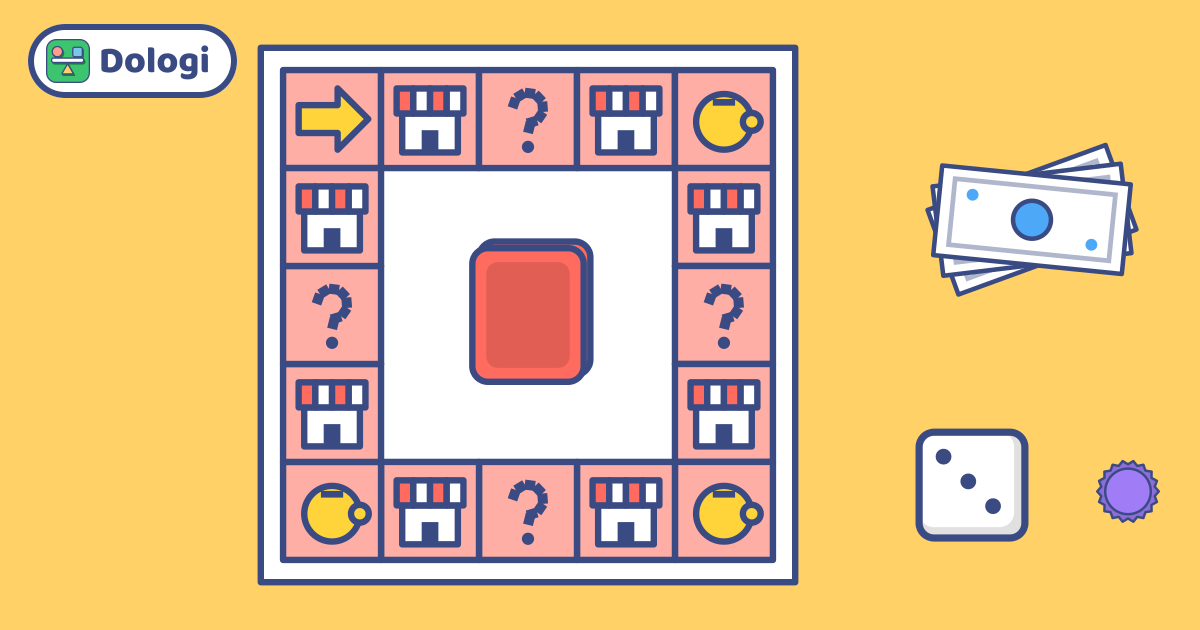
- Board: on a big sheet of paper or a flattened box, draw a loop of 16 squares around the edge. One Start square, eight shop squares, four surprise squares (draw a question mark) and three piggy bank squares.
- Shops: each shop sells one item; your child picks the item and writes a price. For example: candy 2, crayons 3, ball 5, comic book 6, kite 7, pencil case 8, puzzle 9, backpack 12.
- Play money: cut paper into small bills marked 1, 2, 5 and 10, a different color for each. Everyone starts with 20.
- Wish cards: about ten cards, each listing three items from the shops. At the start, each player draws one.
- Surprise cards: about ten cards with a mix of good news and spending, such as "Lemonade stand: collect 4," "Fix a flat bike tire: pay 3," "Water the neighbor's plants: collect 2," "Buy a friend's birthday present: pay 3," "Store sale: your next purchase is 2 off."
- Piggy banks: a paper cup for each player. Add a die and some bottle caps as pieces.
Let your child draw the shops, set the prices and invent the surprise cards. Setting prices is already a math problem: "Should the ball cost more or less than the comic book?"
Basic rules
- Take turns rolling the die and moving around the loop.
- Shop square: you may buy the item there. You can buy anything, but only items on your wish card help you win.
- Paying and change: the buyer hands over money, and the banker (a different player each game) makes change. An item costing 6 paid with a 10 gets 4 back.
- Surprise square: draw a surprise card and do what it says.
- Piggy bank square: put as much money as you like into your own piggy bank. Money in the piggy bank can only come out when you pass Start.
- Passing Start: collect 5 in allowance. The piggy bank also pays 1 for every 5 saved (save 10, get 2 extra).
- Winning: the first player to buy all three wish-card items and get back to Start wins.
Buy now or save?
This is the most interesting part of the game. A few situations your child will run into:
- Landing on a shop with something really tempting that isn't on the wish card. Buying it feels great right now, but it might leave you short for something you need. Needs and wants has more ways to talk about this.
- Lots of money but no needed shop nearby: put it in the piggy bank for the bonus at Start, or keep it in hand in case a surprise card says pay up?
- A surprise card says pay and there isn't enough: next time, kids often keep a little back "just in case."
You don't need to point out the right choice. The game shows the consequences, and next round your child will try something different.
The math in the game, by age
| Age | Suggested tweaks | What your child practices |
|---|---|---|
| 7–8 | Only 1s and 5s, prices up to 10 | Adding and subtracting within 20, trading a 5 for five 1s |
| 9–10 | Add 2s and 10s, prices up to 15 | Paying with several bills, quick change, running totals |
| 11–12 | Cards like "half price" and "buy two, save 3," a spending log | Simple fractions, comparing prices, planning a budget |
For older kids, add a small spending log: one line for every purchase, payment and piggy bank deposit. At the end, add it up and check that it matches the money in hand.
The end of the game: talk about choices
When someone wins, don't pack up right away. Everyone shares one choice they made and why:
- "I bought the ball even though it wasn't on my card because I liked it, but then I didn't have enough for the backpack."
- "I put 10 in my piggy bank, got 2 extra at Start, and that was exactly enough for the comic book."
Just listen and ask, "Would you do anything differently next time?" This is the part that connects the game with real-life money, as in teaching kids about money.
The Math topic in Dologi has a puzzle called Just enough: "Which basket is worth exactly the same as yours on the bottom card?" Just like checking whether you have enough money for something, your child has to compare the value on both sides before choosing.
In short
- Draw a 16-square loop with shops, surprise squares and piggy banks; make play money in 1s, 2s, 5s and 10s, plus three-item wish cards.
- Buy, pay, make change and save with interest; the first to buy all three wish items and reach Start wins.
- Let your child decide whether to buy now or save; the game shows the results.
- Adjust bills and prices by age, and end every game with each player explaining one choice.
Read more: Vending machine role play, Design a board game with your child