Six is the age when many children have just started school or are about to. Your child can sit still longer, talks more clearly, and is beginning to handle tasks that need two ideas at once: finding the card that is both round and blue, remembering five things in the right order, picturing the dinner table as if looking down from the ceiling.
Below are thinking skills often seen around age 6, each with a 10-minute game made from things you already have at home.
What many 6-year-olds can do
The table shows things many children around 6 can do. These are rough markers only: every child has their own pace, ahead in some skills and needing more time in others.
| Skill | Around 6, many children can | Suggested game |
|---|---|---|
| Sorting | Sort things by two features at once (color and shape) | Four-square board |
| Memory | Repeat a sequence of four or five things in order | Object train |
| Patterns | Spot a simple growing pattern: add one, add two | Bottle-cap towers |
| Observation | Find five differences between two scenes | Change five things |
| Space | Draw a familiar place as seen from above | Dinner table map |
| Self-control | Wait for a turn and follow a shared rule | Turn-taking games |
If your child can't do one of these yet, simply play an easier level for a while. It is nothing to worry about.
Sorting by two features: the four-square board
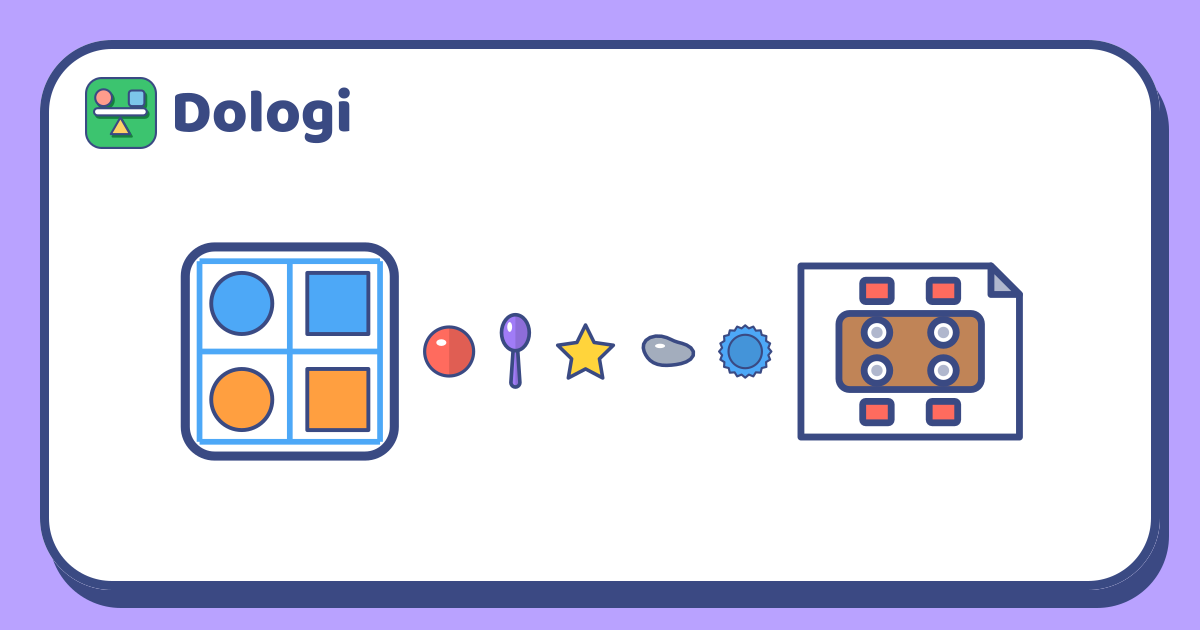
Divide a large sheet of paper into four squares: two rows, two columns. Cut cards from old cardboard: circles and squares, each in blue and in orange. Put a sample card at the start of each row (circle, square) and at the top of each column (blue, orange).
Your child picks up each card and places it in the right square. An orange circle has to sit in the "circle" row and the "orange" column at the same time. That's harder than two piles: your child has to keep two ideas in mind.
Once that feels easy:
- Change the features. Use real objects: spoons and forks, big and small. Or animal pictures: flies or doesn't, lives in water or on land.
- Empty square. Leave one square empty and ask "which card goes here?". Your child has to read both the row and the column to answer.
- One card out of place. Put a card in the wrong square on purpose. Your child finds it and says why it doesn't belong.
Memory: the object train
Line up five small things like a train: a bead, a spoon, a star, a pebble, a bottle cap. Your child looks for about ten seconds, then you cover them with a cloth and mix them up. Your child rebuilds the train in the original order.
Start with four things, then add a fifth. Ways to keep it fresh:
- Say it out loud. No objects needed: you say "cat, cup, umbrella, apple", your child says it back. Next time your child makes up the list for you.
- Find the swapped cars. Don't mix everything up, just swap two things. Your child points out which ones moved.
- Make a story. Suggest linking the things into a short story: "the bead rolled into the spoon, the spoon scooped up the star…". Finding a way to remember on their own is a big step.
Patterns and observation: bottle-cap towers, change five things
Growing bottle-cap towers. Make a stack of one cap, next to it a stack of two, then three. Ask "how many caps in the next stack?". Once your child gets it, switch to adding two each time: one, three, five. Your child counts to check, then says the rule in words: "each stack gets two more caps". Then make the same pattern with spoons or drawn dots, so the rule isn't tied to caps.
Change five things in the room. Your child looks carefully at one corner of a room, then steps outside. You change five things: turn a book over, move a cushion, put a pen away. Your child comes back and finds all five. Then swap roles. The game teaches looking in order, left to right and top to bottom.
Space and taking turns: the dinner table map, turn-taking games
Dinner table map. Before a meal, your child stands on a chair (with an adult holding on) and looks down at the table. Then they draw it on paper: the table is a rectangle, each plate a circle, each chair a small square. Ask "where is Dad's chair in the picture?" or "what does a cup look like from above?".
Next time, your child draws the map first and then sets the table to match. Moving between real things and a drawing is the first step toward reading maps.
Turn-taking games. Waiting for a turn is a thinking skill too: your child has to keep the rule in mind and hold back the urge to act right away. Pick short games with clear turns: roll a die and move a counter along a drawn path, or build a block tower one block each. Follow the rules with adults too, and let your child remind you when you "forget" a turn.
Playing so your child wants to come back
- One game at a time, about 10 minutes. Stop while your child still wants more, and they'll ask to play again tomorrow.
- Ask "how do you know?". When your child can explain why a card belongs in that square, they are really thinking, not guessing.
- Let your child set the puzzle. Making a puzzle for someone else deepens understanding of the rule.
If your child enjoys these games, the Memory, Patterns and Space topics in Dologi have puzzles of the same kind, starting easy and getting harder. A few minutes on a device each day is one more way to practice, not a replacement for play with real things.
In short
- Around age 6, many children start to hold two ideas at once, remember longer sequences and picture things from above.
- One game per skill: the four-square board, the object train, bottle-cap towers, change five things, the dinner table map, turn-taking games.
- Keep it short, ask "how do you know?", and switch roles so your child sets the puzzle.
- Age markers are rough; if your child can't do something yet, step back a level.
Read more: Thinking activities for 5-year-olds: a game at home for each skill, Sorting by two features at once: color and shape