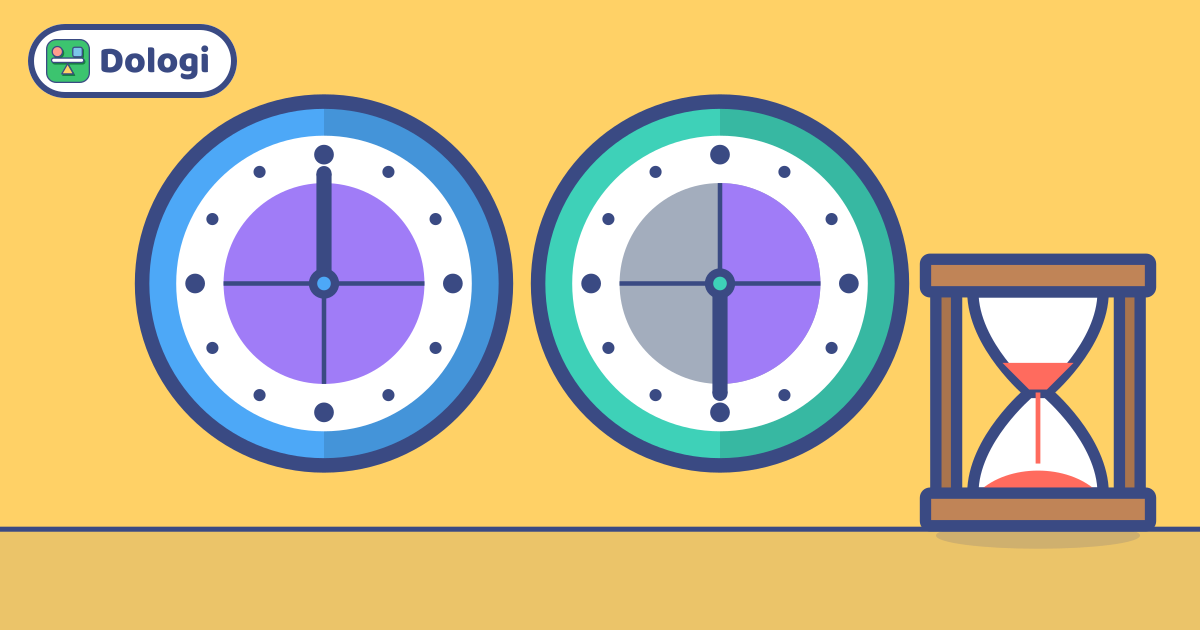
"The movie is 1.5 hours long, so that's 1 hour 50 minutes, right?" Many children aged 8 to 11 make this mistake, and it's a very reasonable one. Almost everything they count goes in tens: money, centimeters, decimals. Time is the exception. An hour has 60 minutes, a minute has 60 seconds, and a day has 24 hours.
This post is for parents who want to help. It explains why time conversions trip children up, then gives you a paper plate, a few landmark numbers and some everyday routines to practice with at home.
Why counting in tens gets in the way
- The decimal looks like a clock. 1.5 and 1:50 share the same digits. So do 2.15 and 2:15. A child who sees "1.5 hours" reads the 5 as "50 minutes" because that's what it looks like on a digital clock.
- Ten is the habit. After 9 comes 10, after 99 comes 100, and 100 cents make a dollar. Children expect the minutes to roll over at 100, not at 60.
- The calculator gives a decimal. 90 minutes ÷ 60 = 1.5. Correct, but the 0.5 means half an hour, not 5 or 50 minutes. Nobody told the calculator that.
The fix is to give your child a picture of an hour that isn't built on tens.
A paper plate clock in four quarters
Take a paper plate and draw two lines through the center: one from 12 to 6, one from 3 to 9. Your child colors the four quarters in four colors. Then mark the 12 five-minute ticks around the edge.
Now count together. One quarter has three five-minute ticks, so one quarter is 15 minutes. Two quarters are half the plate: 30 minutes. Three quarters: 45 minutes. All four: 60 minutes, one full hour.
Ask: "Half an hour is half of the plate. How many minutes is that?" Most children say 30 without hesitation. Then write 0.5 hours next to it. The 5 after the decimal point is five tenths, which is a half, not 50 minutes.
| Part of an hour | As a decimal | Minutes |
|---|---|---|
| A quarter | 0.25 hours | 15 minutes |
| A half | 0.5 hours | 30 minutes |
| Three quarters | 0.75 hours | 45 minutes |
| A whole hour | 1 hour | 60 minutes |
For 10 to 11 year olds who know decimals well, add one more row: a tenth of an hour, 0.1 hours, is 6 minutes, because 60 ÷ 10 = 6.
Landmark numbers: 60, 30, 15
You don't need a long table. A few landmarks get you most of the way:
- 1 hour = 60 minutes; 1 minute = 60 seconds; 1 day = 24 hours.
- Half an hour = 30 minutes; a quarter hour = 15 minutes.
- Hours to minutes: multiply by 60. Minutes to hours: take out as many 60s as you can; what's left is minutes.
A few to try together, with the plate on the table:
- 90 minutes: one 60 and 30 left. 1 hour 30 minutes, or 1.5 hours. That's a full soccer game without halftime.
- 105 minutes: one 60 and 45 left. 1 hour 45 minutes, or 1.75 hours, a typical movie.
- 2 hours 15 minutes: the 15 minutes are a quarter, so it's 2.25 hours, not 2.15.
- 1.5 minutes: a minute and a half, so 90 seconds.
- 100 seconds: one 60 and 40 left. 1 minute 40 seconds, not 1 minute.
The question to ask after every answer: "Is the leftover more than 59?" If it is, there's another whole hour (or minute) hiding in it.
Add up a real routine
Time conversions make the most sense when they're about your child's own day. Write a routine on paper and add it up together.
School mornings: breakfast 20 minutes, getting dressed and brushing teeth 15 minutes, walking to school 25 minutes. That's 20 + 15 + 25 = 60 minutes, exactly 1 hour. So if school starts at 8:00, what time does your child need to get up?
Evenings: homework 45 minutes, bath 20 minutes, a bedtime story 30 minutes. 45 + 20 = 65 minutes, which is 1 hour 5 minutes. Add 30 more: 1 hour 35 minutes. Show your child the trick of collecting each full 60 into an hour as you go, then adding the rest.
| Your child writes | What went wrong | Question that catches it |
|---|---|---|
| 1.5 hours = 1 hour 50 minutes | Read the decimal as minutes | "Half an hour is how many minutes?" |
| 2 hours 15 minutes = 2.15 hours | Copied the minutes after the decimal point | "What part of an hour is 15 minutes?" |
| 1 hour 45 minutes + 30 minutes = 1 hour 75 minutes | Didn't collect the full 60 | "Is 75 minutes more than an hour?" (so 2 hours 15 minutes) |
| 100 seconds = 1 minute | Treated a minute as 100 seconds | "How many seconds are left after one minute?" |
In many US schools, converting hours, minutes and seconds shows up around 4th grade. If your child is younger and still learning to read a clock, start there first.
Practice with Dologi
In Dologi's Math topic, the What time is it? puzzles start with reading the clock. At harder levels, a big clock shows the time now and your child chooses the right answer for "What time will it be in 45 minutes?" or "in 1 hour and 15 minutes?", or works out the finish time for "You read for 35 minutes, then play for 40." That last one is exactly the routine adding from above: collect the 60, then add the rest.
In short
- Time doesn't count in tens: 60 minutes make an hour, 60 seconds make a minute.
- A paper plate in four colored quarters shows that half an hour is 30 minutes and a quarter is 15, so 1.5 hours is 1 hour 30 minutes.
- Learn the landmarks 60, 30 and 15, and ask "Is the leftover more than 59?" after every answer.
- Practice by adding up your child's real routines, collecting each full hour as you go.
Read more: Teaching your child to tell time: from o'clock to minutes, Unit conversion mistakes: why kids multiply when they should divide, Teaching fractions to children: start by sharing a cake