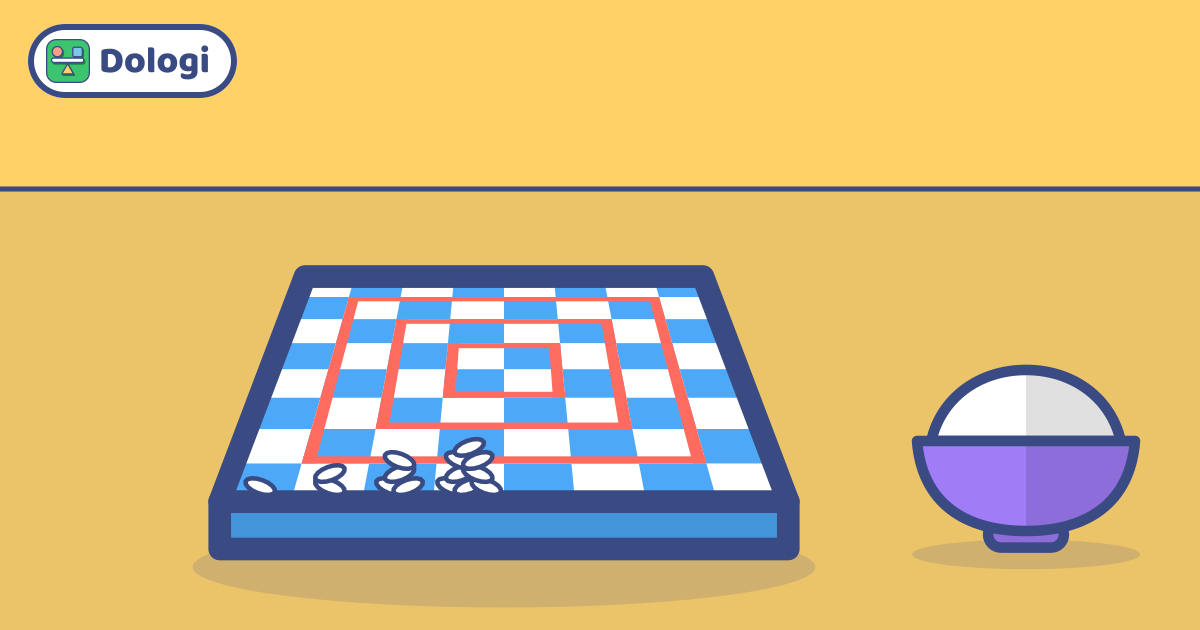
Here's a question to try at the dinner table: "How many squares are on a chessboard?" Your child will very likely say 64, since the board has 8 rows of 8. That's the number of small squares, but it isn't the answer to the question. Four small squares together make a 2×2 square. Nine make a 3×3 square. The whole board is a square too.
If you have a chessboard at home, you have a ready-made math worksheet. Below are three puzzles that suit children of roughly 8 to 12: counting every square, the rice that doubles on each square, and counting light and dark squares. Each one comes with an answer worked out step by step.
Puzzle 1: how many squares on the board?
Don't start counting on the full 8×8 board. The squares overlap, and it's easy to lose track or count one twice. A good problem solver does something else first: solve a smaller version, look for a pattern, and only then go back to the big one.
Grab some graph paper, draw a few small boards (2×2, 3×3, 4×4), and set out colored pencils so your child can outline each square they find.
A 2×2 board. There are 4 small squares, plus the whole board is one 2×2 square. That's 4 + 1 = 5 squares.
A 3×3 board. There are 9 small squares. What about 2×2 squares? Let your child trace them: the top-left corner of a 2×2 square fits in 4 places (two across, two down). Add the whole board as one 3×3 square. That's 9 + 4 + 1 = 14 squares.
A 4×4 board. Let your child try this one alone first: 16 squares that are 1×1, 9 that are 2×2, 4 that are 3×3 and 1 that is 4×4. Total: 30.
Find the pattern, then go to 8×8
Put the results in a table and ask your child what they notice:
| Board | 1×1 | 2×2 | 3×3 | 4×4 | Total |
|---|---|---|---|---|---|
| 2×2 | 4 | 1 | 5 | ||
| 3×3 | 9 | 4 | 1 | 14 | |
| 4×4 | 16 | 9 | 4 | 1 | 30 |
Every number in a row is a perfect square (1, 4, 9, 16…), going from biggest to smallest. Why? On a 4×4 board, a 2×2 square can slide into 3 positions across and 3 positions down, so there are 3 × 3 = 9 places for it. The bigger the square, the less room it has to slide. On an 8×8 board, a square of side k fits in (9 − k) × (9 − k) places.
Now apply it to the real board:
| Square size | 1×1 | 2×2 | 3×3 | 4×4 | 5×5 | 6×6 | 7×7 | 8×8 |
|---|---|---|---|---|---|---|---|---|
| How many | 64 | 49 | 36 | 25 | 16 | 9 | 4 | 1 |
Answer: 64 + 49 + 36 + 25 + 16 + 9 + 4 + 1 = 204 squares.
Adding those eight numbers is good mental math practice too. Suggest pairing them up into friendly numbers: 64 + 36 = 100, 49 + 1 = 50, 16 + 4 = 20, 25 + 9 = 34, and then 100 + 50 + 20 + 34 = 204.
Bonus challenge for 11- and 12-year-olds: how many rectangles are on the board, counting the squares too? Hint: every rectangle is set by two vertical lines and two horizontal lines. An 8×8 board has 9 vertical lines, and there are 36 ways to pick 2 of them; the horizontal lines also give 36 ways. Answer: 36 × 36 = 1,296 rectangles.
Puzzle 2: rice that doubles on every square
There's an old story that gets told many different ways. The person who invented a game played on a chessboard was offered any reward by the king. They asked only for rice: one grain on the first square, two on the second, four on the third, and so on, each square getting double the one before, all the way to the last square. The king laughed at such a small request, until he found out that all the rice in his storehouses wasn't enough.
Work out the first few squares together. For the first four or five, you can even count out real grains of rice:
| Square | 1 | 2 | 3 | 4 | 5 | 6 | 7 | 8 |
|---|---|---|---|---|---|---|---|---|
| Grains | 1 | 2 | 4 | 8 | 16 | 32 | 64 | 128 |
After the whole first row, all eight squares together hold just 255 grains, not even a handful. Then the numbers take off:
- Square 11 holds 1,024 grains, the first to pass a thousand.
- Square 21 holds 1,048,576 grains, more than a million.
- Square 31 holds 1,073,741,824 grains, more than a billion.
- Square 64 holds 9,223,372,036,854,775,808 grains, more than nine quintillion.
Here's something fun for your child to discover: add up all the squares so far and compare the sum with the next square. 1 + 2 + 4 = 7, and square 4 has 8. 1 + 2 + 4 + 8 = 15, and square 5 has 16. The squares before always add up to exactly one grain less than the next square. So all 64 squares together hold 18,446,744,073,709,551,615 grains, which is square 64 doubled, minus one.
Your child doesn't need to remember these long numbers. What's worth keeping is the feeling: when something keeps doubling, it starts slowly and then grows faster than you can picture.
Puzzle 3: light squares and dark squares
These are shorter puzzles you can play right on a real chessboard:
- How many light squares and how many dark squares? Every row has 4 light and 4 dark, so 32 and 32.
- What about a 5×5 board? 25 is odd, so it can't split evenly: 13 squares match the color of the corner, and 12 are the other color.
- How many light squares are in any 3×3 square on the board? It depends. If its corner is light, there are 5 light and 4 dark; if the corner is dark, it's the other way around. A 2×2 or 4×4 square always splits evenly. Ask your child why squares with an even side split evenly while squares with an odd side are off by one.
Square colors also help prove something that sounds impossible: can a chessboard with two opposite corners cut off be covered completely with dominoes? That one has its own walkthrough in the post on impossible puzzles linked at the end of this page.
How to solve them together
- Let your child guess first. "What do you think?" A guess that's way off makes the real answer feel surprising.
- Let them color, hold and count. Colored pencils for outlining, real rice for the first few squares. Busy hands help the idea land.
- Ask "why?" more than "how many?" If your child can explain why a 4×4 board has nine 2×2 squares, they've got the pattern, and the answer follows.
- One puzzle at a time. One puzzle per sitting is plenty. Save the next one for another day.
Once the Creative corner is turned on, Dologi's daily sessions sometimes include the chess puzzle Where can it go?: on a small board, your child taps every square one piece can reach, which means checking and counting square by square along the piece's path. For more chessboard play, the Chess room in the Creative corner has Learn chess, going from each piece to each topic.
In short
- A chessboard has 64 small squares but 204 squares in all; start with 2×2, 3×3 and 4×4 boards so your child can find the perfect-square pattern.
- The rice story gives a feel for big numbers: square 21 already holds over a million grains, square 64 more than nine quintillion.
- Counting light and dark squares is short but deep: squares with an even side split evenly, those with an odd side are off by one.
- Let your child guess, color, count and explain why; one puzzle at a time is enough.
Read more: Does chess make kids better at math? What it can do and what's still uncertain, Impossible puzzles: teaching 10-to-12-year-olds to prove there is no solution