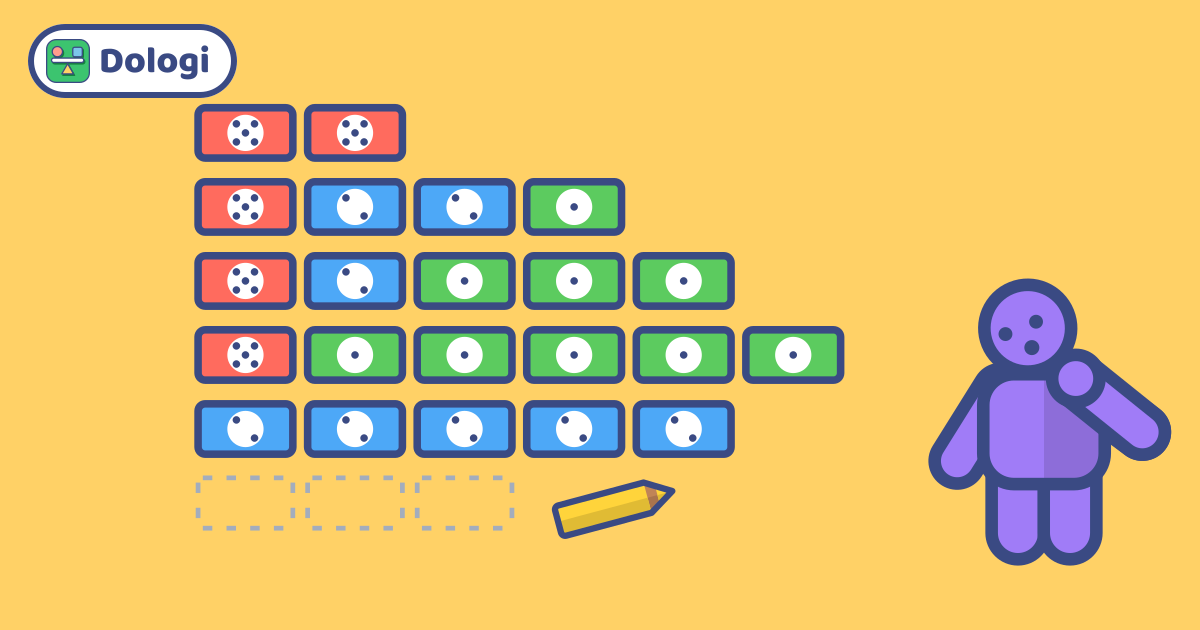
"How do you pay 10?" Two 5s, obviously. But there's also five 2s, or one 5, two 2s and a 1... How many ways are there altogether? That question turns a stack of play money into a race to find new ways, and teaches 8- to 11-year-olds a really important skill: listing things in order so you don't miss any.
Getting ready
- Three kinds of play money: 1 notes, 2 notes and 5 notes, about ten of each. Homemade works fine: green paper for 1, blue for 2, red for 5, with dots drawn on each note.
- A sheet ruled into a table with four columns: 5s, 2s, 1s, total notes.
- One shared rule: a "way to pay" is a group of notes, and order doesn't matter. 5, 2, 2, 1 and 2, 1, 5, 2 are the same way.
Round 1: Take turns naming a new way
- On your turn, say a way to pay exactly 10, then lay out the notes so everyone can check.
- If nobody has said it yet, write it in the table. A repeat means you lose your turn.
- Can't think of a new one? Pass. When everyone is stuck, stop and ask: "Have we found them all? How can we be sure?"
Usually a family finds seven or eight ways and then starts guessing. That's when the ordered table earns its keep.
Sort the table from most 5s to fewest
Rearrange the ways you've found: first by number of 5s (two, then one, then none), and within the same number of 5s by number of 2s from most to fewest. The rest is made up with 1s.
| 5s | 2s | 1s | Total notes |
|---|---|---|---|
| 2 | 0 | 0 | 2 |
| 1 | 2 | 1 | 4 |
| 1 | 1 | 3 | 5 |
| 1 | 0 | 5 | 6 |
| 0 | 5 | 0 | 5 |
| 0 | 4 | 2 | 6 |
| 0 | 3 | 4 | 7 |
| 0 | 2 | 6 | 8 |
| 0 | 1 | 8 | 9 |
| 0 | 0 | 10 | 10 |
There are exactly ten ways. The table shows why nothing is missing: with two 5s there's only one way; with one 5 there's 5 left, so the number of 2s can only be two, one or none; with no 5s the number of 2s runs from five down to zero, six possibilities. One plus three plus six makes ten.
Don't hand over a finished table. Let your child sort the ways the family found and spot for themselves which rows are missing.
Round 2: Pay with the fewest notes
Change the question: what's the smallest number of notes you can pay with? For 10, it's two 5s. Then try other prices:
- 8: three notes (5, 2, 1).
- 9: three notes (5, 2, 2).
- 13: four notes (5, 5, 2, 1).
After a few prices, kids usually find the trick themselves: take the biggest note you can first, then the smaller ones. With 1, 2 and 5 notes, this always gives the fewest notes.
Round 3: Which prices can't you pay with just three notes?
New rule: you can pay with at most three notes. Read out prices from 1 to 15 one by one and let your child try.
Most work: 11 is 5, 5, 1; 12 is 5, 5, 2; 15 is three 5s. But there are exactly two prices in this range you can't pay: 13 and 14. Let your child discover them, then ask why: even the three biggest notes only reach 15, and a little less than that can't be put together from three notes.
Going further for 10- and 11-year-olds
Count the ways for other prices and write them in a row:
| Price | 5 | 6 | 7 | 8 | 9 | 10 | 11 | 12 |
|---|---|---|---|---|---|---|---|---|
| Ways | 4 | 5 | 6 | 7 | 8 | 10 | 11 | 13 |
Ask: "From 9 to 10, why does the number of ways jump by two instead of one?" (Because at 10 you can pay with two 5s, which opens up a whole new group of ways.) That's how a mathematician looks at a table: find where the pattern changes, then ask why.
The Math topic in Dologi has a puzzle called Just enough: "Which basket is worth exactly the same as yours on the bottom card?" Just like finding ways to pay 10, your child has to see that different groups can be worth the same amount.
In short
- Three kinds of notes, 1, 2 and 5; a way to pay is a group of notes, order doesn't matter.
- Take turns naming new ways; when stuck, sort the table from most 5s to fewest to see there are exactly ten.
- Later rounds: the fewest notes (biggest note first) and the prices you can't pay with three notes (13 and 14).
- Older kids count the ways for many prices and look for where the pattern changes.
Read more: How many outfits can you make? Counting combinations, Make a shopping board game at home