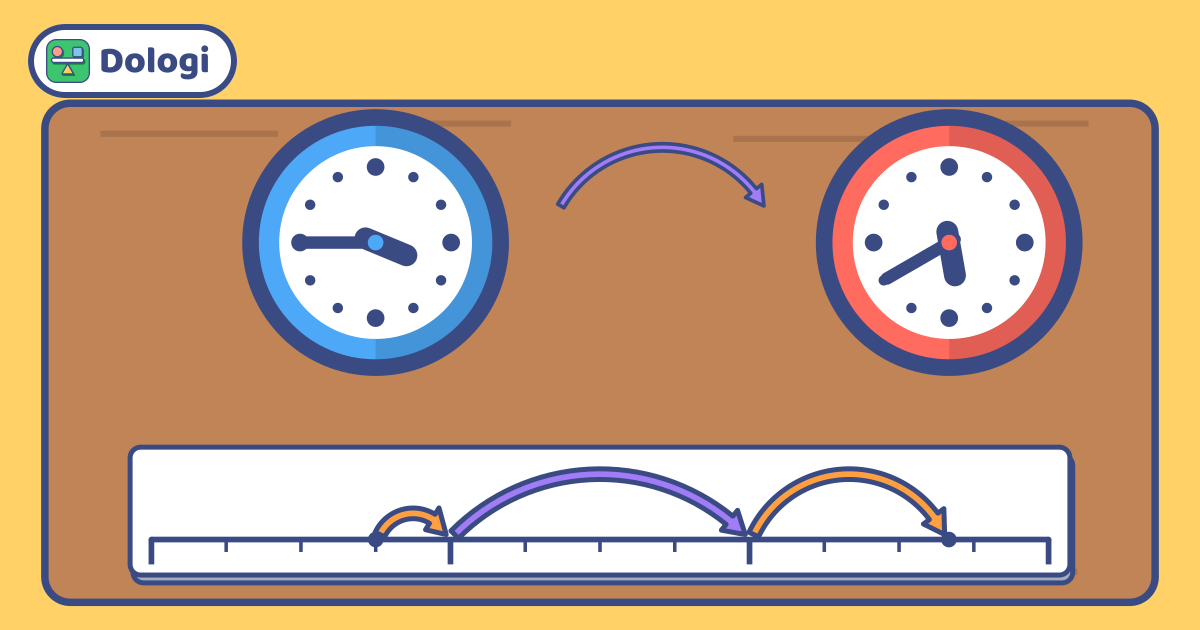
"How much longer until lunch?" "How long is the movie?" "When will Grandpa get here?" Children ask these questions every day, often several times an hour. Each one is a small math problem: how much time passes from one clock time to another. Teachers call it elapsed time, and many children find it harder than reading the clock itself, because an hour has 60 minutes, not 100, and the usual way of subtracting doesn't work.
One simple method works on a real clock and on paper, and daily life is full of real questions to practice with. This article assumes your child can already read the time to the nearest five minutes. If not, start with teaching your child to tell time.
On the clock: jump to the o'clock, then add the rest
The idea is to break the wait into easy pieces: first up to the next o'clock, then whole hours, then the minutes that are left over.
Example: it's 10:40 and lunch is at 12:15.
- From 10:40 to 11:00: the long hand goes from the 8 to the 12, four jumps of five. That's 20 minutes.
- From 11:00 to 12:00: the short hand moves one number. That's 1 hour.
- From 12:00 to 12:15: three jumps of five. That's 15 minutes.
Add them up: 1 hour 35 minutes until lunch.
Start on a real clock or a paper plate clock: your child moves the long hand, counts the jumps of five out loud, and says "one hour" for every full turn past the 12. If both times fall within the same hour, such as 4:10 to 4:45, there's nothing to jump to: just count by fives, 7 jumps, 35 minutes.
A time line on a strip of paper
Once the clock method makes sense, move it to paper. Cut a long strip and draw a straight line. Make a big tick for each o'clock and, if you like, small ticks for every quarter hour. Mark the start and end times with a dot, then draw curved jumps above the line, just like the cover of this article:
| From | To | Jumps | Total |
|---|---|---|---|
| 3:45 | 5:40 | 15 min + 1 hour + 40 min | 1 hour 55 minutes |
| 10:40 | 12:15 | 20 min + 1 hour + 15 min | 1 hour 35 minutes |
| 11:30 AM | 2:10 PM | 30 min + 2 hours + 10 min | 2 hours 40 minutes |
The strip shows every jump at once, and long waits don't need several turns of the hand. It also handles noon: on the line, 12 is just another o'clock. From 11:30 AM to 2:10 PM, the jumps are 30 minutes to noon, two hours to 2:00 PM, then 10 minutes. Say "AM" and "PM" out loud as you cross noon, so your child links the line to the words on schedules and tickets.
In the US, elapsed time usually shows up in 3rd grade, often with exactly this kind of number line, so a homemade strip lines up nicely with schoolwork.
Plan a day off together
The best practice material is your own weekend. On a Saturday morning, make a simple plan together and let your child write the times. Then ask how long each part lasts.
| Activity | Starts | Ends | How long? |
|---|---|---|---|
| Breakfast | 8:00 AM | 8:30 AM | 30 minutes |
| Park | 9:15 AM | 11:00 AM | 1 hour 45 minutes |
| Lunch | 12:00 PM | 12:45 PM | 45 minutes |
| Movie at home | 2:30 PM | 4:10 PM | 1 hour 40 minutes |
Then use the plan for real questions during the day. "It's 11:20 and lunch is at 12:00. How long do we have?" (40 minutes.) "The movie is 1 hour 40 minutes long and has to end by 6:00. When should it start?" For that one, go backwards: 6:00 minus 1 hour is 5:00, minus 40 minutes is 4:20.
One or two questions a day, asked when the answer matters, do more than a page of exercises. Then check against the real clock: did lunch come when your child said it would?
Mix-ups to watch for
- Subtracting like ordinary numbers. For 10:40 to 11:15, children sometimes write 1115 − 1040 = 75 and answer "75 minutes." The real answer is 35 (20 minutes to 11:00, then 15 more). Subtracting this way treats an hour as 100 minutes; jumping to the o'clock avoids it.
- Counting the marks instead of the jumps. From 3:00 to 5:00, a child may count "3, 4, 5" and say three hours. There are only two jumps between those three numbers. Point at the spaces, not the ticks.
- Forgetting the hour changes. At 10:40, the next o'clock is 11:00, not 10:00. Ask "Which o'clock comes next?" before counting.
- Getting lost at noon. After 12 comes 1, and AM turns into PM. On the paper strip, draw noon a little bigger.
- Adding the minutes wrong at the end. If the pieces add up to 60 minutes or more, that's another hour: 20 + 45 = 65 minutes = 1 hour 5 minutes.
What to try at each age
- Ages 5 to 6: no minutes yet. Count whole hours with the short hand: "Grandpa comes at 3 o'clock. It's 1 o'clock now. Let's count the jumps." A sand timer or a kitchen timer helps with short waits.
- Ages 7 to 8: waits within one hour, counting by fives on the clock: from 4:10 to 4:45, or how long until the bath at 7:30 when it's 7:05 (25 minutes).
- Ages 9 to 12: waits across several hours and across noon, the paper time line, schedules with start and end times, working backwards from an end time, and times that aren't multiples of five, such as 9:52 to 11:07 (8 minutes, 1 hour, 7 minutes: 1 hour 15 minutes).
In Dologi, the Math topic has a puzzle called What time is it?. At higher levels it asks exactly this question: "How many minutes pass from the first clock to the second?" Your child can count on by fives with the long hand, or jump to the o'clock first, just like on the paper strip.
In short
- Elapsed time means: how much time passes from one clock time to another.
- Jump to the next o'clock, then add whole hours, then the leftover minutes.
- A paper time line shows all the jumps at once and makes noon easy to cross.
- Use real questions from your own day, and check the answer against the clock.
Read more: Games with a homemade paper plate clock for ages 6 to 9, How long is a minute? Helping children get a feel for time, Date and time puzzles for 7-to-11-year-olds