Your child opens a chess book and finds lines like "1. e4 e5 2. Nf3". It looks like code, but it's just how players write down moves, short and clear like an address. Many kids around 8 to 12 pick it up in a few sessions when they learn it one step at a time, with games along the way. If you don't know notation yourself, learn it together.
Square names: letter first, then number
Seen from White's side, the 8 columns are lettered a through h from left to right, and the 8 rows are numbered 1 through 8 from nearest to farthest. A square's name is its column letter plus its row number, letter first: e4 is column e, row 4. It works like a grid square on a map or a seat at the movie theater.
- a1 is always White's bottom-left corner, a dark square. Each player has a light square at their bottom right.
- White starts on rows 1 and 2, Black on rows 7 and 8.
- The white king starts on e1, the black king on e8.
From Black's side, the names stay the same, just upside down. Great mental-rotation practice: "You're sitting on Black's side. Where's e4?"
Piece letters and a few symbols
Each move is the piece's letter followed by the square it moves to. Pawns get no letter.
| Piece | Letter |
|---|---|
| King | K |
| Queen | Q |
| Rook | R |
| Bishop | B |
| Knight | N (K is taken by the king) |
| Pawn | (no letter) |
Some books for younger kids use tiny piece pictures instead, so check the key at the front of the book together first.
- x means a capture: Nxe5 is a knight taking on e5. When a pawn captures, write the column it came from: dxe5.
- + is check, # is checkmate.
- O-O is castling kingside, O-O-O is castling queenside.
- e8=Q means a pawn reached e8 and became a queen. (Here's a guide to these special rules.)
If two knights (or two rooks) can reach the same square, add the column or row they came from, like Nbd2. Save that for later.
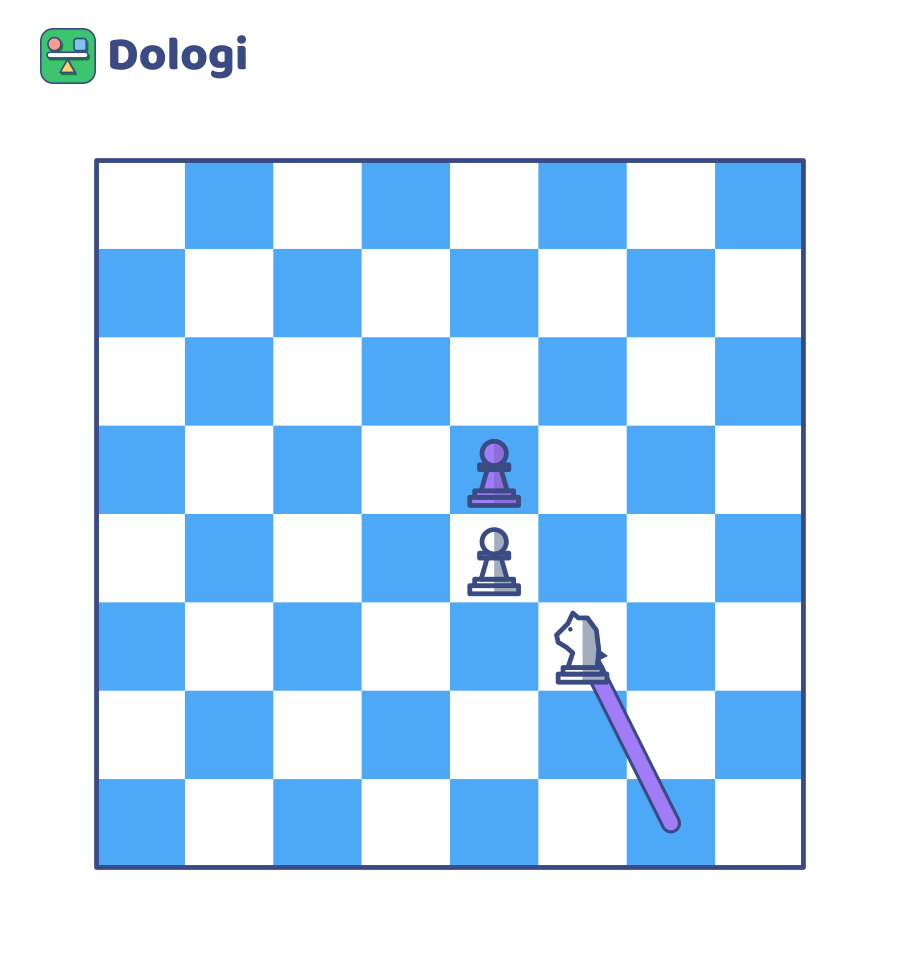
This is the position after 1. e4 e5 2. Nf3. The 1 and the 2 are move numbers; each covers one move by White and one by Black. The picture has no letters or numbers, so your child can count columns and rows to find f3.
Games for practicing notation
- Name that square: you say "c6," your child touches it. Then switch roles.
- Read it, play it: read a short game aloud while your child moves the pieces. The shortest possible game is a fun start: 1. f3 e5 2. g4 Qh4#. Played correctly, White is checkmated after just two moves.
- Hidden piece hunt: one person secretly places a piece, the other asks "Is anything on d4?", like the pencil-and-paper ship game on grid paper. Fewest questions wins.
- Knight's directions: you pick a start and an end square; your child writes the knight's hops in notation, then tries them on the board.
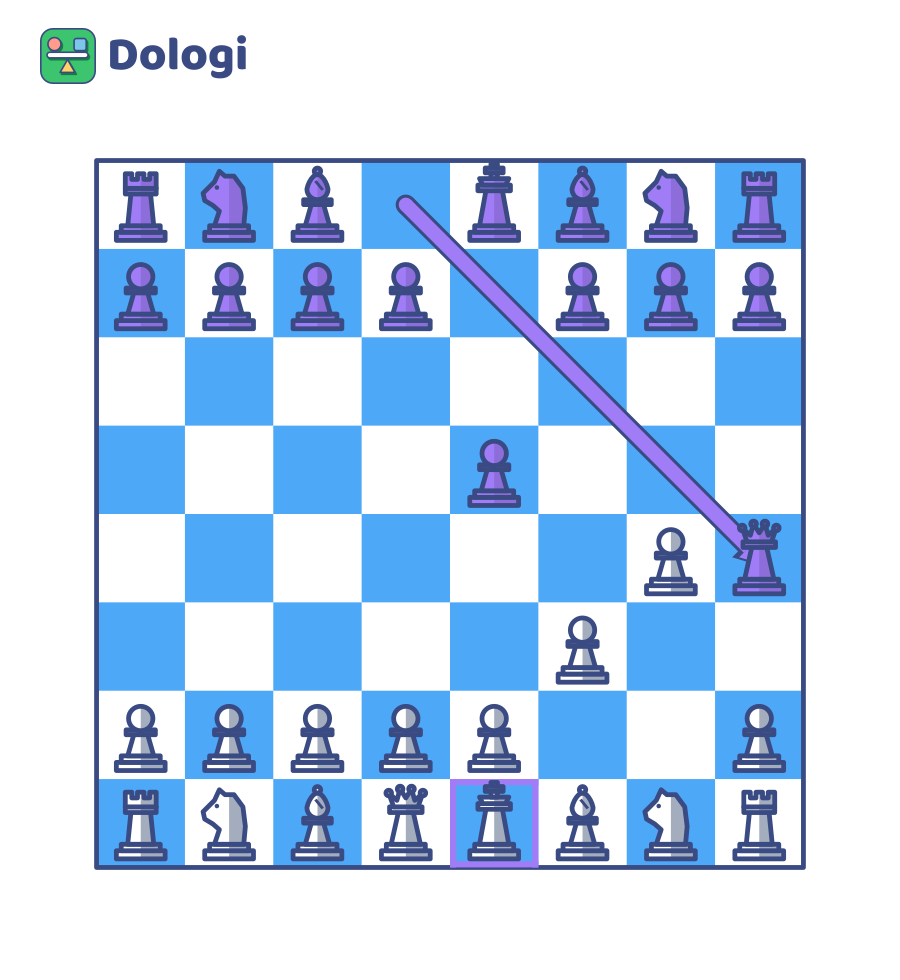
After playing that short game, your child compares their board with this picture. If it matches, they read all four moves correctly.
Recording a short game
Next, your child records a game on a three-column sheet: move number, White's move, Black's move. After each move, the player who just moved writes it down before the other one goes. Start with 10 to 15 moves. Cross out mistakes and rewrite; readable is enough. Put the date and the players' names at the top.
A small notebook for games becomes your child's "chess journal"; flipping back, they'll see how their play has changed.
What notation is good for
- Reviewing games: a recorded game can be replayed move by move to find where it turned. Here's how to review without criticism.
- Playing with faraway family: Grandpa in another state texts "Nf3," your child plays it at home and texts back a move. One game can last all week.
- Reading books and puzzles: chess books, newspaper puzzles and their solutions all use notation, so your child can keep learning on their own.
- Picturing moves: reading "Nf3" and seeing where the knight lands is real spatial thinking practice, like reading a map.
In the Chess room in Dologi's Creative corner, the game's settings ring has a Show a–h and 1–8 on the board switch to see column and row names while playing, and a Write moves in chess letters switch, which shows the review move list in notation (Nf3, exd5) instead of piece pictures and squares. Games are saved in Your chess games; open Watch the game again to step through the moves and compare them with your child's own sheet.
In short
- A square's name is its column letter (a–h) plus its row number (1–8); a1 is the bottom-left corner on White's side.
- A move is the piece's letter plus its new square; pawns get no letter; x is a capture, + check, # checkmate, O-O castling.
- Practice with games, then record short games on a three-column sheet.
- With notation, your child can review games, play with family far away and read chess books and puzzles alone.
Read more: Reviewing a chess game with your child: learning from mistakes without criticism, Knights jump in an L, bishops slide diagonally: how chess builds spatial thinking in kids, Castling, en passant and pawn promotion: the three special chess rules that confuse kids