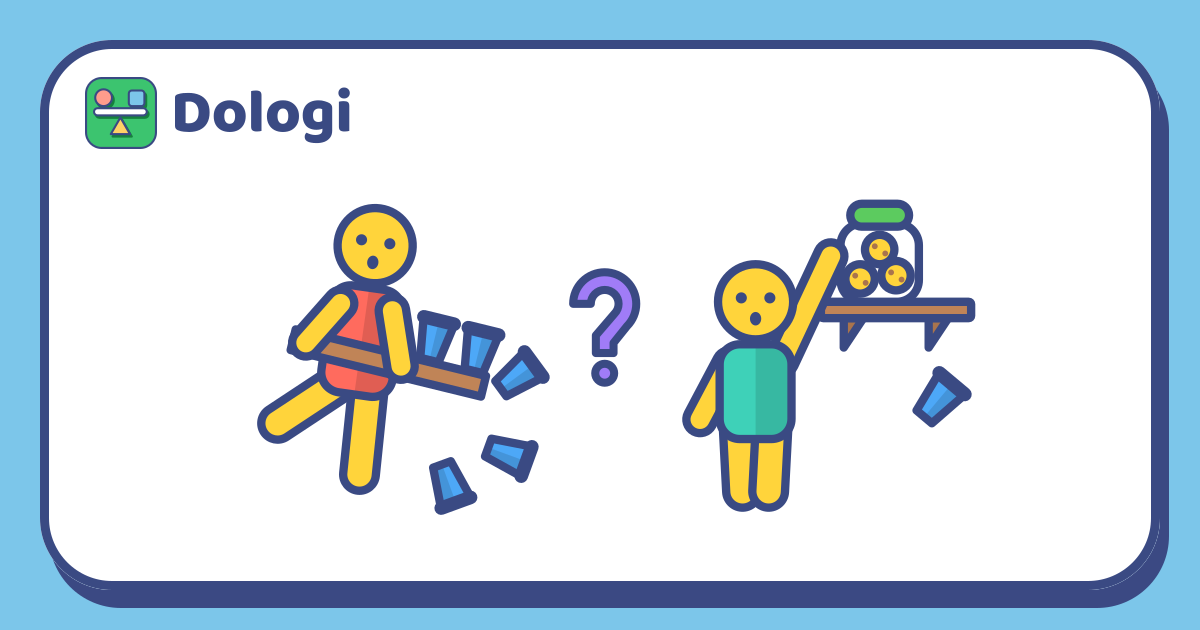
Here is a little story to try at dinner. One child is helping to set the table, trips over a toy and drops a whole tray of plastic cups. Another child climbs up to take cookies they were told not to touch and knocks one cup off the shelf. Then ask: "Which child did something more wrong? Why?"
Children's answers are often surprising, and they tell you a lot about how your child is thinking. This article explains why this kind of question is worth asking, gives you a set of story pairs to use at home, and suggests questions that help your child think about intentions and consequences without turning the talk into a test. It suits children aged roughly 5 to 10.
Why "who did worse?" is a good question
Two things can be weighed when something goes wrong: the consequence (what happened, how big the mess is) and the intention (what the person was trying to do). Adults usually weigh both. Young children often look mostly at what they can see. Many children around 5 to 7 will say the child with the whole tray did worse, "because more cups fell". Somewhere around 7 to 10, many start to say "but the first one didn't mean to". These ages are only a rough guide: every child gets there at their own pace, and the same child can answer differently depending on the story.
Neither answer is "wrong" for their age. The point is not to reach the adult answer quickly but to practice looking beyond the mess to the reasons behind it. That skill helps with friendships, sibling quarrels and, later, with judging fairly when something goes wrong at school.
Story pairs to tell at home
Keep each story to two or three sentences, and change as little as possible between the two halves of a pair: one child has a good or innocent aim and causes a lot of damage, the other breaks a small rule and causes a little.
| By accident, big consequence | On purpose or against a rule, small consequence |
|---|---|
| A child carries a tray of cups to help, trips and every cup falls | A child climbs to the cookie jar they were told to leave alone and one cup falls |
| A child plays catch in the garden as agreed, and the ball knocks over a whole block tower | A child gives a friend's tower a push to annoy them, and one block falls |
| A child carries a pot plant to water it, and soil spills across the floor | A child flicks a drop of paint on a sibling's drawing to tease them |
Tell the pair, then ask the two questions: "Who did something more wrong?" and "Why do you think so?" Wait for the answer. The "why" is more interesting than the choice.
Questions that help, without grading
Whatever your child answers, avoid "Right!" or "No, that's wrong." Instead, keep the thinking going:
- "What was each child trying to do?" This brings the intention into view without telling your child how to weigh it.
- "Did they know something could go wrong?" This opens the middle ground: running with a full tray is not a plan to break cups, but it is a bit careless.
- "How do you think the owner of the cups felt?" Feelings link both sides: the mess matters to someone, whatever the reason.
- "What could each child do now?" Help clean up, say sorry, tell an adult, be more careful next time.
Then flip the story. Keep the intention the same and change the damage: "Now the child sneaking cookies knocks over the whole tray. Does that change anything?" Or keep the damage the same and change the intention: "Two children each break one cup. One was helping, one was sneaking cookies. Is that different?" Changing one thing at a time lets your child notice which part really changes their answer.
If your child still says the bigger mess is worse, that's fine. Say something like "I see, you're thinking about how many cups broke", and come back to the topic another day with a new pair.
Both matter: intentions and consequences
There is a trap on the other side too. "I didn't mean to" is important, but it is not a magic phrase that makes the mess disappear. A useful family idea is: meaning well makes it less wrong, but we still help put it right. A child who spills the cups by accident is not "naughty", and they can still help pick them up.
It also helps to talk about care. "I didn't mean to" and "I didn't think" are close but not the same. Thinking ahead (two hands on the tray, walk slowly, move the toy first) is something your child can practice, and it is a positive thing to praise.
Bringing it into everyday life
- When a real accident happens, stay calm first. Ask "What happened?" and "What were you trying to do?" before deciding anything. Then move on to fixing it together.
- With siblings and friends, when one child is upset, ask "Do you think they meant to?" It doesn't excuse everything, but it often softens the moment.
- With stories and cartoons, pause when a character causes trouble and ask what they wanted to do.
- Show it yourself. When you knock something over, say it out loud: "I didn't mean to, but I made a mess, so I'll clean it up."
In Dologi, a wrong answer is never marked with red crosses: your child is simply invited to look again and try once more. That is the same spirit as these talks: a mishap is something to understand and put right, not something to be told off for.
In short
- Telling two short stories and asking "who did worse, and why?" helps your child think about intentions, not only the size of the mess.
- Younger children often focus on the damage, and with time many start to weigh intentions too; the ages are only approximate.
- Don't grade the answer: ask what each child was trying to do, how others felt and what could be done now, then flip the story.
- Meaning well makes it less wrong, but we still help put things right.
Read more: Is sharing equally the same as sharing fairly?, Teaching children to recognize feelings, Asking "Why do you think that?" even when your child is right