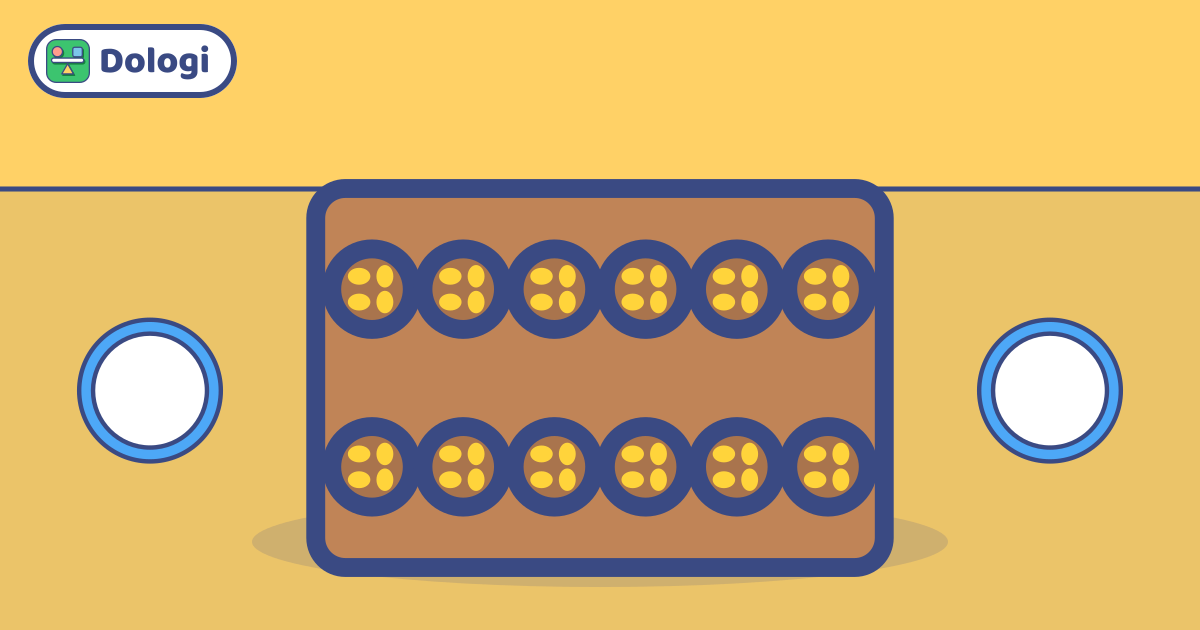
"Four pebbles… one, two, three, four. The last one lands in my store, so I go again!"
Mancala isn't one game but the name of a big family of "sowing" games: you scoop up the pebbles from one hole and drop them one by one into the holes that follow. The name comes from an Arabic word linked to moving. Many countries have their own versions with their own boards and rules, such as oware (also called awalé) in West Africa, bao in East Africa, congklak in Indonesia and ô ăn quan in Vietnam. Some boards are carved from wood, others are drawn on the ground. All you need at home is an egg carton and a handful of beans, and every turn is counting practice.
Making a board at home
- Board: a twelve-cup egg carton gives you two rows of six cups. Put a small bowl at each end as a "store". You can also draw two rows of six circles on paper, with a bigger oval at each end.
- Pieces: 48 small things, four in each cup. Dried beans, pebbles, buttons or shells all work. If babies or toddlers are around, use pieces big enough not to be swallowed, and keep them out of reach afterwards.
- Sides: the players sit facing each other across the long sides. Each player owns the six cups nearest to them and the store on their right.
A simple start for younger children
For children around four to six, start with sowing and counting only:
- Pick up all the pieces from one of your cups.
- Going counter-clockwise (to your right), drop one piece into each cup in turn, including your own store.
- Then the other player has a turn.
Don't worry about capturing yet. Let your child count out loud, one piece per cup, and before each move ask: "You have three beans. Where will the last one land?" Your child can point first, then sow and check. That small guess is the heart of the game.
One easy set of rules
Rules differ from country to country, and families often have their own. This is a common, simple two-row version:
- Sowing: on your turn, pick up all the pieces from one of your own six cups and sow them counter-clockwise, one per cup. Drop one into your own store as you pass it, but skip the other player's store.
- Extra turn: if your last piece lands in your own store, you go again.
- Capture: if your last piece lands in an empty cup on your own side, and the cup directly opposite has pieces in it, you take that last piece and everything in the opposite cup, and put them all in your store.
- Otherwise your turn simply ends.
- End of the game: when all six cups on one side are empty, the game stops. The other player moves whatever is left on their side into their own store. Count the stores; whoever has more wins.
Play the first few games with the board between you and say each step out loud: "Last bean in an empty cup on my side. What's opposite?"
Counting ahead and thinking ahead
The skill that wins mancala is counting before you move. A child with six cups has up to six possible moves, and checking them one by one is a big step in planning. There is also a neat number pattern to discover: a cup that is three steps from your store needs exactly three pieces to land in it and earn an extra turn. Let your child find that out by playing, then ask about it.
Questions that help:
- "Which cup would give you another turn?"
- "Is there a move that lands in an empty cup on your side? What would you capture?"
- "Who has more in their store now? How many more?"
Older children start noticing the other side of the board. A cup full of beans opposite one of the other player's empty cups is an easy capture for them, so sometimes the best move is the one that spreads that pile out.
| Rough age | What to try |
|---|---|
| 4–5 | Sowing only; counting one piece per cup; guessing where the last piece lands |
| 6–7 | Extra turns and captures with an adult's help; counting the stores at the end |
| 8–9 | The full rules; checking every cup before moving; spotting extra-turn cups |
| 10 and up | Protecting big piles; starting with three or five pieces per cup; trying another country's rules and comparing |
Ages are only a rough guide, and every child is different.
In Dologi, the Math topic has puzzles such as "Add along the lines", where children place numbers so that each line adds up to a given total. As with choosing a cup in mancala, children try a move, count, and change their mind if it doesn't work.
In short
- Mancala is a family of sowing games found in many countries; an egg carton and 48 beans make a board at home.
- Start with sowing and counting, and ask "where will the last piece land?"
- The easy rules add an extra turn in your store and a capture from an empty cup on your side.
- The real skill is counting ahead: checking each cup before moving.
Read more: The last stick game: a simple strategy game that teaches children to work backwards