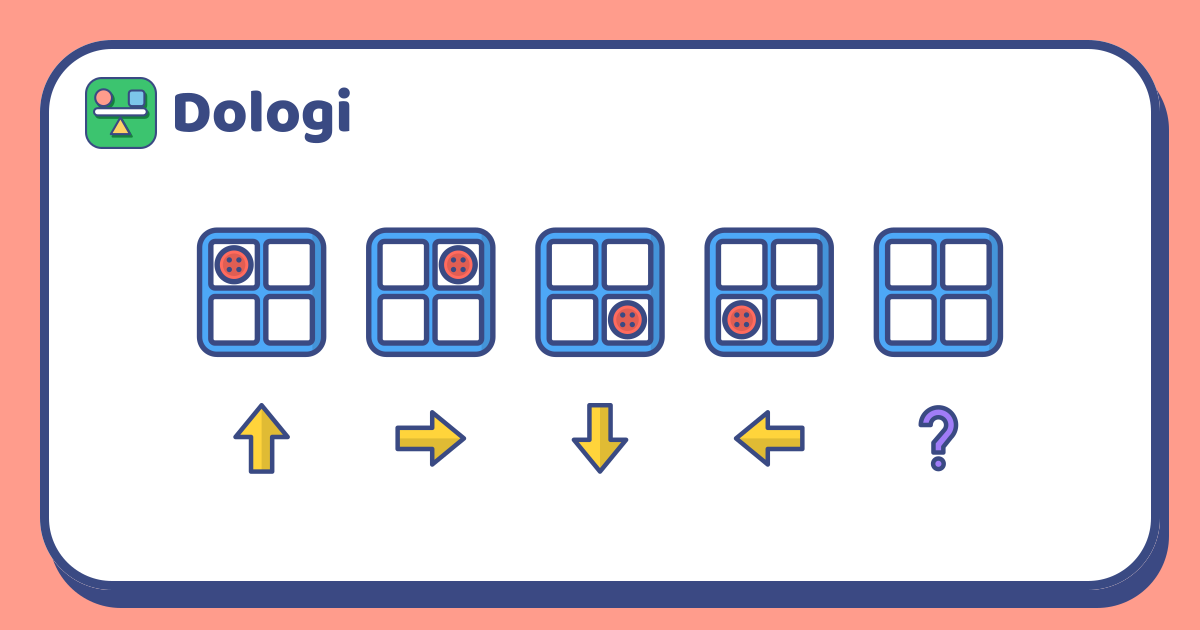
Most pattern games for children are about things that repeat: red, blue, red, blue. Motion patterns work differently. Nothing new appears. The same object simply moves or turns by the same amount at every step: a dot hops from square to square around a grid, an arrow turns a little further each time, a clock hand moves on by one hour. To find the next picture, your child has to notice what changed between two pictures and imagine that change happening once more.
On paper, this kind of puzzle can feel surprisingly hard, because the movement is only implied. At home it is easy to practice with a button, a sheet of paper and an arrow cut from card. This article shows how to start with real objects, then move on to drawings where two things move at the same time.
What makes a motion pattern
In a motion pattern, each picture is the one before it plus one move. Two questions solve almost every puzzle of this kind:
- What moves? A dot, an arrow, a clock hand, a small shape inside a frame.
- How does it move each step? Which way (clockwise, the way clock hands go, or the other way) and how far (one square, two squares, a quarter turn, half a turn).
Once your child can say "the dot moves one square clockwise every time", the next picture follows on its own. A common slip is comparing the first and last pictures, which hides the size of each step. Encourage your child to look at two neighboring pictures, say the move out loud, then check that the same move works between the next two.
Start with a button on four squares
All you need is a sheet of paper and something small to move: a button, a coin or a bottle cap.
- Draw a large square divided into four. Put the button in the top-left square.
- Make a few moves. Move it to the top right, then the bottom right. Each time, pause and ask your child to point to where it will go next, before you move it.
- Let your child check. They move the button themselves to see if they were right. If not, go back one step and watch the move again.
- Change the rule. Go the other way round, or jump two squares at a time so the button hops across the diagonal. Ask your child to describe the new rule in their own words.
- Swap roles. Your child invents a rule and moves the button; you guess. Now and then, guess wrong on purpose and let them explain your mistake.
Then put it on paper: your child draws a row of four-square frames, marks the button in each one and leaves the last frame empty. Switching between real moves and drawings is the most useful step, because it shows that each frame is a snapshot of one move.
An arrow that turns
Cut an arrow from card and put it on the table, pointing up. At each step, turn it a quarter turn clockwise, the way the hand of a clock moves from the top to the right side. Say the directions together: up, right, down, left. Then ask, "What comes next?"
After four quarter turns the arrow is back where it started, and many children enjoy discovering that for themselves. When quarter turns are easy, try:
- Half turns: up, down, up, down.
- Turning the other way: up, left, down, right.
- Smaller turns for older children: an eighth of a turn, so the arrow also points to the corners.
Some children find it easier to stand up and turn their own body along with the arrow. Feeling the turn helps them keep track of the direction.
Two things moving at once
When each movement feels easy, combine them. Draw a row of frames where the button walks around the four squares clockwise while an arrow under each frame turns a quarter turn. The row looks busier, so follow one thing at a time, as with any two-rule pattern:
- Cover the arrows with a hand and predict where the button goes.
- Cover the squares and predict which way the arrow points.
- Put both answers together for the next frame.
Then add a twist: give the two things different rhythms. The button moves one square each step, but the arrow only flips between up and down. Ask your child when both will be back at the start together. Older children can also jump ahead: "Where will the button be after ten moves?" One lap takes four moves, so after eight moves it is back at the start, and two more moves bring it to the bottom right. Another good challenge is the broken row: one of you draws a row with one wrong frame, and the other finds it and says which rule it breaks.
Ideas by age
Ages are a rough guide; every child moves at their own pace.
| Age (rough guide) | Ideas to try |
|---|---|
| 6–7 | A button moving around four squares, one direction; a paper arrow turning a quarter turn each step; saying the move out loud |
| 8–9 | Drawing rows of frames; going the other way; jumping two squares; two things moving with the same rhythm |
| 10–11 | Two things with different rhythms; jumping ahead to the tenth step; finding the broken frame; inventing rows for you to solve |
In Dologi, the Patterns topic includes a puzzle type called "Going around": a row of arrows or clocks that turn the same way by the same amount at every step, and your child picks what comes next. At higher levels the turns get bigger, or the missing picture sits in the middle of the row. The hint gives the same advice as this article: watch what turns, which way and by how much.
In short
- In a motion pattern, the same object moves or turns the same way by the same amount at every step. Ask: what moves, which way, and how far?
- Start with real objects, like a button going around four squares and a paper arrow that turns, and let your child check by moving them.
- Move on to drawn rows of frames, then add a second moving thing and follow one thing at a time.
- Stretch older children by jumping ahead, finding broken frames and having them make puzzles for you.
Read more: Two rules at once: patterns that change color and shape for older kids, Turning shapes in your head: building children's spatial thinking