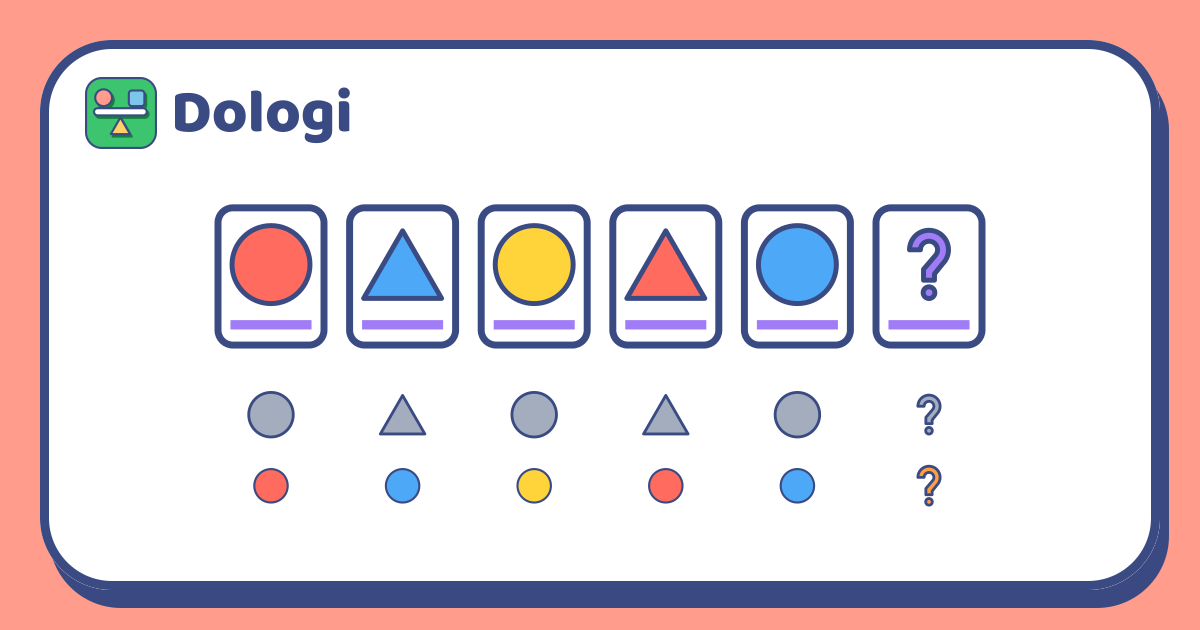
Most children meet patterns early: red, blue, red, blue, or clap, stamp, clap, stamp. Around the age of seven, many find those easy and start to enjoy a harder kind of sequence, where two things change at the same time. A row of cards might switch between circles and triangles while the color moves through red, blue and yellow. Each change on its own is simple. Together, they can look like a jumble.
This article shows a way of thinking that works for any two-rule pattern: look at one feature at a time, say its rule out loud, then put the rules back together. You will also find a game where your child builds the puzzles and you have to solve them.
Why two rules feel so much harder
Try this row of cards: red circle, blue triangle, yellow circle, red triangle, blue circle. What comes next?
If your child looks at whole cards, nothing seems to repeat. No two neighboring cards match, and the first card does not come back for a while. That is the trap. The pattern is there, but it is hidden because the two features repeat on different beats:
- The shape repeats every two cards: circle, triangle, circle, triangle.
- The color repeats every three cards: red, blue, yellow, red, blue, yellow.
Because the beats do not line up, the same card (red circle) only comes back at the seventh place. A child who searches for a repeating block of whole cards waits a long time; a child who checks one feature at a time spots both rules within a few cards.
Look at one feature at a time
Teach this as a short routine. With practice it becomes a habit your child uses without being reminded.
- Name the features. Ask: "What is changing from card to card?" Here, the color and the shape. In other patterns it might be size, number of dots or direction.
- Read only one feature. Cover the shapes with a finger, or simply ask your child to read the row saying only colors: "red, blue, yellow, red, blue…". Then read it again saying only shapes: "circle, triangle, circle, triangle, circle…".
- Say each rule in a sentence. "The colors go red, blue, yellow, then start again." "The shapes take turns: circle, triangle."
- Predict each feature separately. After blue comes yellow. After circle comes triangle.
- Put the answer together. The next card is a yellow triangle.
Writing the two rows out can help a lot at first. Your child draws one line of colored dots (color only) and one line of plain gray shapes (shape only) underneath the real cards. Seeing the features pulled apart makes each rule easy to read.
| Card | 1 | 2 | 3 | 4 | 5 | next |
|---|---|---|---|---|---|---|
| Color only | red | blue | yellow | red | blue | yellow |
| Shape only | circle | triangle | circle | triangle | circle | triangle |
Putting the rules back together
Once your child can find the next card, stretch the thinking a little further.
- Jump ahead. "What will the tenth card be?" Your child can keep counting along each row, or notice shortcuts: shapes on even places are always triangles; colors restart at places 1, 4, 7, 10. So the tenth card is a red triangle.
- Find where it all repeats. Ask: "When does a red circle come back?" Children aged 10 to 12 can discover that a two-beat rule and a three-beat rule line up again after six cards. That is a gentle first meeting with the idea of a common multiple.
- Spot a broken card. Lay out a two-rule row with one mistake, such as a blue card where a yellow one belongs. Your child finds the wrong card and says which rule it breaks: the color rule, the shape rule, or both.
If your child gets stuck, go back to one feature. Asking "What do the colors do?" usually helps more than giving the answer.
Your child makes the puzzle
Making a pattern for someone else shows real understanding, because your child has to hold both rules in mind at once. All you need is a few colored cards or paper squares and a pencil.
- Your child picks two features: color and shape work well to start.
- They choose a rule for each, with different beats. For example, colors repeat after three steps, shapes after two.
- They draw or lay out five or six cards, then hide the next one face down.
- You try to guess the hidden card and explain your thinking out loud.
Now and then, make an honest mistake, such as following only the shape rule. Your child explains which rule you missed, and explaining is a good way to check their own understanding. Later, they can try other features: size, number of dots or arrow direction.
Ideas by age
Ages are a rough guide; every child moves at their own pace.
| Age (rough guide) | Ideas to try |
|---|---|
| 7–8 | Color and shape with short beats (two and three); read one feature at a time out loud; draw the color row and shape row |
| 9–10 | Predict the tenth or twelfth card; find a broken card; make two-rule puzzles with color cards |
| 11–12 | Three features at once; find when the whole card repeats; rules that grow, such as dots going up by one while the color repeats |
In Dologi, the Patterns topic has a puzzle type called "Two rules at once": a row of ladybugs, flowers or dice where two things change, for example the color repeats while the number of spots goes up. The hint gives the same advice as this article: look at one thing at a time.
In short
- In a two-rule pattern, each feature follows its own rule, often on a different beat, so whole cards seem not to repeat.
- Teach a routine: name the features, read one feature at a time, say each rule, then combine the answers.
- Stretch older children by jumping ahead, finding when the whole pattern repeats and spotting broken cards.
- Let your child build two-rule puzzles for you: explaining your mistakes deepens their own understanding.
Read more: Sorting by two features at once: color and shape, Growing patterns: add two, double up, and guess what comes next