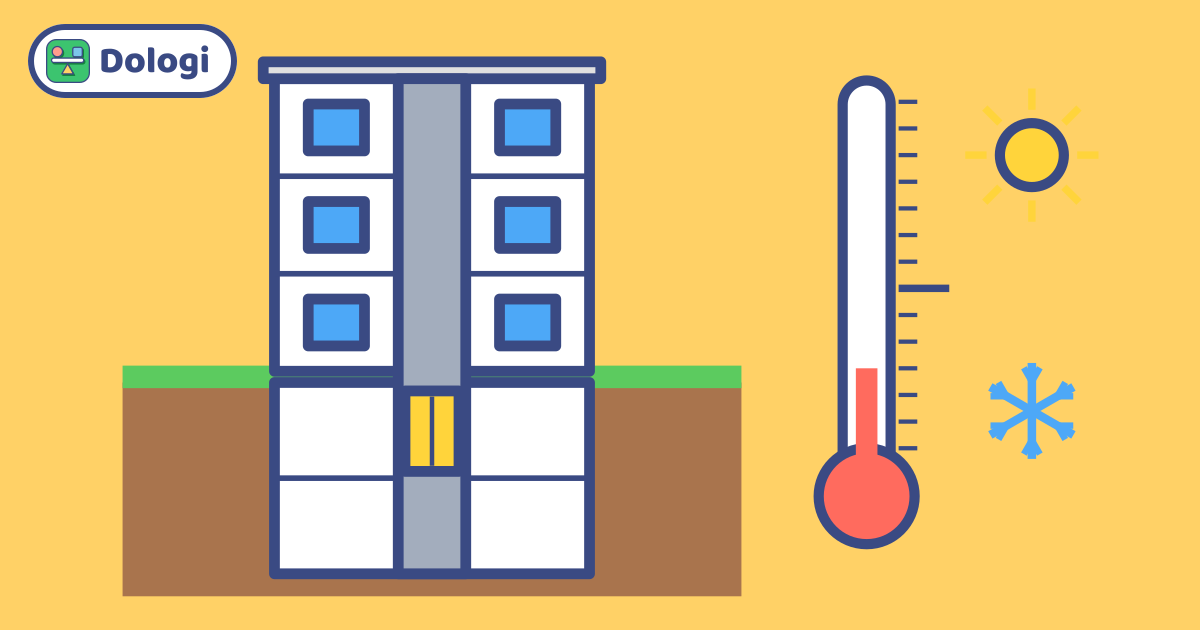
"What's 3 take away 5?" Many children say "you can't" or "2". In second or third grade, "you can't" fits everything they have learned so far. But your child met numbers below zero long ago: on the freezer, in the elevator going down to the parking garage, and when they borrowed candy from a sibling. Negative numbers usually arrive in school around sixth grade, but you can introduce them much earlier with things your child sees every day. This post is for parents of 8–11 year olds.
An elevator is a number line standing up
Next time you ride an elevator in a mall or a parking garage, point at the buttons: 1, 2, 3 above, and B1, B2 below. "B" means basement, under the ground.
Draw a number line that stands up like an elevator shaft:
- Ground level is 0.
- Up 1 floor is +1, up 2 floors is +2.
- Down 1 basement level is −1, down 2 levels is −2.
One fun detail: American elevators have no "0" button. The street floor is called 1 (or L for lobby), and the next one down is B1 or LL. In much of Europe the street floor is called the ground floor and the buttons really say "0", "−1", "−2".
Ask your child: "Two levels down from the ground, which level is that?" (B2, which is −2.) "From B2, how many floors up to the street?" (2 floors.)
The thermometer: colder than zero
Water freezes at 0 °C on the Celsius scale used in science class and most of the world. When it gets colder still, the thermometer shows negative numbers:
- A home freezer is usually set to about −18 °C, which is about 0 °F.
- A winter morning in Minnesota or Canada can easily be −20 °C.
- Weather reports from cold places say "minus five", meaning −5 °C.
A thermometer is another number line standing up. A few questions your child can answer by counting the marks:
- This morning it was −3 °C and it warmed up 5 degrees by noon. What is the noon temperature? −3 + 5 = 2 °C.
- In the afternoon it was 2 °C and it dropped 6 degrees overnight. How cold is the night? 2 − 6 = −4 °C.
- From −4 °C up to 3 °C, how many degrees warmer is that? Count the marks: 4 degrees to reach 0, then 3 more, 7 degrees in all.
- The room is 25 °C and the freezer is −18 °C. The difference is 25 + 18 = 43 degrees.
Owing candy: having less than nothing
A negative number can also be a debt. Maya borrows 3 candies from her brother to share with a friend. Maya is now at "minus 3 candies": she has none, and she still owes 3.
- Grandma gives Maya 5 candies. She pays her brother back 3 and keeps 2: −3 + 5 = 2.
- What if Maya has 2 candies and has to pay back 5? She hands over both and still owes 3: 2 − 5 = −3.
That is also the answer to "3 take away 5": −3, which means 3 short.
Comparing negative numbers: is −5 or −2 bigger?
This is where children slip most often. They know 5 is bigger than 2, so they think −5 is bigger than −2. Go back to the thermometer: −5 °C is colder than −2 °C, and the red column is lower. On a standing number line, the number lower down is the smaller one.
| Compare | Children often think | Correct | Where to look |
|---|---|---|---|
| −5 and −2 | −5 is bigger | −2 is bigger | −5 °C is colder than −2 °C |
| −1 and −10 | −10 is bigger | −1 is bigger | B1 is higher than the tenth basement level |
| 0 and −3 | the same, both are "nothing" | 0 is bigger | no candy beats owing 3 |
| −4 and 1 | −4 is bigger | 1 is bigger | every negative number is less than every positive one |
A small tip: the more you owe, the poorer you are. Owing 5 candies is worse than owing 2, so −5 is less than −2.
Games to play at home
- Paper elevator: tape a strip of paper up the wall and mark it from −5 to 5, with 0 as the ground. Your child moves a clothespin "elevator" while you call out "up 3", "down 4", and they read the floor.
- Weather reporter: your child reads the temperature of a cold city on a weather map and says how many degrees warmer or colder it is than yesterday.
- Candy ledger: write down the candy borrowed and paid back during the day with + and −, and add it up at bedtime to see who still owes whom.
The Math topic in Dologi has a puzzle called Number line hops: "From the dot, the rabbit hops along the arrows. Which number does it stop on?" In the app the number line starts at 0; once your child is comfortable hopping forward and back, just stretch the line past zero and they are into negative numbers.
In short
- Elevators and thermometers are number lines standing up: the ground and 0 °C are zero, and below that are the negative numbers.
- Owing candy explains 2 − 5 = −3: you pay everything and are still short.
- Comparing: on a standing number line, lower means smaller; −5 °C is colder than −2 °C.
- A paper elevator, a weather report and a candy ledger help your child get used to them.
Read more: When "more than" means subtract, Decimals for kids aged 9–11: start with a ruler and money