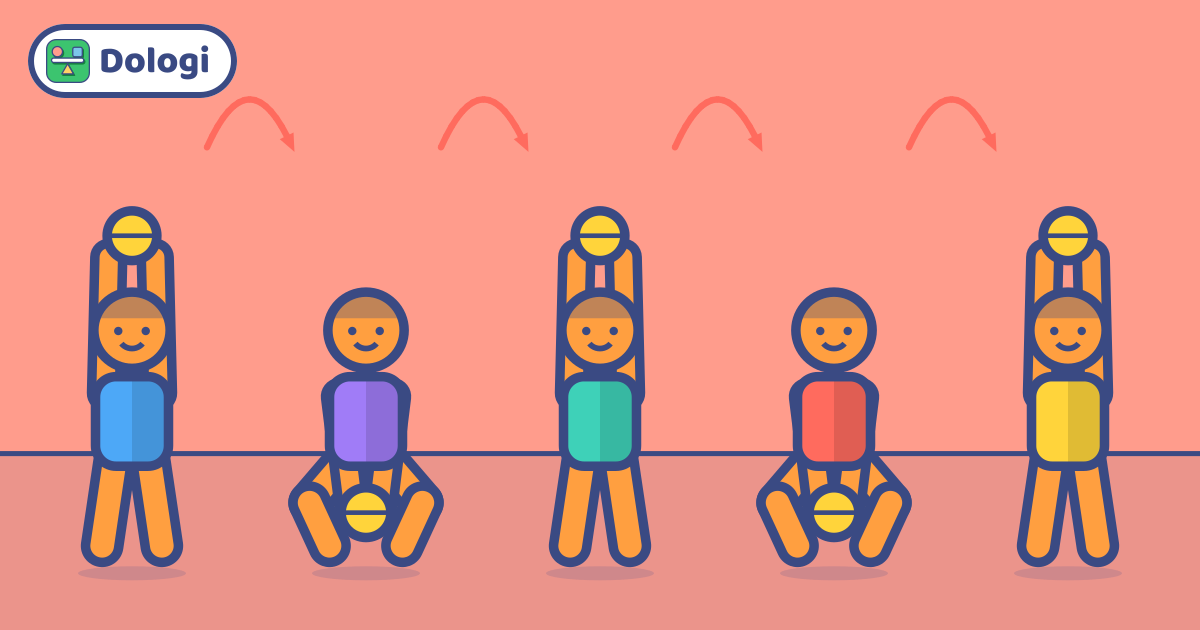
A line of kids, one behind the other, and a ball traveling from the front to the back. The first child passes it over their head, the second passes it under their legs, the third goes over again... When their turn comes, each child has to work it out: over or under this time?
It's the over-under relay lots of kids already know, with one small rule that turns it into pattern practice: the ball has to follow a repeating sequence. It suits groups of 4 to 12 kids aged about 4 to 10, in a schoolyard, a park or a big living room.
Getting ready
- One soft ball: a light plastic ball, a foam ball, a small cushion or a rolled-up pair of socks.
- Stand in a single line, everyone facing the same way, about an arm's length apart.
- Two ways to pass: over, lifting the ball with both hands over your head to the child behind; under, bending down and passing the ball between your legs to the child behind.
How to play
- Pick one child as the rule maker. They think of a pattern, for example "over, over, under," and whisper it to the first three kids in line.
- Those three pass the ball following the rule. The whole line watches carefully.
- From the fourth child on, nobody may say the rule. Each child has to figure out how to pass to keep the sequence going.
- When the ball reaches the back, the last child runs to the front with it and keeps passing, and the sequence carries on. With a small group, send the ball around two or three times.
- At the end, the rule maker reveals the rule. The whole line reads the sequence out loud to check.
- Choose a new rule maker and a new rule.
For the fourth child, the line has already done "over, over, under." They reason: the "over, over, under" group just finished, so it starts again, which means over. That's pattern reasoning, done with the whole body.
Pattern levels
| Pattern | Said out loud | Good for |
|---|---|---|
| AB | over, under, over, under | ages 4–5 |
| AAB | over, over, under | ages 5–6 |
| ABB | over, under, under | ages 5–6 |
| AABB | over, over, under, under | ages 6–8 |
| ABC | over, under, side (twist and pass the ball around your side) | ages 7–9 |
| Growing | over, under; over, over, under; over, over, over, under... | ages 9–10 |
For longer rules, let more kids start: with AABB, the first four need to know the rule, because the others have to see one full repeating group before they can work out what comes next.
Four-year-olds find it easier if the whole line chants along with every pass: "Over! Under! Over! Under!" Once they've got it, drop the chanting and just watch.
When someone gets it wrong
- Nobody is out. The line stops, reads the sequence aloud from the start, "over, over, under, over...," and asks: "What's the repeating group? Where does it start again?"
- Let them pass again the right way, then keep going.
- Change places: kids who tend to get stuck can stand near the back, so they see more passes before their turn.
- Praise the reasoning: "You counted back from the start and found it. Nice thinking!"
Two-team race
With a big group, split into two teams standing in parallel lines, both using the same rule given by a grown-up. The team that passes correctly all the way to the back first wins. A wrong pass has to be redone, so rushing still makes you slower. Kids learn that being fast but wrong doesn't win.
Seated indoor version
On a rainy day or in a small space, sit in a circle and pass the ball to the side following a sequence of moves: pass it in front, pass it behind your back, lift it over your head. The patterns are the same: AB, AAB, ABC... You can add sounds too, clapping once or twice with each pass to match the sequence.
What kids learn about patterns
- The repeating group: "over, over, under" is one group, and then it repeats. Spotting that group is the key to every pattern puzzle.
- Predicting: to know what to do on your turn, you have to look at what already happened and predict what comes next.
- One pattern, many ways to write it: after the game, draw the sequence on paper with circles and triangles, or with the letters A and B. "Over, over, under" and "red, red, blue" are the same AAB pattern. Kids aged 8 to 10 love this discovery.
- Paying attention while waiting: every child has to follow the whole line, not just their own turn.
Thinking activities for 4-year-olds has more first patterns for little ones.
The Patterns topic in Dologi has a puzzle called Repeating patterns: "A group of pictures repeats. What comes next?" Its hint matches the way the line reads out the passes: say the pictures out loud in order and find where the group starts again.
In short
- Stand in a line and pass a soft ball over the head or under the legs in a repeating sequence.
- The first few kids know the rule; everyone after watches the sequence and works out their own turn.
- Start with AB, then AAB, AABB, ABC and growing patterns; chanting together helps little ones.
- If someone slips, read the sequence from the start to find the repeating group; afterward, draw it on paper with shapes or the letters A and B.
Read more: Thinking activities for 4-year-olds, Add one move