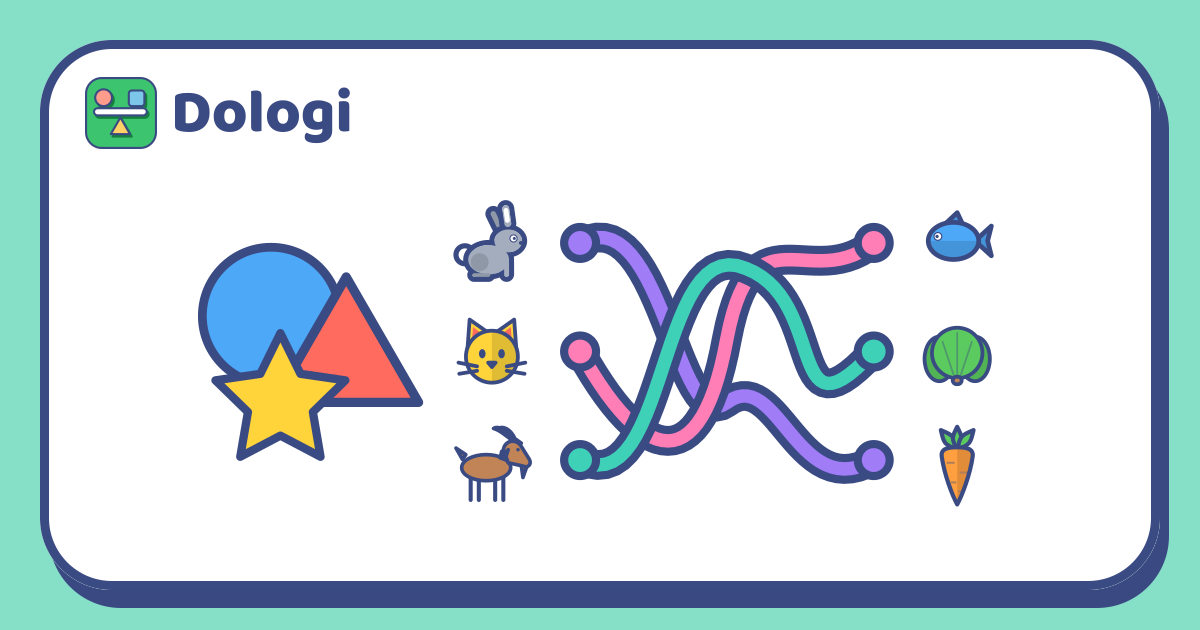
Look at a drawing where a few shapes sit on top of each other, or at the bundle of cables behind the television. To say how many shapes there are, or which plug belongs to which lamp, your eyes have to stay on one outline from start to finish, without jumping to the line that crosses it.
Children practice this all the time without noticing, and you can make it into two quick paper games: a pile of overlapping shapes to color in, and tangled lines that join animals to their food. This article shows how to draw both in a few minutes, how to play, and how to make them harder for children aged roughly 5 to 10.
Why overlapping pictures are tricky
When shapes overlap, their edges cross and cut the picture into many small pieces. A child who looks quickly may count the pieces instead of the shapes, or miss a shape that is half hidden. Tangled lines work the same way: at every crossing there are two ways to go, and the eye easily slips onto the wrong line.
Both games ask your child to do one thing: pick one line and follow it all the way, while other lines pass across it. It is a useful habit when reading a busy picture, a simple map or a chart, and later a long sum where the eyes must not skip to the next row.
Game 1: color each shape in the pile
You need paper, a dark pen and three or four crayons.
- Draw three or four simple shapes on top of each other: a circle, a triangle, a square, a star. Use a dark pen and let each shape overlap at least one other.
- Ask first: "How many shapes are there?" Let your child guess without touching.
- Trace one shape with a finger, all the way round, until the finger is back where it started.
- Go over that outline with one crayon. Then pick a new crayon for the next shape.
- Count the colors. Each color is one shape. Compare with the first guess.
The small pieces where shapes cross are not shapes of their own. If your child counts seven when there are four, coloring usually shows why.
| Age (rough guide) | Shapes | How they overlap |
|---|---|---|
| 5–6 | 3 | Large shapes, a little overlap |
| 7–8 | 4–5 | More overlap, the same shape twice in different sizes |
| 9–10 | 5–6 | Look-alikes such as a square and a rectangle, a small shape fully inside a big one |
Game 2: tangled lines from animals to their food
- Draw three animals down the left side of the page: simple faces are enough, such as a rabbit, a cat and a goat.
- Draw three foods down the right side, in a different order: a fish, a cabbage, a carrot.
- Join each animal to its food with a wavy line. Make the lines cross each other two or three times, at clear angles, and never let two lines just touch without crossing.
- Your child puts a finger on the rabbit and slides it along the line without lifting it. At each crossing the finger goes straight on. Whatever is at the end is the rabbit's food.
- Next round, eyes only. Your child keeps their hands in their lap, follows the line with their eyes and says the answer, then checks with a finger.
For younger children, draw each line in its own color. For older children, use one color for every line, so the only way to tell them apart is to follow them.
Making it harder
Change one thing at a time:
- More lines: four or five animals, more crossings, lines that run close together for a while.
- Lines that go under: leave a small gap in a line where it passes under another, like a real string. The line carries on at the other side of the gap.
- New questions for the pile: which shape is at the bottom? Which shape is not in the pile at all?
- Swap roles: your child draws a pile or a tangle for you. To make a fair puzzle, they have to check that every animal reaches exactly one food, which is good practice in itself.
- Real life: tangled skipping ropes, branches crossing in a tree, leaves lying on top of each other on the ground. "Which leaf is on top?" is the same game outdoors.
Keep it light
- Two or three puzzles at a time is plenty. Stop while your child still wants more.
- Praise the method: "you kept your finger on the line at every crossing".
- If the finger jumps to another line, say "let's go back to the last crossing" rather than "wrong".
- How long children can concentrate on detail varies from child to child and changes with age. If your child often seems to strain to see small lines, mention it to their doctor.
In Dologi, the Focus topic has two kinds of puzzle on this idea. In "Shape pile", your child counts the whole shapes in a pile of overlapping outlines, or finds which shape is or is not in it. In "Follow the string", your child follows a string from an animal to find which balloon it is tied to, and where strings cross, the part with a gap goes underneath.
In short
- Overlapping shapes and tangled lines ask the eyes to follow one outline all the way while other lines cross it.
- For a pile of shapes, trace each one with a finger, go over it in its own color, then count the colors.
- For tangled lines, follow each one with a finger, straight on at every crossing, then try with eyes only.
- Make it harder with more lines, one color, gaps where a line goes under, and let your child draw puzzles for you.
Read more: Find-and-cross-out sheets: a homemade selective attention activity for your child, Spot the difference: games that train children's observation skills