"Is it perimeter or area?" Many children can recite both formulas and still pick the wrong one on a word problem. The reason is simple: the two words sound like math vocabulary, not like two different questions. Perimeter asks: how far is it all the way around? Area asks: how much space does it cover? Once your child has walked around an edge and covered a surface with their own hands, the two ideas stop blurring together. Here's how to do that at home with things you already have.
Perimeter: go all the way around
Grab a ball of yarn or a long piece of string. Together, run it along the edge of the kitchen table, all the way around, until it meets the starting point. Pinch the string there, then lay it out straight on the floor and measure it with a tape measure.
That length is the perimeter of the tabletop: the distance around the outside. You can check it by measuring each side and adding:
- A table 6 feet long and 3 feet wide: 6 + 3 + 6 + 3 = 18 feet around.
- In metric, a table 150 cm by 90 cm: 150 + 90 + 150 + 90 = 480 cm.
Other ways to feel perimeter: walk heel to toe around the edge of a rug and count steps, or run a toy car around the border of a placemat. Perimeter is always a length, so it's measured in inches, feet, centimeters or meters.
Area: cover it with squares
Now take a pad of square sticky notes (the common 3-inch ones work well) or cut paper squares that are all the same size. Choose something flat, like a placemat, a cutting board or a large book, and ask your child to cover it completely: no gaps and no overlaps. Then count the squares.
That count is the area: how much surface is inside. An 18-by-12-inch placemat takes 6 sticky notes across and 4 rows down, so its area is 24 squares. Your child may notice they don't need to count one by one: 4 rows of 6 is 4 × 6 = 24. That's exactly why the area of a rectangle is length times width.
Two things are worth saying out loud:
- Area is counted in squares, so the units are square inches, square feet or square centimeters. "24 sticky notes" is an area too, just measured with a homemade square.
- We use squares because they fit together with no gaps. Circles would leave holes, and then the count wouldn't be fair.
Same perimeter, different area
This is the experiment that usually makes it click. Give your child 16 toothpicks (or cotton swabs for younger kids) and some paper squares cut so each side is one toothpick long. Ask them to build rectangles using all 16 toothpicks for the outline, then fill each rectangle with paper squares.
| Rectangle | Perimeter | Area |
|---|---|---|
| 7 × 1 | 16 toothpicks | 7 squares |
| 6 × 2 | 16 toothpicks | 12 squares |
| 5 × 3 | 16 toothpicks | 15 squares |
| 4 × 4 | 16 toothpicks | 16 squares |
The outline never changes, but the inside more than doubles from the long strip to the square. Of all these rectangles, the square holds the most.
Then turn it around: take 12 paper squares and arrange them into different rectangles. A 1 × 12 strip has a perimeter of 26, a 2 × 6 rectangle has 16 and a 3 × 4 rectangle has only 14. Same area, very different perimeters.
No toothpicks? Draw the rectangles on graph paper and count the edges of the boxes instead.
Mix-ups children often make
- Counting edge squares instead of edges. On a 4 × 4 square drawn on graph paper, children often count the 12 boxes along the border and call that the perimeter. But the perimeter is 16 units: each corner box has two sides on the outside. Trace the outline with a finger and count the sides, not the boxes.
- Mixing up the units. Perimeter is in inches or centimeters; area is in square inches or square centimeters. If an answer says "24 inches" for the inside of a placemat, ask: "Is that a length or a number of squares?"
- Thinking a bigger perimeter means a bigger area. The toothpick table shows it doesn't. A long, skinny garden needs more fence but has less room for plants.
- Adding when they should multiply, or the other way round. Ask the question in plain words first: "Am I going around, or covering it?" Going around means adding the sides. Covering means counting squares, which for a rectangle is rows times columns.
What to try at each age
- Ages 5 to 7: no formulas yet. Use the words "all the way around" and "cover it up." Walk around the rug, cover a placemat with sticky notes, compare which book needs more notes.
- Ages 7 to 9: measure sides with a ruler and add them; count squares on graph paper. In the US, area and perimeter usually come up in 3rd grade; in England, perimeter starts around Year 3 and counting squares for area around Year 4.
- Ages 9 to 12: the formulas (perimeter = 2 × (length + width), area = length × width), L-shaped rooms split into two rectangles, and real questions: how much trim goes around a bulletin board, how many floor tiles cover a closet.
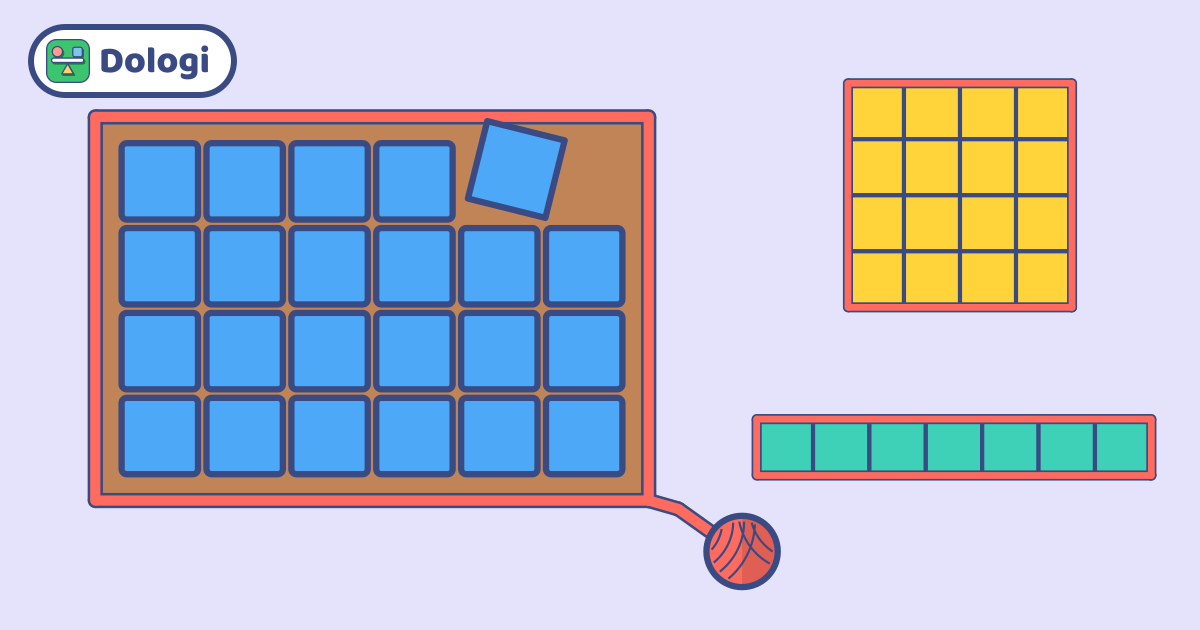
The Math topic in Dologi has a puzzle called Count the squares. At easier levels children count all the small squares in a block; at harder levels they look for the block outside the board that has as many squares as the gap, and the hint reminds them the block doesn't have to fit the gap, only the number of squares matters. That's area in a nutshell: the same number of squares can come in very different shapes.
In short
- Perimeter is the distance around the edge; measure it with a string, a ruler or by adding the sides.
- Area is how many squares cover the inside, with no gaps and no overlaps; for a rectangle, rows times columns.
- Same perimeter doesn't mean same area: with 16 toothpicks, a 7 × 1 strip holds 7 squares and a 4 × 4 square holds 16.
- Before calculating, ask: "Am I going around, or covering it?"
Read more: Roll two dice, draw a rectangle: a grid-filling game that helps kids understand multiplication, Which shapes cover a floor with no gaps? Tiling and honeycombs for children