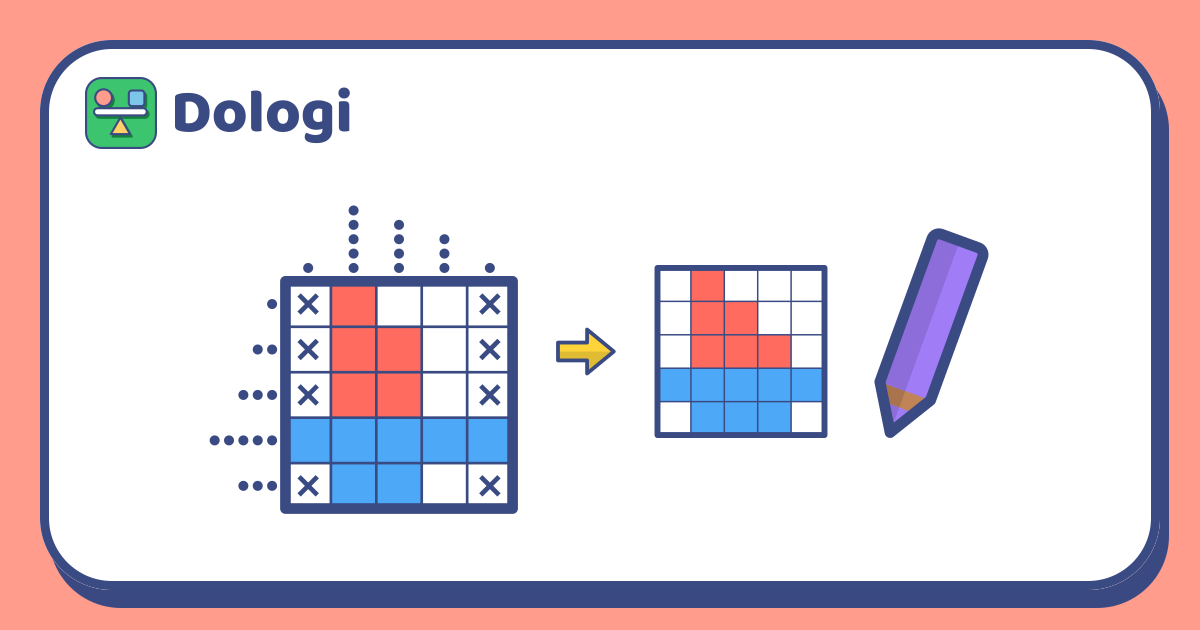
Some puzzles reward a child twice: once for working out the answer, and again when a picture appears. Picture logic puzzles are like that. You get an empty grid with numbers along its edges, and by following the numbers square by square, your child shades in a boat, a cat or a house without knowing in advance what it will be.
They go by many names in puzzle books and magazines, but the idea is always the same. This post explains the clues, gives you two small puzzles to try together (with full solutions), shows three habits that make bigger grids manageable, and explains how to make your own on squared paper. They suit children of roughly 7 to 12; every child is different, so let interest lead, not age.
How the clues work
Each row has a clue on its left, and each column has a clue above it.
- One number tells you how many squares in that line are shaded, all side by side in one unbroken run. A 3 in a row of five squares means three shaded squares touching each other, somewhere in that row.
- Several numbers, like "2 2", mean several runs, in that order (left to right for rows, top to bottom for columns), with at least one empty square between them.
- A row with no shaded squares has the clue 0.
There is no guessing involved. Every square can be worked out from the clues, and when the grid is finished, every row and every column matches its numbers.
When to start, and with which grid
Ages are only a rough guide.
| Grid | Clues | Often around |
|---|---|---|
| 5×5 with a completely shaded row or column | One number per line | 7–8 |
| 5×5 | Some lines with two or three numbers | 8–9 |
| 10×10 | Mixed clues | 9–12 |
| 15×15 and up | Mixed clues | When a child asks for more |
A completely shaded row is a gift for beginners: it gives a sure starting point, and every other step follows from there.
Puzzle 1: a small boat
Copy this 5×5 grid onto squared paper. The row clues are on the left, the column clues across the top.
| 1 | 5 | 4 | 3 | 1 | |
|---|---|---|---|---|---|
| 1 | |||||
| 2 | |||||
| 3 | |||||
| 5 | |||||
| 3 |
If your child is stuck, ask: "Which row or column can only be filled one way?" Then let the next step come from there. The full solution is at the end.
Three habits that crack almost any grid
1. Shade only what is certain. A 5 in a line of five squares fills it completely. For longer lines, try the sliding trick: imagine pushing the run as far left as it can go, then as far right. Squares covered both times must be shaded. A 4 in five squares always covers the middle three; a 7 in ten squares always covers the middle four.
2. Mark the empty squares. As soon as a line has all its shaded squares, put a small dot or cross in every remaining square. These marks are just as useful as shading: they tell the next line where its run cannot go.
3. Check both directions. Each time a square is shaded or marked, look at its row and at its column. Most progress comes from this back-and-forth: a finished column gives a row its first certain square, which then helps another column.
When a child is stuck, it is almost always because they forgot habit 3. Ask: "You just shaded this square. What does it tell the column?"
Puzzle 2: clues with two numbers
Here some lines have more than one run. Column clues read from top to bottom.
| 4 | 2 1 | 3 | 2 1 | 4 | |
|---|---|---|---|---|---|
| 1 1 | |||||
| 2 2 | |||||
| 5 | |||||
| 1 1 1 | |||||
| 3 |
A hint for the second row: two runs of two plus the empty square between them make 2 + 1 + 2 = 5, exactly the width of the grid. So there is only one way to place them. The fourth row works the same way: 1 + 1 + 1 plus two gaps is also 5.
Make your own at home
Children often enjoy making puzzles even more than solving them, and it is easy.
- Draw the picture first. On squared paper, shade a simple shape in a 5×5 or 6×6 area: a tree, a heart, a fish.
- Count the clues. For each row, count the runs of shaded squares from left to right and write the numbers on the left. Do the same for each column, top to bottom, and write them above.
- Copy the empty grid with only the clues, and swap with your child.
- Test it. Solve the copy without looking at the picture. If you reach a point where you would have to guess, the puzzle has more than one answer. Change a square or two and count again.
Taking turns works well: your child makes one for you, you make one for them. Writing clues that lead to exactly one picture is a real logic task in itself.
In Dologi, the Focus topic has "Secret picture" puzzles: children paint each square using a code key until a hidden picture appears. They make a gentle warm-up before edge-clue grids, which add the extra step of reasoning out which squares to shade.
Answers
Puzzle 1 (a sailing boat): the 5 in row 4 and the 5 in column 2 fill completely. Columns 1 and 5 already have their one square in row 4, so mark the rest. Row 1 already has its one square in column 2. Column 3 needs 4 and its top square is marked, so it is rows 2 to 5. Row 2 is now complete, so column 4 starts in row 3 and runs to row 5.
| 1 | 5 | 4 | 3 | 1 | |
|---|---|---|---|---|---|
| 1 | ■ | ||||
| 2 | ■ | ■ | |||
| 3 | ■ | ■ | ■ | ||
| 5 | ■ | ■ | ■ | ■ | ■ |
| 3 | ■ | ■ | ■ |
Puzzle 2 (a cat's face): row 3 is full; rows 2 and 4 can only be placed one way (see the hint). Column 3 needs a run of 3, its square in row 2 is empty and rows 3 and 4 are shaded, so the run is rows 3 to 5. In columns 2 and 4, rows 2 and 3 form the 2, so the 1 has to come after the gap, in row 5. Row 5 is now complete, so its corners stay empty, which means columns 1 and 5 run from row 1 to row 4.
| 4 | 2 1 | 3 | 2 1 | 4 | |
|---|---|---|---|---|---|
| 1 1 | ■ | ■ | |||
| 2 2 | ■ | ■ | ■ | ■ | |
| 5 | ■ | ■ | ■ | ■ | ■ |
| 1 1 1 | ■ | ■ | ■ | ||
| 3 | ■ | ■ | ■ |
In short
- The numbers at the edge say how many squares in that row or column are shaded, in unbroken runs, with gaps between runs.
- Start with a 5×5 grid that has a completely shaded line, then move to two-number clues and 10×10 grids.
- Shade only what is certain, mark empty squares with a dot, and check the row and the column after every move.
- To make a puzzle, draw the picture first, count the clues, then solve your own copy to make sure there is only one answer.
Read more: Color by code: matching dots to colors to reveal a picture · Number grid puzzles for children: when to start and how to begin with small grids