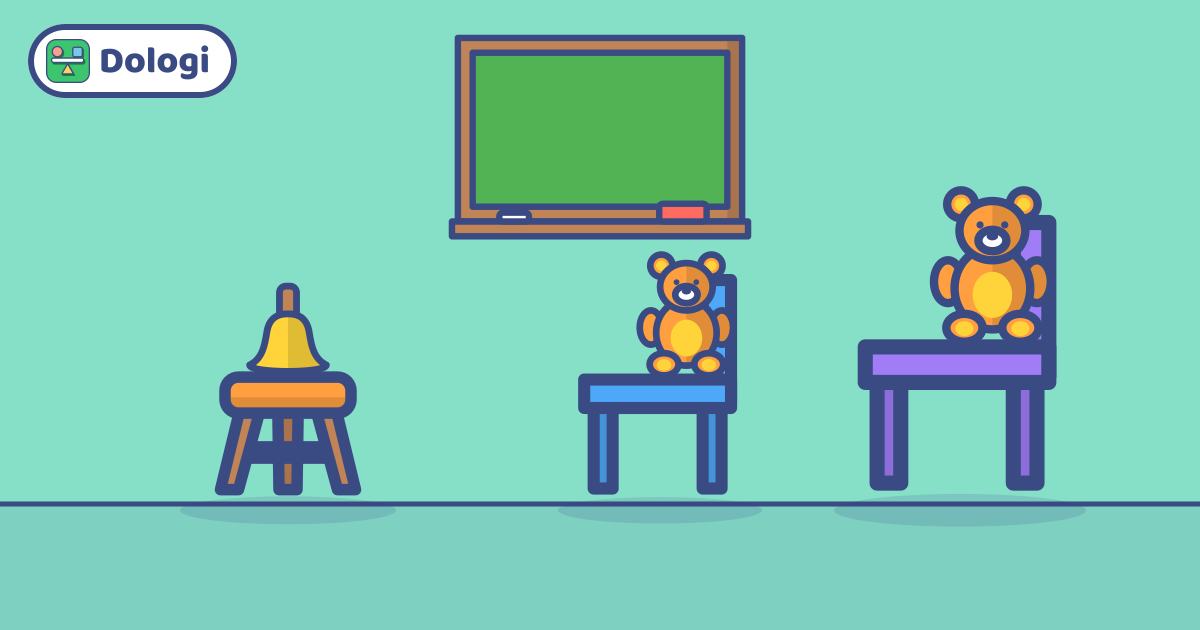
When we think about starting big school (kindergarten or first grade in the US, Reception or Year 1 in the UK), we usually think about letters and numbers. But for many five- and six-year-olds, the hardest part is something else: the rhythm. A lesson has a start and an end. A bell tells everyone when to stop. The teacher gives an instruction once, to the whole class, and nobody says "Maya, please take out your notebook."
Children who already know these "rules of the game" may feel calmer on the first day. You can let your child try them at home, in a safe and funny way, by playing school. A few minutes a day in the months before school is plenty, and you don't need any letters or numbers at all.
What may feel new in a classroom
Every school is different, and your child's teacher will explain how things work. But these are common surprises:
- A lesson of a set length, then a short break (recess), then another lesson.
- A bell or another signal that says it is time to stop, move or line up.
- Instructions given to the whole group: "Everyone, take out your notebook."
- Circle time on the rug, raising your hand and waiting to be called.
- Looking after your own things: your coat, your bag, your pencils.
- Lining up at the door, and asking to go to the bathroom.
If your child has been to preschool, some of this will be familiar. Playing school simply puts it all together.
Set up a classroom in five minutes
Use what you already have:
- A small table or the coffee table, with cushions or small chairs.
- "Pupils": teddy bears, dolls, a younger sibling, maybe a grandparent who is happy to join in.
- A "board": a big sheet of paper taped to the wall, or the back of an old calendar.
- A signal: a hand bell, a spoon on a glass, a clapping rhythm or a kitchen timer.
- A break corner with a snack or a ball.
Five games to practice the rhythm
1. A short lesson, then a longer one
Start with a five-minute "lesson": drawing, sorting buttons by color, listening to a short story. Your child sits at their place until the signal. Every few days, add a minute or two. Many children enjoy about ten to fifteen minutes by the time school starts, but every child is different, so go at your child's pace. For more on this, see How long can children focus at each age?.
2. The bell game
When the bell rings, everyone stops, puts their pencil down and looks at the teacher. A second ring means break. Swap roles so your child gets to ring the bell too.
3. Instructions for everyone
The "teacher" gives one instruction to the whole class, without saying any names: "Everyone, put the red pencil on the table." It is said once. Your child watches what the others (the bears) are doing, then does the same. For extra fun, let your child try to catch the teacher who forgets to say "everyone." Later, give two-step instructions: "Everyone, stand up and push in your chair."
4. Raise your hand
The teacher asks a question. Whoever wants to answer raises a hand and waits to be called. The bears keep "forgetting" and shouting out, and your child gets to remind them.
5. Tidy up before break
Before the break signal, each pupil puts their own things in their own bag or box. Your child packs the bears' "bags" too. Finish by lining up at the door, bears first. If you'd like more ideas about school bags, try Teaching your child to pack their own backpack.
Let your child be the teacher often. They love it, and by giving the instructions they learn the rules from the inside.
Keep it light
- Only a few minutes, and only when your child wants to. Stop while it is still fun.
- Laugh at mistakes. The bear who talks during the lesson is the best teacher of all.
- Don't use it to drill letters or to warn. Avoid "At school the teacher will be strict with you." Talk warmly about the real teacher and the school.
- Make the school familiar. If you can, walk past the school or visit the playground together, and read a picture book about a first day at school.
- Listen to worries. If your child seems very worried about starting school, or the worry lasts, talk with their preschool teacher or the new teacher.
For ideas about listening to the teacher, see Listening in class: how to help your child pay attention to the teacher.
In Dologi's Listening topic, the puzzle Listen and play back asks your child to listen to a few notes, then play the same white keys in the same order. It is a small practice of listening first and then acting, like following the teacher's instruction. A session is short and has a clear end, while the classroom game itself is best played away from screens.
In short
- Starting big school is also about rhythm: lessons, bells, breaks and instructions for the whole class.
- Playing school at home, a few minutes a day, lets your child try these in a safe, funny way.
- Let your child be the teacher often, and laugh at mistakes instead of correcting them.
- Keep it light, talk warmly about the real school, and speak with a teacher if worry lingers.
Read more: Getting ready for school: building thinking skills before reading and math, How long can children focus at each age?