Somewhere in upper primary, children meet the definition: "A prime number is a whole number greater than 1 whose only factors are 1 and itself." It's correct, but it's dry, and it's easy to memorize without seeing anything. There's a way to let children see prime numbers, even before they learn the definition: take a handful of blocks and try to arrange them into a rectangle. This post walks through that game, how to sieve the primes on a hundred chart, and the places where children usually go wrong.
The rectangle game
Get about twenty identical square blocks (toy cubes, bottle caps or paper squares all work). The rules:
- Take an exact number of blocks, say 6.
- Arrange them into a rectangle with at least two rows, every row with the same number of blocks, nothing left over and nothing missing.
With 6 blocks: two rows of 3. It works, so 6 is a composite number.
With 7 blocks: two rows gives a row of 4 and a row of 3, one block short. Three rows gives 3, 3 and 1 left over. Four, five or six rows is even worse. The only way is one straight row of 7. 7 is a prime number.
So the easy-to-remember version is: a prime is a number of blocks that only makes one row. A rectangle of 2 rows of 3 is the multiplication 2 × 3 = 6, and the number of rows and the blocks per row are factors of 6. When children later meet the definition "only two factors", they'll see straight away that it's the same idea.
Try-it table from 2 to 20
Let your child build each one and fill in the table. Don't give the answers first.
| Blocks | Rectangle possible? | How |
|---|---|---|
| 2, 3, 5, 7 | No | only one row |
| 4 | Yes | 2 rows × 2 |
| 6 | Yes | 2 × 3 |
| 8 | Yes | 2 × 4 |
| 9 | Yes | 3 × 3 |
| 10 | Yes | 2 × 5 |
| 11, 13 | No | only one row |
| 12 | Yes | 2 × 6 and 3 × 4 |
| 14, 15 | Yes | 2 × 7; 3 × 5 |
| 16 | Yes | 2 × 8 and 4 × 4 |
| 17, 19 | No | only one row |
| 18, 20 | Yes | 2 × 9, 3 × 6; 2 × 10, 4 × 5 |
Between 2 and 20 there are 8 primes: 2, 3, 5, 7, 11, 13, 17, 19. Some numbers, like 12, 16, 18 and 20, make several different rectangles, but one rectangle is enough to show a number is composite.
Two special cases: 1 and 2
1 is neither prime nor composite. One block has no rows to compare, and by definition a prime must have exactly two different factors, while 1 has only one. Mathematicians agreed on this so that every number breaks down into prime factors in only one way.
2 is the only even prime. Every even number bigger than 2 can be laid out as two equal rows, so it's composite.
Sieving the primes on a hundred chart
Once the blocks make sense, move to a hundred chart (ten rows of ten numbers, 1 to 100). This method is called the Sieve of Eratosthenes:
- Cross out 1.
- Circle 2, then cross out every multiple of 2 (4, 6, 8...).
- Circle 3 and cross out every multiple of 3 that's still left.
- Do the same with 5 and 7.
- Every number still standing is prime.
The result: there are 25 primes from 1 to 100. Your child may ask: "Why stop at 7?" The answer is in the rectangles again. Any composite number up to 100 can be made into a rectangle whose short side is 10 blocks or fewer, because 11 rows of 11 is already 121. And that short side is always a multiple of 2, 3, 5 or 7, so crossing out the multiples of those four numbers is enough.
Looking at the finished chart, children notice that the primes above 5 sit only in the four columns ending in 1, 3, 7 and 9. But it doesn't work the other way round: 21, 27 and 33 are in those columns too, and they're all crossed out.
Common misconceptions
- "Odd numbers are prime." 9, 15, 21, 25 and 27 are odd but make rectangles: 9 is 3 rows of 3.
- "If it looks strange, it must be prime." 51 = 3 × 17, 57 = 3 × 19, 91 = 7 × 13. They look hard to divide, but all three are composite. Check 3 (add the digits and see if the total divides by 3) and 7 before deciding.
- "1 is prime because it only divides by 1 and itself." It sounds reasonable, but 1 has only one factor, not two.
By age
- 8–9: play the rectangle game with blocks, no need for the word "prime" yet. Call them "numbers that only make one row".
- 9–10: the try-it table up to 20, the words prime and composite, sieving the hundred chart. In the US this usually comes up around 4th grade, in England around Year 5.
- 11–12: prime factorization, for example 12 = 2 × 2 × 3 and 84 = 2 × 2 × 3 × 7. Every composite number is a product of primes, the smallest building blocks of multiplication.
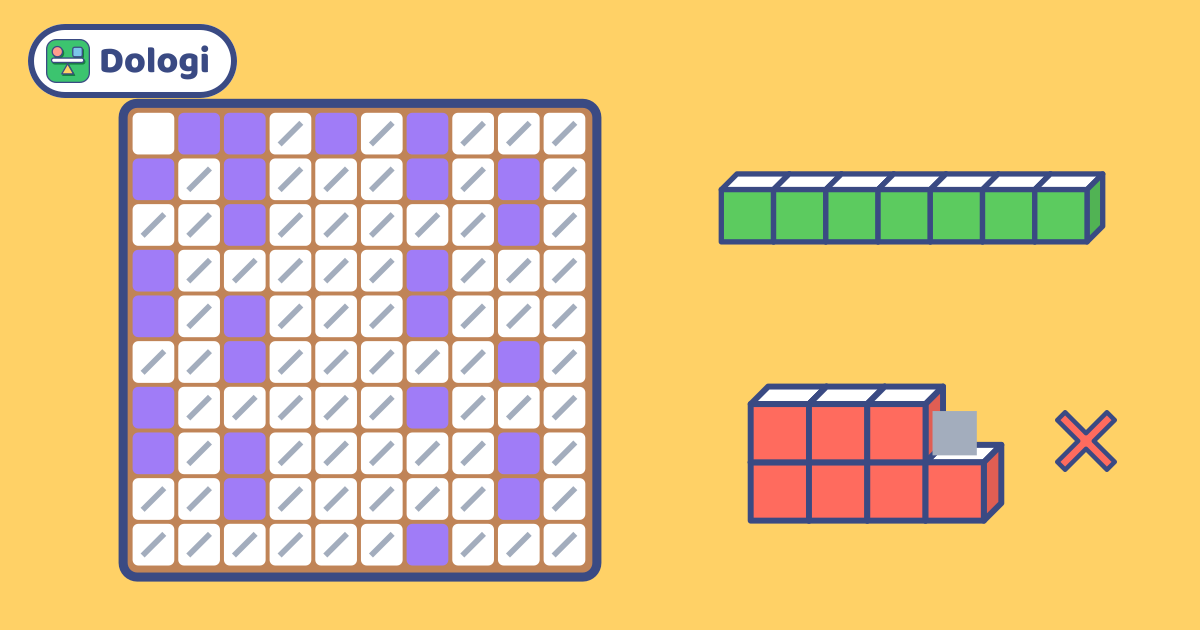
The Math topic in Dologi has a puzzle called Count the squares, which at harder levels asks: "Which block outside the board has as many squares as the gap?" Sometimes the right block has a completely different shape from the gap: the same number of squares can be arranged in many shapes, exactly what children see when they build with blocks.
In short
- A prime is a number of blocks that only makes one row; if it makes a rectangle with two or more rows, it's composite.
- 1 isn't prime; 2 is the only even prime.
- Sieve the hundred chart by crossing out multiples of 2, 3, 5 and 7: 25 primes remain.
- Odd doesn't mean prime: try 9, 21, 51 and 91.
Read more: What is multiplication? Explaining equal groups to a 7-year-old, Times tables: should children memorize them or understand them first?