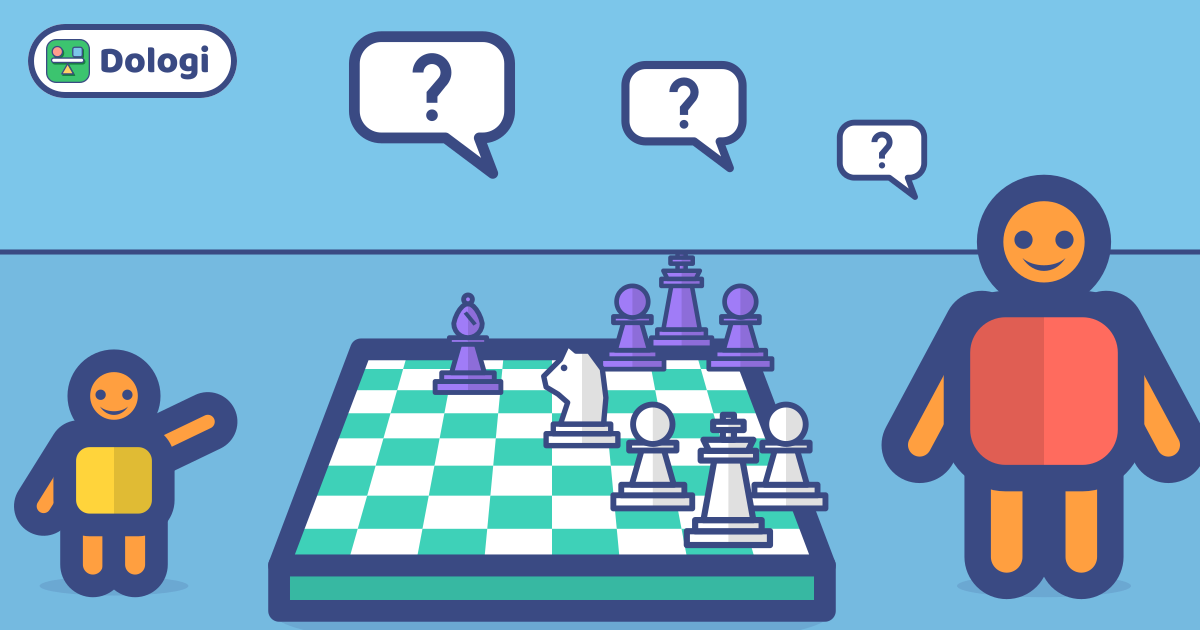
Your child picks up the knight, sets it down on a square, and keeps a finger on it. You see it right away: your bishop is aiming straight at that square. "Don't go there, you'll lose your knight!" is already on the tip of your tongue.
Say it, and your child keeps the knight, but the move was yours. Next time, they glance at your face before letting go of a piece. This article covers the questions you can ask during the game, how to hint in small steps when your child still doesn't see it, when to just tell them, and how to ask so chess stays fun.
Why ask instead of tell
- Questions teach your child how to look at the board. Telling fixes one move. A question helps your child practice finding the danger, and that skill carries over to every game after this one.
- The move stays theirs. When your child spots the threat to their knight, saving it feels like their own win.
- You learn what your child is thinking. Their answer tells you whether they didn't see the bishop at all, or saw it and thought it couldn't take. Those two call for different kinds of help.
A general hint ladder that works for any tricky problem is in When your child is stuck: how to give hints step by step. This article is about the chessboard: which questions to ask, and when.
Five questions to use during a game
| When | Question | What your child practices |
|---|---|---|
| Right after your move | "What do you think my move was for?" | Seeing the board from the other side |
| Before their move | "Which of your pieces has nobody protecting it?" | Spotting pieces that can be taken |
| Before their move | "Can you take anything?" | Not missing your mistakes |
| Piece set down, finger still on it | "Are you sure? Take one more look." | Stopping to check before deciding |
| Anytime | "What are you planning next?" | Playing with a plan, not one move at a time |
A few small things make these questions work better:
- Ask "Are you sure?" after good moves too. If you only ask when a blunder is coming, the question turns into an alarm bell: your child hears it, knows something is wrong and changes the move without thinking.
- Explain "nobody protecting it" once. An unprotected piece is one that, if it gets taken, none of your child's pieces can take back. The first few times, check together: which of your pieces can reach that square?
- Wait for an answer. Count to ten in your head. A quiet child is usually a thinking child.
Chess for children has three safety-check questions your child can learn to ask themselves before each move. The questions here are yours, for when you're sitting across the board, and over time your child will start asking them on their own.
Hints in steps: general, area, piece
If your child still doesn't see it, don't jump to the answer. Go one step at a time, each a little more specific, and give your child a chance to look after each one:
- General: "One of your pieces is in danger. Can you find it?"
- Area: "Look around the middle of the board." Or: "Keep an eye on my left side."
- Piece: "Look at your knight. Can any of my pieces reach that square?"
Even at step three, your child is the one who finds the bishop and decides how to save the knight: move it away, protect it with another piece, or take the attacker first. Only if all three steps aren't enough do you show them directly, with the reason: "This bishop moves diagonally and can reach this square, so a knight here will get taken."
When to just tell them
Asking isn't always the best choice. Tell your child directly when:
- They're still learning the rules. How the bishop moves, how pawns capture, how castling works: that's information, not a puzzle. Just teach it and show them.
- They've been stuck a long time and are getting frustrated. Eyes off the board, fiddling with captured pieces, sighing. More hints will only make the game feel heavy.
- They're tired, or it's late. A fun game today matters more than a complete lesson.
- They ask, "Just tell me." Now and then, that's fine. Afterward, ask them to explain why the move works, so they still do some of the thinking.
Telling doesn't mean playing for them. Point out the piece in danger, then let your child choose the move.
Keep the questions from feeling like a test
- Don't ask on every move. A few times per game is plenty. Save questions for moments that really matter.
- Sound curious. "Oh, what's that move for?" lands very differently from "Why would you go there?"
- Accept "I don't know." Then look at the board together. The right answer doesn't have to come right away.
- Let your child question you. "What are you planning next?" Swapping roles helps them get used to thinking out loud during a game.
- Let a few mistakes go. Not every move needs a hint. Losing a piece is also how lessons stick, and it gives you something to look at later when reviewing the game together.
When your child plays on their own in the Chess room in Dologi's Creative corner, the Hint button works in steps too: the first tap only highlights a piece worth moving, the next tap shows an arrow for the move, and the third tap explains why it's a good move, for example "This move takes the queen." Your child can tap it as many times as they like. The Magnifier marks your child's pieces that are in danger, such as a piece under attack with nothing protecting it, much like asking "Which of your pieces has nobody protecting it?"
In short
- Ask instead of tell: your child practices reading the board, and the move stays theirs.
- Five questions for any game: what was my move for, which piece is unprotected, can you take anything, are you sure, what's your plan.
- If your child still doesn't see it, hint in steps: general, area, piece. Only show the move after all three, and give the reason.
- Tell directly when your child is still learning the rules, stuck for a long time, frustrated or tired, but let them choose the move.
Read more: Playing chess with your child: should you let them win or play for real?, Reviewing a chess game with your child: learning from mistakes without criticism