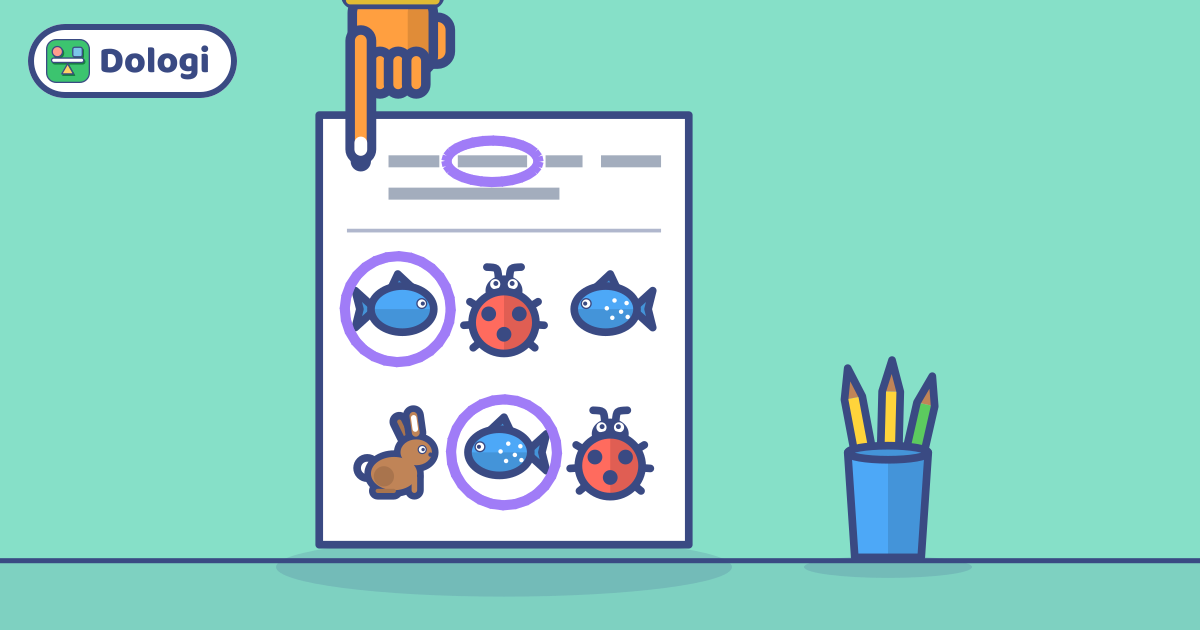
The worksheet says, "Circle two fish." Your child circles all three. Another page says, "Underline the word that is not a color," and they carefully underline the color words. It isn't that they can't do the work. They just didn't read the whole direction.
This is very common between about 6 and 11, and it happens in every subject, not just math. The good news: reading directions is a habit, and a few minutes a day at home builds it. This post covers why kids skip part of the directions and four small things that help them read to the end: tracking with a finger, circling the action word, saying the task back in their own words, and a game of tricky commands.
Why kids skip part of the directions
- They look at the pictures and guess the job. They see fish and a pencil, think "circle the fish," and stop reading.
- They copy the example. The first item is done for them, so they do every item the same way, even when the directions ask for something more.
- They know the format. Last week's page said "circle all," so this week's "circle two" gets the same treatment.
- Small words carry the meaning. Words for how many (two, each, all), negatives (not, wrong) and action words (circle, underline, match, color) are short and easy for the eyes to skip.
- One sentence holds two jobs. With "Color the shapes and count them," kids often do the first part and forget the second.
There's no need to call your child "careless." Treat it as a skill they haven't practiced yet, like swimming or tying shoes.
Track each word with a finger
The first step is simple: put a finger under the first word of the directions and read one word at a time, sliding the finger along to the period. The finger keeps the eyes from hopping over the little words.
- At 6 or 7, if reading is still slow, you read the directions aloud while your child tracks with a finger. Only then do they pick up the pencil.
- Older kids can read silently, but still track with a finger or the eraser end of a pencil on long directions.
- If there are two sentences, track both. The second one often holds the key part.
Circle the action word
After tracking, your child circles the word that says what to do and underlines the small words that are easy to miss. A little chart taped near the homework spot helps:
| Words in the directions | What they mean | Common trap |
|---|---|---|
| circle, underline, match, color, write | the job to do | circling when it says underline |
| two, three, each, all | how many | circling all when it says two |
| not, wrong, different | flips the question | picking the right word when it asks for the wrong one |
| and, then, after that | there's a second job | stopping after the first part |
| biggest, smallest, closest | only one | picking the first one they see |
Once the habit sticks, your child only needs to circle the action word and underline the "how many" word, not mark every word.
Say the task back in their own words
Before starting, ask: "What do the directions want you to do?" Your child answers in their own words: "I have to circle two fish, not all of them." If they can say it, they understand it. If they say it wrong or leave something out, they reread the directions, without you explaining.
When they finish, they read the directions one more time and ask: "Did I do what it said? Did I circle exactly two? Was there a second part?" That last read takes less than half a minute and catches a lot. If your child often picks an answer before understanding the question, see stop guessing and check.
Reading directions in every subject
This habit isn't just for math. Each subject has its own easy-to-miss directions:
| Subject | Easy-to-miss direction | What to circle |
|---|---|---|
| Math | "Solve, then show your work" | two jobs: solve, then show the work |
| Math | "Circle the greatest number" | only one number |
| Reading | "Underline the verbs in each sentence" | underline, verbs, each sentence |
| Writing | "Write two sentences about your weekend" | two sentences, about what |
| Science | "Match each animal to where it lives" | match, each animal |
Word problems need an extra step on top of this, finding the question and the facts; helping children understand word problems walks through it.
The tricky commands game
The most fun way to practice is a game. You give a command, your child follows it word for word, and each command has a small trap:
- "Bring me two spoons, but not the big ones."
- "Clap once if I name an animal that can fly: dog, robin, cat."
- "Put three socks in the basket, then close the drawer."
- "Touch everything red in the room, except toys."
From around 8, write the commands on cards. Your child draws a card, reads it and does it. Then switch: your child writes tricky commands for you. To set a trap, they have to notice exactly those small words. Fall into a trap now and then so they get to correct you.
The Tap them all puzzles in Dologi's Focus topic are a kind of practice with directions too: "Tap every yellow triangle" means it has to be a triangle and it has to be yellow, and tapping too fast misses one or the other.
In short
- Kids who skip directions usually guess from the pictures, copy the example or skim the small words. It isn't about being lazy or slow.
- Track each word with a finger, circle the action word and underline the words for how many and "not."
- Before starting, your child says the task back in their own words; after finishing, they reread the directions once.
- Practice in every subject and play the tricky commands game, then switch roles so your child sets the traps.
Read more: Stop guessing and check, Understanding word problems, Following multi-step instructions