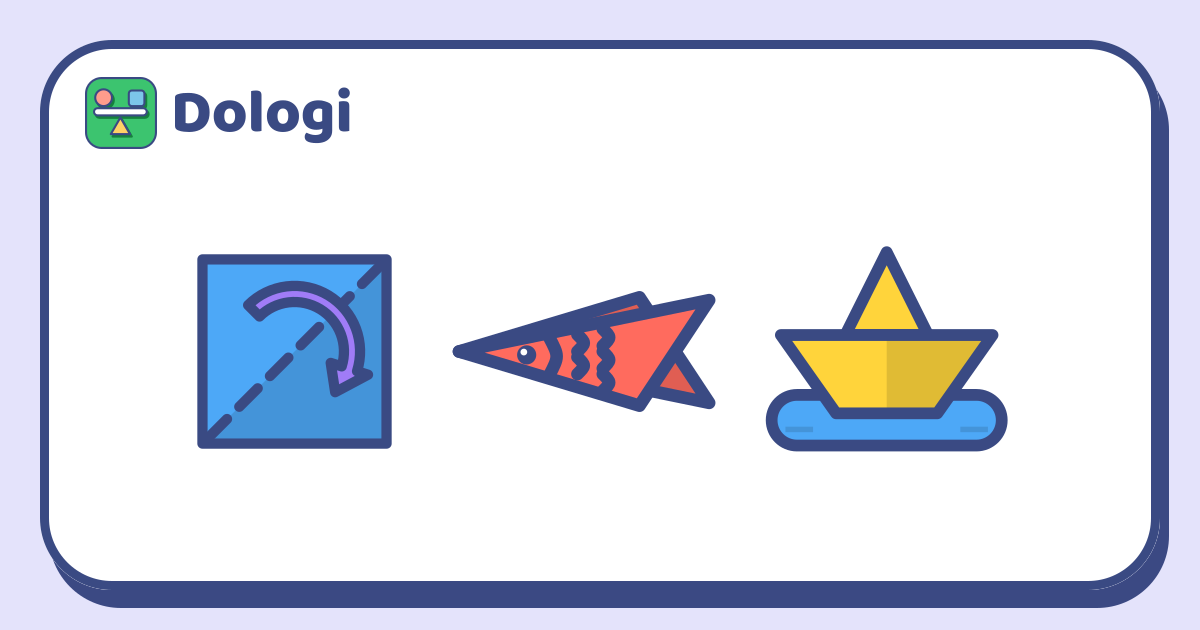
A sheet of paper, a table and ten minutes are all you need to make a fish or a boat together. Paper folding looks like a simple craft, but it asks children to match corners and edges and picture what the next fold will do.
This article walks you through two of the easiest folds: a fish for children from about 5, and the classic paper boat for about 6 to 8. Each step says what to do and what the paper should look like afterwards.
What folding practices
- Matching. Most folds start with "put this corner on that corner". Children look closely and line things up before they press.
- Position words. Top, bottom, left, right, front, back, in half. Folding gives these words a real job.
- Picturing the next shape. Before a fold, ask "What shape will we have now?" A square folded corner to corner becomes a triangle.
- Following steps in order. Skip a step and the fish doesn't come out, so children see why order matters.
The ages here are only a rough guide: some five-year-olds fold neatly, some eight-year-olds still need a hand.
Paper and fold words
- For the fish: a square of paper, about 15 cm on each side. To make one from an ordinary sheet, fold one corner down so the short edge lies along the long edge, then cut off the strip that sticks out.
- For the boat: a rectangle, such as a standard printer sheet.
- Thin paper folds more easily than card, and a different color on each side shows which side is up.
| Fold word | What it means |
|---|---|
| Fold in half | Bring one edge or corner onto the opposite one, so the halves match |
| Crease | Press along the fold with a fingernail so it stays sharp |
| Center line | A crease down the middle, made by folding in half and opening again |
| Turn over | Flip the paper so the back faces you |
| Open and flatten | Pull the layers apart and press the paper into a new shape |
The fish (from about age 5)
- Make a triangle. Lay the square in front of your child like a diamond, colored side down. Fold the right corner over onto the left corner and crease. You now have a triangle, colored on the outside.
- Find the head. The pointed corner on the left is the fish's head. The straight folded edge on the right is its back.
- Fold the top corner. Fold the top corner down so the crease starts exactly at the head point and ends on the back edge a little above the middle. The tip should poke out past the back edge, just below the middle. Crease.
- Fold the bottom corner. Do the same from the bottom: the crease runs from the head point to a little below the middle, and the tip pokes out above the middle. The two tips cross and make the tail.
- Draw. Add an eye near the head, and scales or stripes if your child likes.
If the tips hardly poke out, unfold the corner and end the crease a little further from the middle.
The classic boat (about ages 6 to 8)
- Fold in half. Hold the rectangle upright and fold the top edge down to the bottom edge. Crease. The fold is now at the top.
- Mark the middle. Fold it in half from left to right, crease, then unfold to get a center line.
- Make a roof. Fold each top corner down so the top edge lies along the center line. You get a triangle with a strip of paper underneath.
- Fold up the strips. Fold the front layer of the strip up over the triangle, and fold the little corners that stick out around its edges. Turn over and do the same with the other strip. This is a paper hat.
- Open into a diamond. Put your thumbs into the hat from the bottom and pull the front and back apart, so the two pointed ends come together. Press flat into a diamond with the opening at the bottom.
- Fold up the bottom corner. Fold the bottom corner of the front layer up to the top corner. Turn over and do the same. You have a triangle again.
- Open again. Open the triangle from the bottom in the same way, bring the two pointed ends together and press flat into a smaller diamond.
- Pull it open. Find the two loose flaps at the top of the diamond, hold one in each hand and gently pull them apart. The middle rises into a sail and the boat takes shape.
Steps 5 and 7 are the hardest. Do them together the first few times, slowly, and let your child do the pressing.
Folding together without taking over
- Sit side by side, not opposite each other. If you face your child, your left is their right, and copying your hands becomes a mirror puzzle.
- Fold your own sheet one step ahead. Show a step on your paper, then wait while your child does it on theirs.
- Say it and point: "This corner goes onto that corner." After a few rounds, ask your child to tell you the next step.
- Read the creases. Older children can unfold a finished fish and ask "Which crease made the tail?", then fold it again using only the creases.
- Wonky is fine. A fish with a lopsided tail is still a fish. If your child gets stuck, go back one step.
| Rough age | What to try |
|---|---|
| 5 | The fish, with help lining up steps 3 and 4 |
| 6–7 | The fish alone; the boat with help on the opening steps |
| 8 | The boat alone; teaching the fish to someone else |
If your child enjoys picturing what a fold will do, the "Fold and punch" puzzles in the Space topic in Dologi show a sheet being folded and punched, and children choose how it will look opened out.
In short
- A square and a rectangle of paper are enough for a fish and a classic boat.
- Fold words and position words help children follow each step and explain it.
- Sit side by side, fold your own sheet one step ahead and let your child do the folding.
- When something goes wrong, unfold one step and try again.
Read more: How many coins can a paper boat carry?, Patterns that turn around a center: drawing round designs with folded paper, Fold, punch, unfold: paper puzzles where children predict the holes before opening