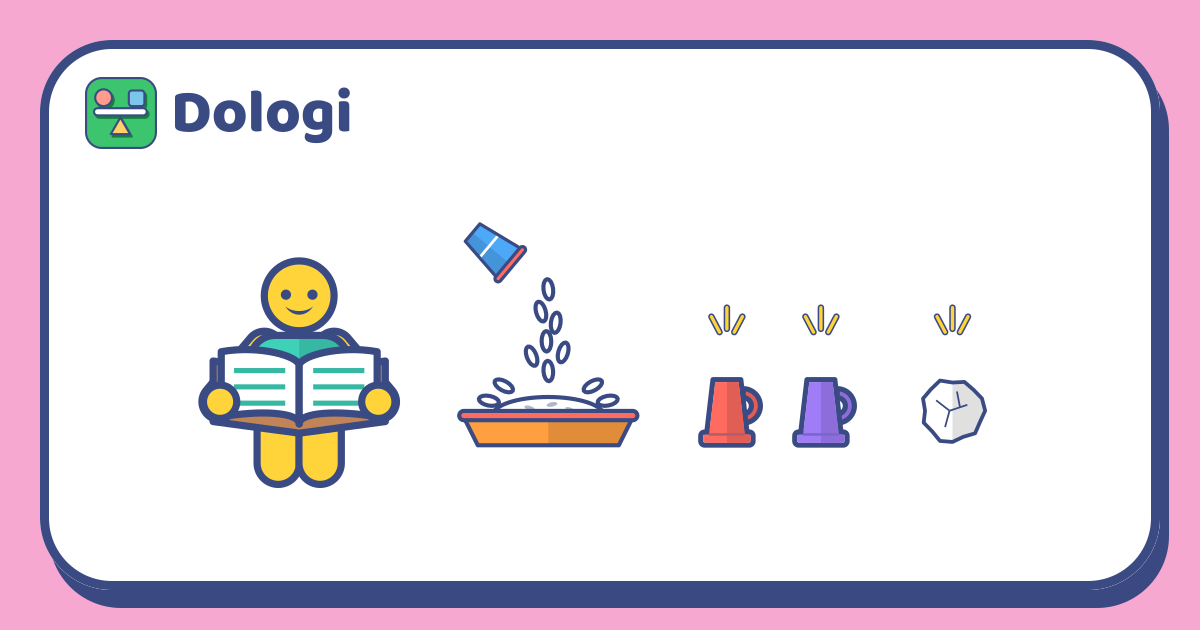
Rice pattering onto a tray sounds surprisingly like rain. Two upside-down cups tapped on the table turn into a horse trotting past. A sheet of paper crumpled slowly becomes a crackling fire. Making sound effects for a story is an old family pastime, and it needs nothing more than a book or a story you make up and a few things from the kitchen.
It is also a quietly demanding activity. Your child has to listen closely to a sound and decide what it is like, try objects and compare them, then plan who makes which sound and when. This article walks you through it step by step, with ideas for children aged roughly 5 to 12.
Choose a short story full of sounds
Pick a story that takes a few minutes to read and has four to six clear sound moments. A folk tale you know by heart works well, and so does a story you invent together. For example:
A traveler rides through the forest at dusk. Rain begins to fall. She ties up her horse, knocks on the door of a small cottage, and the door creaks open. Inside, a fire crackles, and she sits down to dry off while the rain eases.
Read it through once and ask your child: "Which sounds would we hear if we were standing there?" Write the list together, or let younger children draw a small picture for each sound: a cloud, a horseshoe, a door, a flame.
Hunt for sound makers around the house
Now the experiment starts. For each sound on the list, your child suggests an object and tests it. Ask: "What does real rain sound like? Lots of small taps, all at different times, on something hard." Then: "What at home could make lots of small taps?"
| Sound in the story | Object to try | How to make it |
|---|---|---|
| Rain | A handful of dry rice and a baking tray | Let the rice trickle slowly from a cup or your fingers onto the tray |
| Hoofbeats | Two plastic cups, turned upside down | Tap them on the table one after the other: clip, clop, clip, clop |
| Knocking | Knuckles and a wooden table or a book | Three firm knocks, with a short pause between each |
| A creaky door | A cabinet door or a drawer that squeaks | Open it very slowly |
| A crackling fire | A sheet of paper or a used paper bag | Crumple it slowly and gently, close to the listener |
| Wind | Your own breath | Blow softly across the top of an empty bottle, or make a long "whoosh" |
Encourage your child to compare two or three options before choosing. Rice on a metal tray and rice on a towel sound very different. Why? One surface is hard and rings, the other is soft and swallows the sound. Fast taps with the cups make a horse gallop; slow taps make it walk. Each comparison is a small test: try, listen, explain, improve.
Keep it safe: use plastic cups, keep small grains away from very young siblings, and stay close by.
Plan who does what, and when
Once the sounds are chosen, the story needs a plan. Read the text again and mark where each sound comes in. Some families draw a "sound map": a row of small pictures in the order they happen, with an arrow from one to the next.
Then share out the jobs. One person reads, the others make sounds. With two children, each can look after two or three sounds. A few questions help your child think ahead:
- Which sound comes first, and which comes last?
- Does the rain stop suddenly, or fade away little by little?
- Should the hoofbeats get louder as the horse comes closer?
- Is there a moment when two sounds happen together?
Keep the objects lined up on the table in the same order as the sound map. That small habit makes the performance much smoother, and it is planning your child can see.
Tell the story and add the sounds
The reader goes slowly and pauses at each sound moment. The sound makers watch the map and come in at the right time. The first run-through rarely goes perfectly, and that is part of the fun: maybe the door creaked before the knock, or the rain was so loud nobody heard the words.
Afterwards, talk it over together: "Which sound worked best? Which one came in too early? What could we change?" Then try again.
If you have a phone or tablet nearby, record the story and listen back together. Hearing it from the outside helps children notice details they missed while busy making sounds, such as a gap that was too long or a sound that did not quite fit.
What to try by age
| Age (rough guide) | Ideas to try |
|---|---|
| 5–6 | Two or three simple sounds; the adult reads and gives a nod when it is time; the child makes one sound at a time |
| 7–9 | Four to six sounds; the child helps choose and test objects and draws the sound map |
| 10–12 | The child writes or retells a story of their own, plans every sound, directs the others and records the finished version |
Every child is different, so go by what your child enjoys rather than by the table.
In Dologi, the Listening topic includes puzzles such as "Which instrument?", where your child hears a sound and picks the instrument that made it, and "Drum beats", where they count how many times the drum sounds. They draw on the same habit of linking a sound to where it comes from.
In short
- A short story with four to six sound moments and a few household objects is all you need.
- Testing objects and comparing them turns sound effects into a small experiment: try, listen, explain, improve.
- A sound map in pictures helps your child plan the order and come in at the right moment.
- Recording the story and listening back shows what worked and what to change next time.
Read more: Guess what just happened: a listening game where children reason from sounds alone, Homemade instruments from recycling: a drum, a shaker and a rubber band guitar