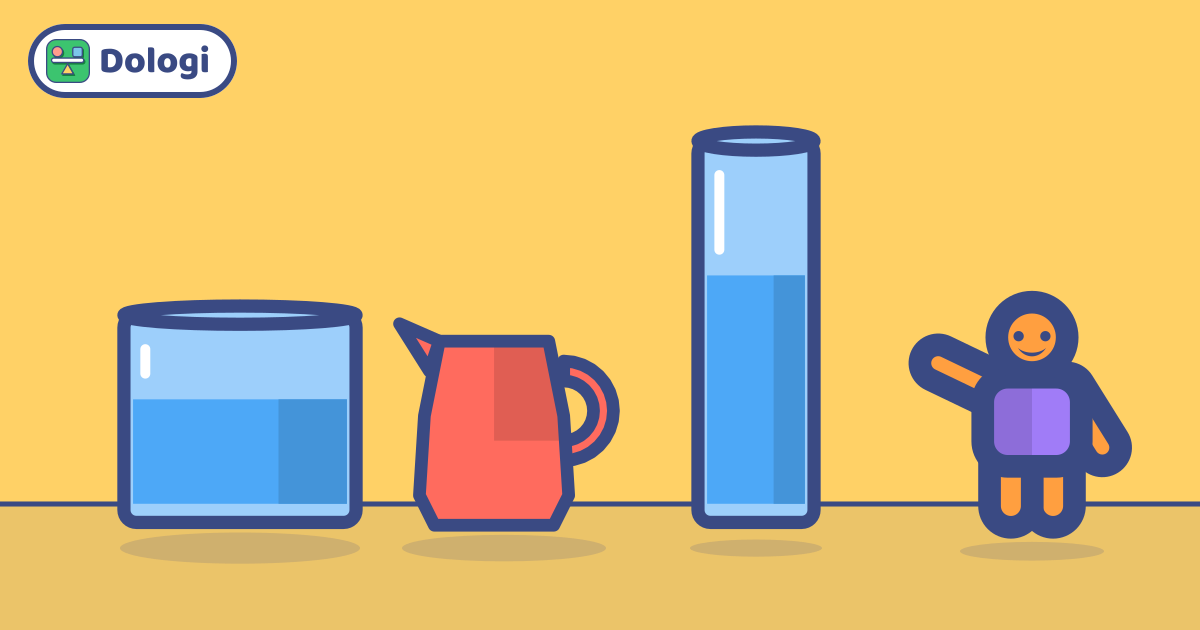
You pour your child's juice into a tall, thin glass, and they cheer: "I've got more!" Their sibling's short, wide glass holds exactly the same amount, but your child is sure. If this sounds familiar, it isn't a mistake to fix. It's a window into how young children think about amounts.
This article explains what's going on, gives you three quick experiments with water, clay and buttons, and shows how to let your child discover the answer for themselves.
Why the tall glass looks like more
Pouring water into a different glass is a classic experiment in developmental psychology. Many children younger than about six or seven say the taller glass has more, because they look at one thing, the height of the water, and don't yet weigh it against the other, the width of the glass. They also don't yet lean on the idea that nothing was added and nothing was taken away.
Children grow out of this at different ages, and the same child may get it right with water and wrong with clay. It says nothing about how clever your child is or how they'll do at school. It's a normal step in learning that an amount stays the same when only its shape changes.
Game 1: water in a tall glass
You need two identical short glasses, one tall thin glass and a jug of water.
- Fill the two identical glasses to the same level. Ask: "Is there the same in both, or does one have more?" Adjust until your child agrees they're the same.
- While your child watches, pour one of them into the tall glass.
- Ask: "Now is there more in this one, more in that one, or the same?"
- Whatever the answer, ask "How do you know?" and listen.
- Pour the water back into the short glass and compare again.
The last step is the check your child can see with their own eyes. Some children say "It's the same again!" and still think the tall glass had more. That's fine. Let it sit.
Game 2: a clay ball and a clay snake
Make two balls of play dough or clay the same size. Your child can check by holding one in each hand or putting them side by side.
Roll one ball into a long snake. Ask: "Is there more clay in the ball, more in the snake, or the same?" Many children say the snake has more because it's longer. Some say the ball has more because it's fatter. Then roll the snake back into a ball and compare the two balls.
Variations: flatten one ball into a pancake, or break it into five small pieces. "Is there more clay now there are lots of pieces?"
Game 3: buttons in a row
Put out two rows of 6 buttons, one directly below the other, each button lined up with a partner. Ask: "Are there the same in each row?"
Now spread one row out so it is longer, without adding or removing any. Ask again. A row that looks longer often looks like "more". Then let your child count both rows: 6 and 6. Some children count, find 6 and 6, and still say the long row has more. Counting and believing the count are two different steps, and both take time.
| Game | What changes | What stays the same | How your child can check |
|---|---|---|---|
| Water | The height of the water | The amount of water | Pour it back into the first glass |
| Clay | The shape: ball, snake, pancake | The amount of clay | Roll it back into a ball |
| Buttons | How long the row is | The number of buttons | Count, or line them up again |
Ask "How do you know?" instead of correcting
The most useful thing you can do is not to give the answer. If you say "No, it's the same", your child may repeat it without believing it. Instead:
- Ask for a reason. "How do you know?" or "How could we find out?"
- Accept every answer calmly. "You think the tall one has more because the water is higher. Let's check."
- Let your child do the checking. They pour, they roll, they count.
- Don't drill. Play each game once or twice, then stop while it's still fun.
When children start to understand, their reasons usually sound like one of these:
- "You didn't add any or take any away."
- "If you pour it back, it'll be the same."
- "It's taller, but it's thinner."
Any of these means your child is thinking about the amount, not just how it looks.
Play again in a few weeks
Write down what your child says the first time, in their words. A few weeks or months later, play the same games again. It's often surprising: the child who was sure the snake had more now laughs, "It's the same clay!" and explains why. Seeing how their reasons change is the best part.
For children who already answer "the same" every time, make it harder: use glasses of very different shapes, or spread the buttons out a lot and bunch the other row together.
In Dologi's Math topic, Count and answer puzzles scatter shapes of different colors across the screen, and your child counts only the ones the question asks for. The hint suggests pointing at each one as you count. It's the same habit as counting the buttons instead of judging by how long the row looks.
In short
- Many children younger than about six or seven think a taller glass, a longer snake or a longer row has more; it's a normal step, not a mistake.
- Try three games at home: water in a tall glass, a clay ball rolled into a snake, and buttons spread out in a row.
- Let your child guess, then check by pouring back, rolling back or counting.
- Ask "How do you know?" instead of correcting, and play again in a few weeks to hear how their reasons change.
Read more: Water play: pouring, measuring and comparing how much, From objects to numbers: when do children understand a number without counting things?