By ten, most children read with ease, can work through problems with several steps and have opinions about nearly everything. They've grown tired of "you ask, I answer". They want to set the puzzle, make the decisions and work on something real.
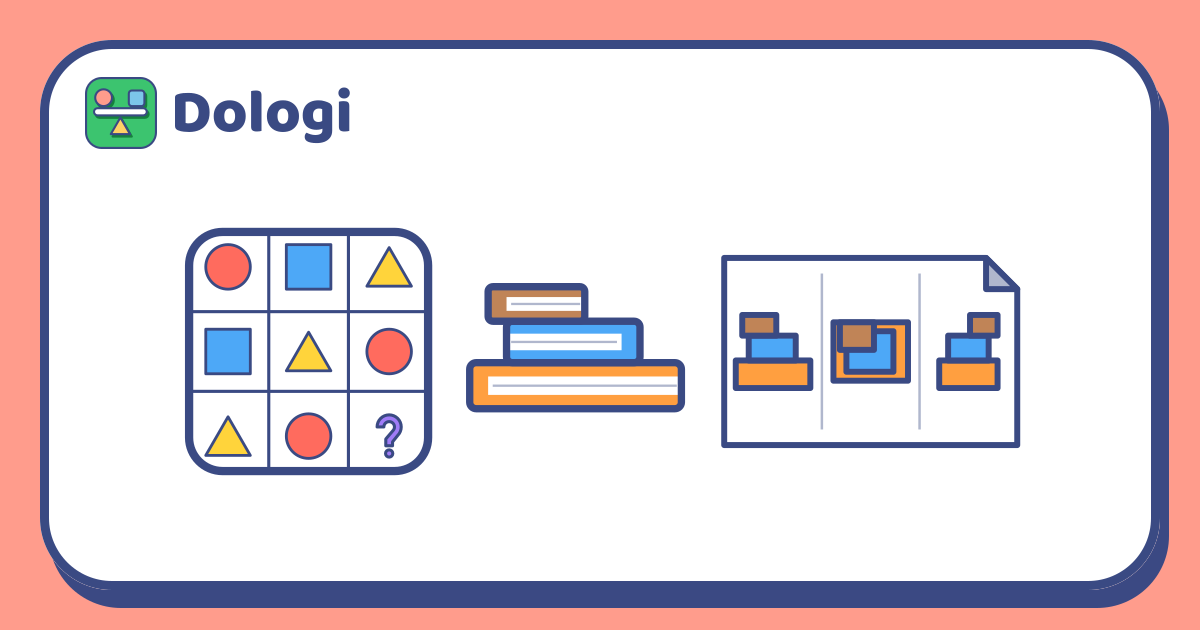
This post gathers thinking skills often seen around age 10 and suggests an activity at home for each: drawing a pattern grid to puzzle you, sketching three views of a stack of books, running a small project across one week and practicing three ideas before choosing. Unlike head-to-head strategy games, these activities are built around everyday objects and family life.
What many 10-year-olds can do
The table shows things many children around 10 can do. These are rough markers only: a child may be ahead in one skill and need more time in another.
| Skill | Around 10, many children can | Suggested activity |
|---|---|---|
| Patterns | Find one rule running along the rows and another running down the columns of the same grid | Draw your own 3×3 pattern grid |
| Space | Picture a solid object from its front, top and side views | Three views of a book stack |
| Planning | Break a big job into small parts and spread them over several days | A small week-long project |
| Many ideas | Come up with a few solutions, compare them and explain the choice | Three ideas, then choose |
If your child can't do one of these yet, start with an easier version. Children of the same age vary a lot, and that's normal.
Draw a 3×3 pattern grid to puzzle you
A pattern grid has three rows and three columns, a shape in each square and one square left empty. To fill the gap you have to look along the row and down the column. At this age, solving someone else's grid is often not that hard any more. The more useful practice is having your child make one.
Suggest three steps:
- Pick a rule for the rows. For example: each row has one circle, one square and one triangle, with no shape repeated.
- Pick a rule for the columns. For example: going down each column, every shape gains one more dot.
- Blank one square and check. Your child covers the square they plan to leave empty and asks: looking only at the rest, is there exactly one answer?
The third step is where most of the learning happens. A first grid often has two answers that both make sense. If you get it "wrong", explain what you were thinking so your child can see where the grid leaks and fix it. A good grid is one where the solver can say why they're sure.
Three views of a book stack
Take three or four books of different sizes and stack them on the table, the largest at the bottom and a small one pushed towards a corner. Fold a sheet of paper into three columns. In the first, your child draws the stack seen straight from the front; in the second, seen from above; in the third, seen from the right. Outlines only, no shading.
Once that feels easy, try harder versions:
- Swap direction. You draw the three views, and your child arranges the books to match all three.
- One view missing. Give only the front and top views. Ask: how many stacks fit these two drawings? Which view would you need to be sure?
- Other things at home. Draw three views of a mug with a handle, a shoebox with the lid off or a stool, and let someone else guess what it is.
The question "which view would you need to be sure?" is much harder than drawing: your child has to think about what each view hides.
A small week-long project
Around 10, many children can keep a goal in mind over several days but aren't used to breaking work down. A small project across one week is a chance to practice. Let your child choose the topic, for example:
- A model of their bedroom made from a cardboard box, with the bed, desk and wardrobe in the right places.
- The family's Sunday dinner menu: choosing dishes, listing ingredients, shopping with you and helping to cook.
Draw a table with seven columns for seven days and stick it on the wall. Your child shares out the jobs across the days. For the menu project, it might look like this:
| Day | Job |
|---|---|
| Monday | Ask everyone what they like and what they can't eat |
| Tuesday | Choose three dishes and write the ingredients list |
| Wednesday | Check what's already at home and cross it off |
| Thursday, Friday | Leave free in case of homework |
| Saturday | Go shopping together |
| Sunday | Cook, set the table and ask everyone what they thought |
At the end of each day, your child ticks off what's done. If they fall behind, rework the table together rather than scolding: adjusting a plan is part of planning too. Your job is to ask ("what does the table say for today?"), not to take over, even when your child takes the long way round.
Three ideas, then choose
Faced with a problem, many children go with the first idea that comes to mind. Help your child build a small habit: think of at least three ways before choosing.
Use real situations at home: how to fit all the new books on a shelf that's nearly full, how to carry all the shopping home in one trip, how to share out weekend chores fairly. Your child names three ways, then draws a small table comparing them on a few criteria they choose, such as how long it takes, whether it costs money, and whether someone ends up doing more than their share. They put a tick for the better option on each criterion, then choose.
Not every idea has to be good; a silly third idea sometimes leads to a fourth that works. What matters is that your child sees a problem often has more than one solution and can explain why they picked this one. The habit fits straight into the week-long project too.
If your child enjoys these activities, the Patterns and Space topics in Dologi have puzzles in the same spirit, getting harder step by step as your child succeeds. A few minutes on a device each day is one more way to practice, not a replacement for setting puzzles, stacking books and running a real project.
In short
- Around age 10, many children can spot patterns along rows and columns, picture a shape from its views and follow a plan over several days.
- Let your child set the puzzle: drawing a pattern grid or three views, then checking it has exactly one answer.
- A small week-long project, planned on a seven-day table, practices making a plan and changing it.
- Practice three ideas before choosing, and ask your child why they picked that one.
Read more: Thinking activities for 8-year-olds: secret codes, block stacks and the habit of checking your work, 3×3 pattern grid puzzles: find the missing square by rows and columns, Seen from above, seen from the side: top and side views for children