At seven, many children are settling into school. They read simple words, count further, and start asking "how do you know?" as often as "why?". This is a good age for games where your child doesn't just find the answer but works it out: crossing off what can't be right, picturing a shape after it turns, deciding what to do first, second and third.
Below are thinking skills often seen around age 7, each with a 10-minute game that needs nothing more than paper, cardboard and things from the kitchen.
What many 7-year-olds can do
The table shows things many children around 7 can do. These are rough markers only: every child has their own pace, ahead in some skills and needing more time in others.
| Skill | Around 7, many children can | Suggested game |
|---|---|---|
| Ruling out | Cross off options that don't fit until one is left | Yes-or-no guessing |
| Turning shapes | Picture a flat shape after a quarter turn | The cardboard corner |
| Patterns | Count on in twos and fives and spot where a count went wrong | Skip-counting trail |
| Memory | Say a short sequence of three things backwards | The backwards echo |
| Planning | Put three steps in order before starting | Breakfast in three boxes |
| Codes | Swap pictures for letters or numbers using a key | Picture-code notes |
If your child can't do one of these yet, play an easier version for a while. Seven-year-olds vary a lot, and that's normal.
Ruling things out: yes-or-no guessing
Lay out about ten small things on the table: a spoon, a sock, an apple, a pencil, a toy car, a cup and so on. You secretly choose one. Your child asks questions you can only answer with "yes" or "no", then removes everything the answer rules out.
"Can you eat it?" — "No." The apple goes to the side. "Is it made of metal?" — "Yes." Now only the spoon and the toy car are left.
The point isn't to guess quickly but to ask questions that clear away many things at once. After a few rounds, ask "which question removed the most?". Your child starts to notice that "is it red?" is often weaker than "is it something you wear?".
Then swap roles: your child picks the object and you ask. Once the table version is easy, play it with no objects at all, using animals or rooms in the house.
Turning shapes in your head: the cardboard corner
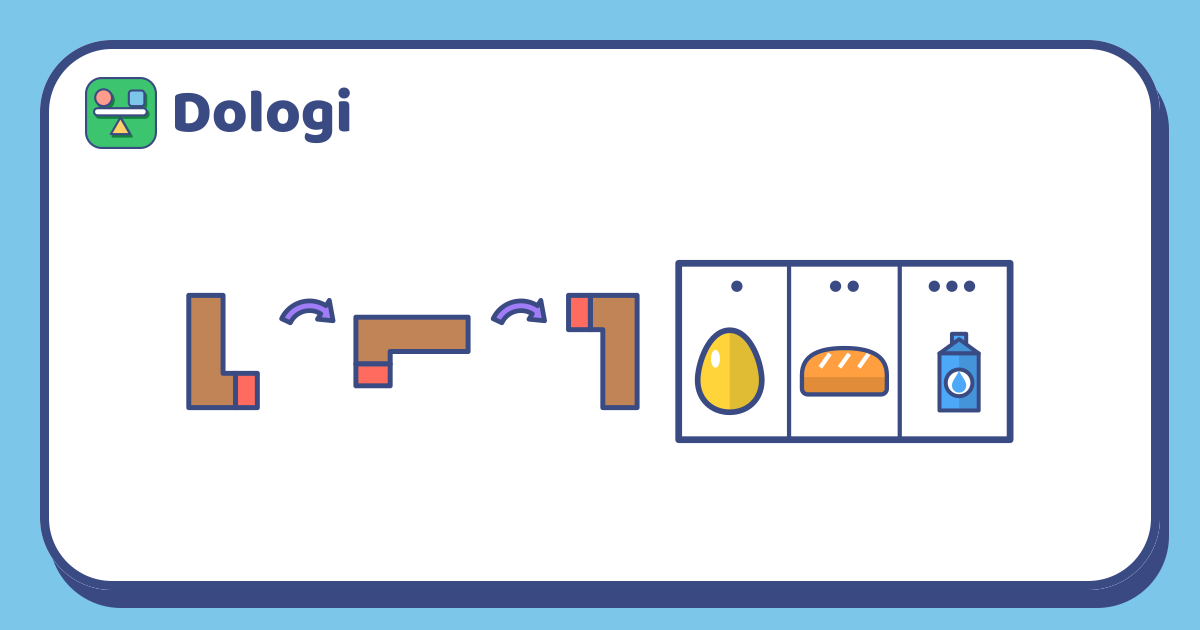
Cut an L shape from cardboard, about the size of a hand, and color one end so you can tell the ends apart. Put it on the table and trace around it on paper.
Ask your child: "If I turn it a quarter, like the hand of a clock, where will the colored end be?". Your child draws their guess on the paper first, then turns the real piece to check. Being right isn't the goal. Comparing the guess with the real result is where the learning happens.
To make it harder:
- Two quarter turns. Guess where it ends up after a half turn.
- Which one is flipped? Draw the L three times, two of them simply turned and one flipped over like a mirror image. Your child finds the odd one out and turns the cardboard to prove it.
- New shapes. Try a T, a step shape, or a shape your child cuts out themselves.
Patterns and memory: skip-counting, the backwards echo
Skip-counting trail. Count things that come in groups: socks in pairs, fingers in fives, shoes by the door. Line up pairs of socks and count "two, four, six…", then switch to counting hands of five. Once your child is confident, make a trail of dot cards with one step missing or one step wrong: 5, 10, 15, 21, 25. Your child finds the card that breaks the rule and says why.
The backwards echo. You say three things: "cat, umbrella, banana". Your child says them back in reverse: "banana, umbrella, cat". This is harder than repeating in order, because your child has to hold the list and work with it at the same time. If three is easy, try four. If it's hard, use objects your child can see first, then hide them.
Planning and codes: breakfast in three boxes, picture-code notes
Breakfast in three boxes. On a weekend, plan breakfast together. Fold a sheet of paper into three boxes. Your child draws the three steps in order: for example, boil an egg, slice the bread, pour the milk. Then ask: "What has to happen first? What can wait until the end? What do we need to get out of the fridge before we start?". Follow the plan and talk about it afterward: did any step need to move?
Planning three steps ahead is easier when your child can see the steps. Pictures in boxes do that job until the plan can stay in their head.
Picture-code notes. Make a key: a star means A, a heart means B, a circle means C, and so on for the letters you need. Write a short note in pictures, such as where to find a hidden snack. Your child uses the key to decode it, then writes a coded note for you. Keep messages to two or three words at first.
Playing so your child wants to come back
- One game at a time, about 10 minutes. Stop while it's still fun, so your child asks to play again.
- Ask "how did you work it out?". Talking through the steps matters more than a correct answer.
- Make mistakes on purpose. Guess wrong now and then and let your child catch you. Spotting an error is a thinking skill too.
- Let your child set the challenge. Choosing the secret object or writing the coded note means understanding the rule from the other side.
If your child enjoys these games, the Logic, Space and Patterns topics in Dologi have puzzles of the same kind, starting easy and getting harder step by step. A few minutes on a device each day is one more way to practice, not a replacement for play with real things.
In short
- Around age 7, many children start to rule out wrong options, turn shapes in their head and plan a few steps ahead.
- One game per skill: yes-or-no guessing, the cardboard corner, skip-counting trails, the backwards echo, breakfast in three boxes, picture-code notes.
- Ask your child to explain how they worked it out, and let them set the challenge for you.
- Age markers are rough; if something is hard, step back to an easier version.
Read more: Thinking activities for 6-year-olds: sorting by two features, remembering sequences and drawing simple maps, The process of elimination: the "if it's not this one, which one is it?" game