At nine, many children no longer just remember things; they start to notice how they remember. They can follow longer instructions, keep several pieces of information in mind while working on them and picture what a shape looks like once it's folded. They also get frustrated quickly when "my head is full".
This post gathers thinking skills often seen around age 9 and suggests a game at home for each: folding a net and guessing the opposite face, sending messages with a flashlight, remembering ten things in three groups, missions with several steps and guessing before checking.
What many 9-year-olds can do
The table shows things many children around 9 can do. These are rough markers only: a child may be ahead in one skill and need more time in another.
| Skill | Around 9, many children can | Suggested game |
|---|---|---|
| Space | Fold a flat net into a box in their head and say which faces end up opposite | Which face is opposite? |
| Working memory | Hold a string of signals in mind and turn it into words | Flashlight messages |
| Memory strategies | Group things by meaning so there's less to remember | Ten things, three groups |
| Following instructions | Carry out three or four steps in order after hearing them once | Secret missions |
| Estimating | Make a reasonable guess, check it and adjust the next guess | Guess, then check |
If your child can't do one of these yet, play an easier version. Children of the same age vary a lot, and that's normal.
Folding in your head: which face is opposite?
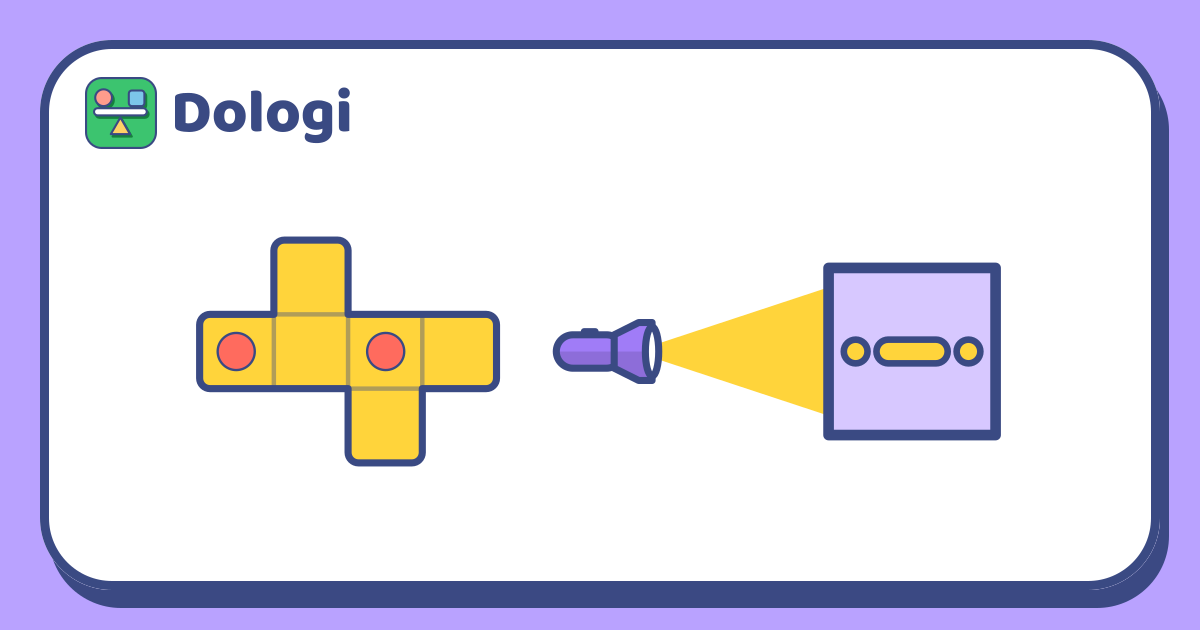
Draw a cross made of six equal squares on card: a strip of four in a row, with one square sticking out above and one below the second square. Cut it out, but don't fold it yet.
Put a dot on one square. Ask your child: "Once it's folded into a box, which square will be opposite the dot?" Your child points to their answer and marks it with a cross. Then fold it and check together.
After a few rounds, your child may spot a useful rule: two squares in a straight line with one square between them end up opposite each other. Let them discover it themselves, then test whether it still works on a different net shape.
To make it harder:
- A homemade dice. Draw dots from one to six on the net so that opposite faces add up to seven, the way many dice do. Fold it and roll it to check.
- Guess the neighbors. Ask which faces will touch the face with the dot, not just which one is opposite.
- Draw a new net. Your child draws a six-square net of their own, predicts whether it folds into a box, then cuts it out and tries.
Flashlight messages: holding and decoding a signal
Agree on a code with your child: a short flash is a dot, a long flash is a dash, and each word on a short list gets its own pattern. For example, "dinner" could be dot-dash and "bed" could be dash-dot-dot. Keep the code table on the fridge.
In a dim room, you flash a message on the wall with a flashlight. The challenge for a nine-year-old is to watch the whole message without writing anything down, then say it out loud or decode it from the table. Keeping several signals in mind while matching them to words is exactly the "hold and work on it" kind of memory that children use for mental arithmetic and multi-step problems.
Start with one word, then two, then a short sentence. Swap roles so your child sends to you. If you'd like to build a full code table, see the dot-and-dash code post linked at the end.
Ten things, three groups: remembering with a plan
Write ten words on a piece of paper, for example: apple, pencil, spoon, banana, ruler, cup, grapes, eraser, plate, bowl. Give your child thirty seconds to look, then turn the paper over and ask them to say as many as they can.
Next, try the same list again, but first suggest sorting it into groups: three fruits, three school things, four kitchen things. Many children remember more the second time, and they can check themselves: "I have three fruits; how many kitchen things am I missing?"
After that, ask your child to choose their own way of remembering:
- Group by meaning, like the example above.
- Make up a short story that joins the words in order.
- Picture each thing in a familiar place around the house.
Afterwards, ask which way worked best and why. Understanding that there are ways to remember, and choosing one that suits the task, is a skill your child will use for years.
Secret missions and guess-then-check
Secret missions. Give one spoken mission with three steps, said only once: "Take a blue pencil from your desk, put it on the third stair, then come back and tell me what's on the kitchen windowsill." Before setting off, your child repeats the mission in their own words. Once three steps are easy, try four. Then swap: your child writes a mission for you, and has to say each step clearly and in order.
Guess, then check. How many steps from the front door to the window? How many beans fill a cup? Your child guesses first, then counts. The second guess is the interesting one: did knowing the first answer help them guess better? Praise a guess that's closer than last time, not just a "right" answer.
If your child enjoys these games, the Memory and Space topics in Dologi have puzzles in the same spirit, such as folding a net into a box in your head, getting harder step by step as your child succeeds. A few minutes on a device each day is one more way to practice, not a replacement for play with card, scissors and a real flashlight.
In short
- Around age 9, many children can fold a net in their head, hold a short message in mind while decoding it and follow instructions with several steps.
- One game per skill: which face is opposite, flashlight messages, ten things in three groups, secret missions.
- Show your child several ways to remember, then let them choose and compare.
- Make guessing before checking a habit, and praise each guess that gets closer.
Read more: Thinking activities for 8-year-olds: secret codes, block stacks and the habit of checking your work, From flat shape to box: cube nets for children, Dot-and-dash codes for kids: send messages with taps and a flashlight