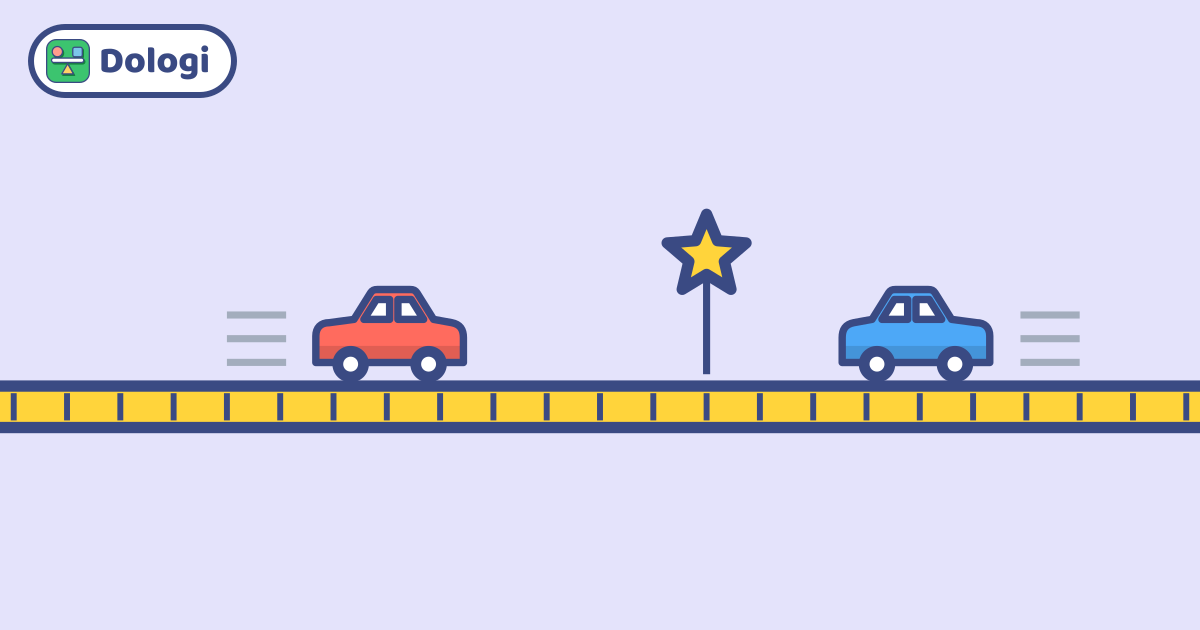
Around ages 10 to 12, children learn the formula: distance equals speed times time. Many can recite it and still go silent at "two cars set off from two cities and drive toward each other." The formula isn't the problem; your child has simply never seen the motion happen. This post is for parents of 10- to 12-year-olds: use a strip of tape and two toy cars to turn motion problems into something your child can watch and count.
Setting up the track
- A strip of masking tape stuck in a straight line on the floor, two or three meters long.
- Evenly spaced marks on the tape, 10 cm apart, numbered 0 to 20.
- Two toy cars in different colors, the push-along kind.
- Paper and a pencil to record each turn.
The basic rule: play in turns. Each turn, each car is pushed a fixed number of marks. "Marks per turn" is the speed, "number of turns" is the time, and "total marks traveled" is the distance.
Three quantities, three calculations
Put the red car on mark 0. Each turn it moves 3 marks. Ask your child: "After 4 turns, how many marks has it gone?" Your child pushes the car turn by turn and counts: 3, 6, 9, 12. A distance of 12 marks = 3 marks per turn × 4 turns.
That one multiplication gives three questions:
| You know | You want | Calculation | Real example |
|---|---|---|---|
| Speed and time | Distance | speed × time | A car at 60 km/h for 3 hours: 180 km |
| Distance and time | Speed | distance ÷ time | 120 km in 2 hours: 60 km/h |
| Distance and speed | Time | distance ÷ speed | 180 km at 45 km/h: 4 hours |
Let your child check each row with the cars and small numbers first, then move on to the real ones. (If you think in miles, the same reasoning works with miles per hour.)
Two cars heading toward each other: when do they meet?
Put the red car on mark 0 and the blue car on mark 20, facing each other. Each turn, red moves 3 marks and blue moves 2. Play turn by turn while your child records the positions:
| Turn | Red car at mark | Blue car at mark |
|---|---|---|
| 1 | 3 | 18 |
| 2 | 6 | 16 |
| 3 | 9 | 14 |
| 4 | 12 | 12 |
The cars meet at mark 12 after 4 turns. Now ask two questions:
- "Each turn, how many marks closer do the cars get?" (3 + 2 = 5 marks.)
- "When they meet, what do the two distances add up to?" (12 + 8 = 20, exactly the starting gap.)
That's the key: two cars meet when the distances they've traveled add up to the gap between them at the start. The gap shrinks by 5 marks each turn, so the number of turns is 20 ÷ 5 = 4.
A textbook problem: "Two cities are 150 km apart. A car leaves city A at 40 km/h while another leaves city B at 35 km/h, driving toward each other. After how many hours do they meet?" Each hour the cars get 40 + 35 = 75 km closer, so they meet after 150 ÷ 75 = 2 hours, 40 × 2 = 80 km from A.
Catching up: two cars going the same way
Put the red car on mark 0 and the blue car on mark 6, both facing right. Each turn red moves 3 marks and blue moves 1. Play until red catches up: on turn 3 they're both on mark 9.
This time ask: "Each turn, how much does red close the gap?" (3 − 1 = 2 marks.) The gap started at 6, so red catches up after 6 ÷ 2 = 3 turns. Toward each other, add the speeds; same direction, subtract them.
A real problem: "Your little sister has already walked 300 m toward school at 60 m per minute. You set off after her on your bike at 80 m per minute. How long until you catch up?" Each minute you close 80 − 60 = 20 m, so it takes 300 ÷ 20 = 15 minutes.
Draw the diagram before calculating
After a few rounds with real cars, your child moves to paper: draw a line for the distance, mark both ends, draw an arrow for each car in the direction it travels, then mark the meeting or catching-up point. Only once the diagram is done do they write the calculation. The diagram makes your child ask the right question: are the cars moving toward each other or the same way?
A common trap: units
Plenty of wrong answers come not from the method but from units: speed in km/h, time given in minutes, distance in meters. Remind your child to convert to matching units first: a car at 60 km/h for 30 minutes (half an hour) goes 30 km, not 1,800 km.
The Space topic in Dologi has a puzzle called Drive the car: "Fill every slot so the car drives over every star." Your child has to count the squares in each direction before the car moves, just like counting marks on the tape.
In short
- Marked tape and two toy cars: marks per turn are speed, turns are time, total marks are distance.
- Distance = speed × time; the two divisions follow from it.
- Toward each other: cars meet when their distances add up to the starting gap, so add the speeds; same direction: subtract them.
- Draw a line diagram with arrows before calculating, and convert to matching units.
Read more: Tree-planting and fence-post problems, Word problems: helping your child understand what the question is asking