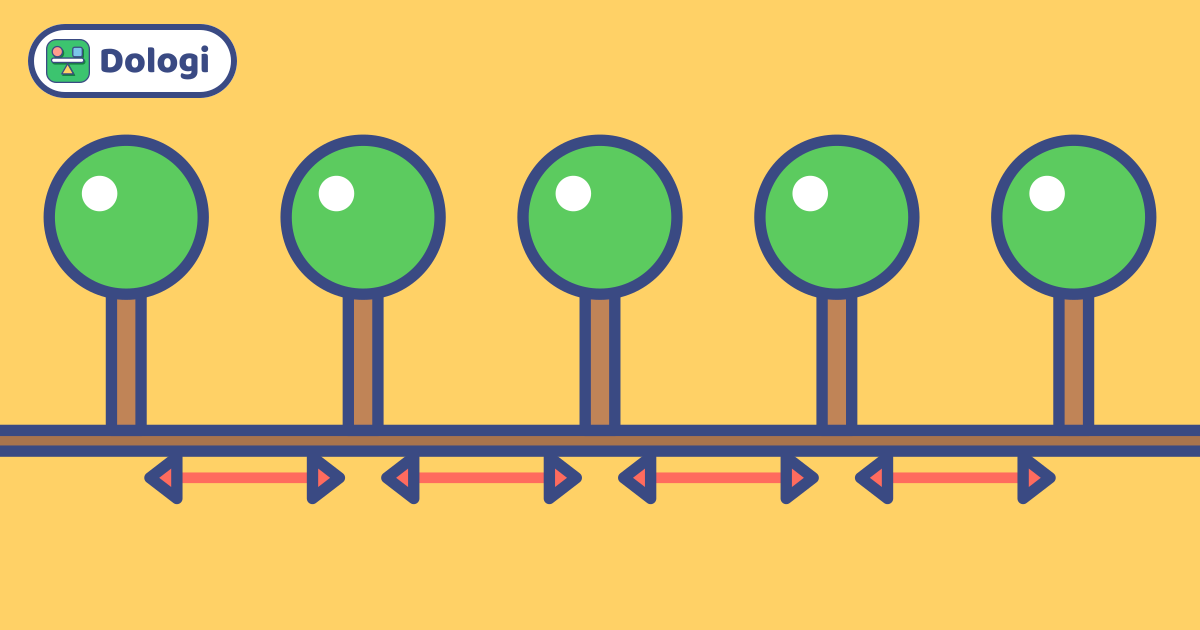
"A path is 20 meters long. A tree is planted every 5 meters, with a tree at each end. How many trees are there?" Most children answer straight away: 20 ÷ 5 = 4 trees. The right answer is 5. Tree-planting problems, also known as fence-post problems, trip up primary school children because of one small detail: the number of trees and the number of gaps aren't the same. This post is for parents of 7- to 10-year-olds, to help your child see that detail with their own hands before learning any formula.
Lay real sticks on the floor
Before solving anything, lay five sticks (chopsticks, pencils, craft sticks) in a row on the floor, evenly spaced. Ask your child:
- "How many sticks?" (5)
- "How many gaps between the sticks?" (4)
Then hold up a hand: five fingers, four gaps between them. Your child will remember this picture longer than any formula: with a stick at both ends, there's always one more stick than gaps.
Back to the 20-meter path: 20 ÷ 5 = 4 is the number of gaps. There's a tree at both ends, so the number of trees is 4 + 1 = 5.
The four cases
Use the sticks on the floor to try each case with the same 20-meter path and 5-meter spacing:
| Case | Example | Gaps | Trees |
|---|---|---|---|
| Trees at both ends | A row of trees along a path | 4 | 5 (gaps + 1) |
| A tree at one end only | From the gate to the house, none against the house wall | 4 | 4 (same as gaps) |
| No tree at either end | Between two houses, none against either wall | 4 | 3 (gaps − 1) |
| A closed loop | Around a pond or a round garden | 4 | 4 (same as gaps) |
For a loop, say around a pond 60 meters round with a tree every 5 meters: 60 ÷ 5 = 12 gaps, and also 12 trees, because going all the way round brings you back to the first tree. Lay the sticks in a circle and your child will see it at once.
Tip for your child: always work out the gaps first (length divided by spacing), then ask "is there a tree at each end?" to add 1, keep the same, or take away 1.
Problems from the same family
The same idea of "points and gaps" turns up all over the place. Try these on your child:
- Sawing wood: how many cuts to saw a log into 5 pieces? (4 cuts.)
- Stairs: going from the 1st floor to the 4th floor (counting the ground floor as the 1st), how many flights of stairs do you climb? (3 flights.) Children often say 4.
- A fence: 10 posts, 2 meters apart. How long is the fence? (9 gaps, 18 meters.)
- A striking clock: a clock takes 5 seconds to strike 6. How long to strike 12? (6 strikes have 5 gaps, 1 second each; 12 strikes have 11 gaps, so 11 seconds, not 10.)
- Counting days: a trip from the 3rd to the 10th of the month, inclusive: how many days and how many nights? (8 days, 7 nights.)
The clock is the trickiest: most adults answer 10 seconds too. Have your child clap 6 times while you count the pauses between claps.
Your child writes the problems
Once your child is comfortable, let them invent problems from things around them:
- A row of flower pots on the balcony, fence posts, streetlights on the way home.
- Counting steps and the landings between floors in an apartment building.
- Rows of seats at the theater, trees around the school field.
To write a problem, your child has to decide "is there a tree at each end?", which is exactly the part that matters most.
The Math topic in Dologi has a puzzle called Number line hops: "From the dot, the rabbit hops along the arrows. Which number does it stop on?" Each hop is a gap, and each number the rabbit lands on is a point. Count the hops or count the points: it's the same question as in tree-planting problems.
In short
- Lay sticks on the floor and hold up a hand: five fingers, four gaps; trees and gaps aren't the same.
- Always find the gaps first, then check the ends: both ends add 1, one end keeps it the same, neither end takes 1 away, a loop keeps it the same.
- Same family: sawing wood, stairs, fences, striking clocks, counting days.
- Your child invents problems from the rows of trees and streetlights around them.
Read more: A sidewalk chalk number line: hop forward to add, hop back to subtract, Word problems: helping your child understand what the question is asking