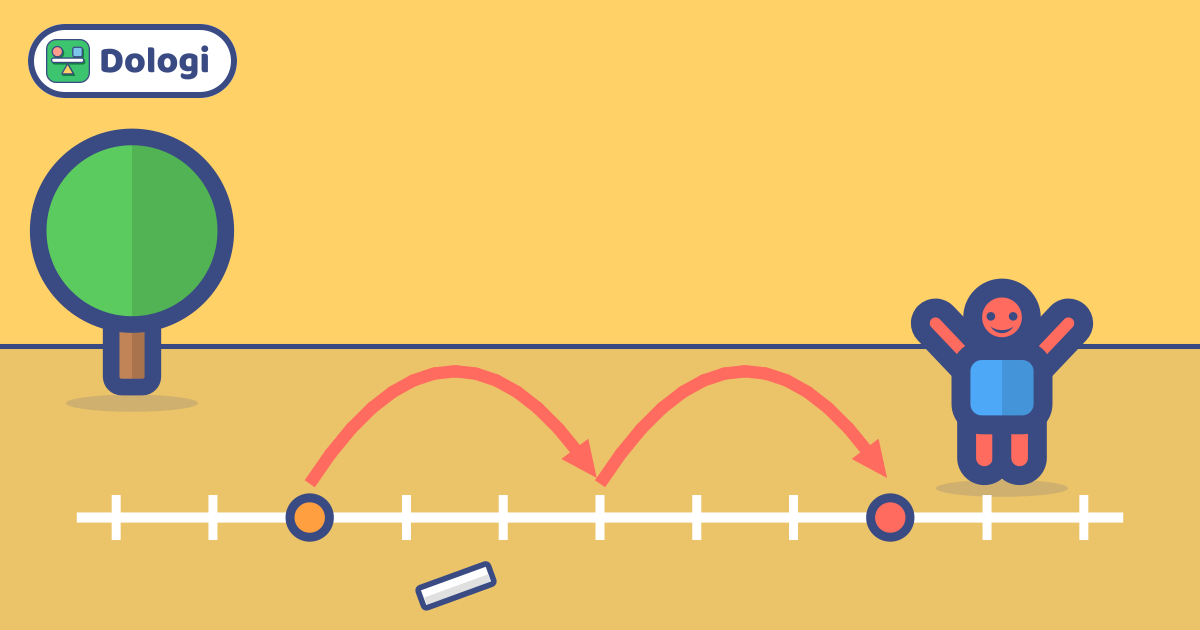
In first grade, your child will see a lot of number lines: a straight line with evenly spaced numbers, used for adding, subtracting and comparing. On paper, a number line is a row of tiny marks. Outside, it can be 20 feet long, and your child can walk it with their own two feet. When they hop from 3 to 7 themselves, they can feel that adding means moving forward, subtracting means moving back, and the distance between two numbers is something you can count in steps.
This post covers how to draw the number line, three games for kids roughly 5 to 8, and a few challenges for older kids. All you need is sidewalk chalk and a safe stretch of pavement.
Getting ready and drawing the line
- Where to play: a driveway, a patio, a quiet sidewalk or a playground with no cars. Indoors, use painter's tape on the floor.
- Draw a straight line about 16 to 20 feet long.
- Add evenly spaced tick marks, each one a comfortable hop for your child, roughly 16 to 20 inches apart. Even spacing matters most; a shoe works fine as a ruler.
- Write a number under each mark: 0 to 10 for beginners, 0 to 20 for kids who can already add within 10.
- A pebble or a beanbag to mark guesses.
Let your child write the numbers with you. Writing giant numbers on the ground is fun handwriting practice, too.
Game 1: Stand, hop, read the number
- Call out: "Stand on 3. Hop forward 4!"
- Your child stands on the 3 and counts each hop out loud: one, two, three, four.
- They read the number they landed on, 7, then say the whole thing: "3 plus 4 equals 7."
- For subtraction, hop backward: "Stand on 9. Hop back 3!" Your child can hop backward or turn around and hop.
A common mistake: counting the mark they're standing on as "one," which makes the answer off by one. Tell your child, "We count the hops, not the line you start on." At first, you can clap once for every hop so they count along with the claps.
Game 2: Guess where you'll land
Before hopping, your child puts the pebble where they think they'll stop. Then they hop to check.
- Spot on? Your child gets to shout "Nailed it!"
- Off? Ask, "By how many hops? Why?" Usually it's the counting-the-starting-line mistake above.
This game turns a math problem into a prediction you test. Over time, your child will place the pebble without needing to hop, which means they're doing the math in their head.
Game 3: The mystery hop
Switch roles: you hop, your child watches.
- You stand on 2 and hop to 9. Your child guesses: "What did you add?" They can count your hops, or stand on 2 themselves and hop to 9 to count.
- You stand on 10 and hop back to 6: "What did I take away?"
This is the "missing number" kind of problem (2 plus what equals 9?) that many kids find hard on paper. On a number line, it's just counting the distance between two marks.
Challenges for 7 and 8 year olds
| Challenge | How to play | What your child practices |
|---|---|---|
| Hop by 2s | From 0, each hop skips over two spaces: 0, 2, 4, 6… Then start from 1 | Skip counting, even and odd numbers |
| Hop by 5s | On a line to 20, hop 0, 5, 10, 15, 20 | Counting by 5s, a head start on multiplication |
| Through ten | Stand on 8, add 5: hop 2 to reach 10 first, then 3 more | Adding past 10 by splitting a number |
| Fewest hops | Get from 0 to 17 hopping 1, 2 or 5 spaces at a time. What's the fewest number of hops? | Trying different ways and comparing |
For the last one, let your child try a few routes and keep track of how many hops each takes with chalk tally marks beside the line. There's no need to give the answer right away; kids remember what they compare for themselves.
From the driveway to the worksheet
After a few sessions outside, when your child meets a number line on a worksheet, remind them: "Just like when we hopped outside." Let them "hop" a finger along the paper line, counting each step the same way. First addition: combining groups and first subtraction: taking away have more ways to teach adding and subtracting with objects before moving to the number line.
The Math topic in Dologi has a puzzle called Number line hops: "From the dot, the rabbit hops along the arrows. Which number does it stop on?" It's the same thing your child did on the driveway, except this time the rabbit does the hopping.
In short
- Draw a 16 to 20 foot chalk number line with evenly spaced marks one hop apart, numbered 0 to 10 or 0 to 20.
- Adding means hopping forward, subtracting means hopping back; count the hops, not the line you start on.
- Guess the landing spot with a pebble, then hop to check; switch roles for the mystery hop.
- Older kids can hop by 2s and 5s, add through ten, and find the route with the fewest hops.
Read more: Hopscotch: a counting game, First addition: combining groups