Your child knows the times tables and is solid at multiplying by a single digit, but 23 × 14 comes out as 115. Look at the workbook and you'll see why: the second row is written straight under the first, not shifted one place. Remind them "don't forget to move it over" and next time they forget again, because to them it's just a rule to remember. This article is for children aged 9 to 11 and helps them understand why the row shifts, so they no longer need to remember it.
The common mistake
Working out 23 × 14 in columns, your child does this:
- 23 × 4 = 92, writes 92. Correct.
- 23 × 1 = 23, writes 23 straight under the 92. Wrong place.
- Adds 92 + 23 = 115.
The right answer is 322. Every multiplication was right; the 23 was just in the wrong place.
Your child can catch this mistake on their own: 23 × 14 must be bigger than 23 × 10 = 230. An answer of 115 makes no sense.
Why children forget
When multiplying by the 1 in 14, your child thinks "23 times 1 is 23." But that 1 is in the tens place: it's 10, not 1. The second row is really 23 × 10 = 230. Shifting one place to the left is simply a way of writing 230. Without seeing this, all your child has is a strange rule to memorize.
Step 1: See the pattern of multiplying by 10
Have your child work these out and look closely:
| Number | Times 10 |
|---|---|
| 7 | 70 |
| 23 | 230 |
| 45 | 450 |
| 108 | 1,080 |
Ask: "Where did the digits move?" Every digit moves one place to the left, and the ones place becomes 0. That's the pattern your child will use in the second row.
Step 2: A rectangle of squares
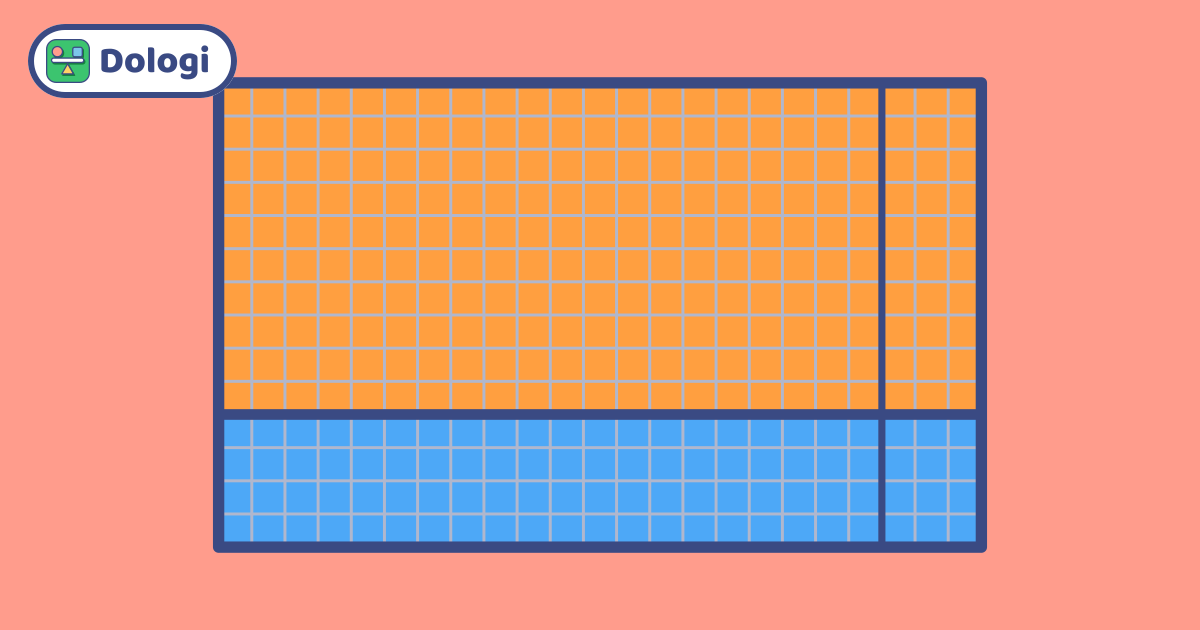
- On squared paper, draw a rectangle 23 squares wide and 14 rows tall. The number of squares inside is 23 × 14.
- Draw a line across after the tenth row. The top part has 23 × 10 = 230 squares, the bottom strip 23 × 4 = 92.
- Color the two parts differently and add them: 230 + 92 = 322.
Your child sees right away that the big top part is "23 times 10," many times bigger than the thin strip. Writing it as 23 under the 92 makes that big part smaller than the strip, which is clearly wrong.
For even more clarity, draw a vertical line splitting the 23 columns into 20 and 3. Now there are four pieces: 20 × 10 = 200, 3 × 10 = 30, 20 × 4 = 80, 3 × 4 = 12. Added up, still 322.
Step 3: Move on to the written method
Once your child has seen the two parts on the grid, switch to the column method. In many English-speaking schools, children write a 0 in the ones place of the second row:
| Hundreds | Tens | Ones | |
|---|---|---|---|
| First number | 2 | 3 | |
| Second number (×) | 1 | 4 | |
| First row: 23 × 4 | 9 | 2 | |
| Second row: 23 × 10 | 2 | 3 | 0 |
| Answer | 3 | 2 | 2 |
Say it out loud: "4 times 23 is 92, that's the thin strip. 1 ten times 23 is 23 tens, which is 230, that's the big part, so it starts in the tens column." That placeholder 0 is the reminder that the second row is times ten.
Checking with an estimate
Before calculating, ask: "Which two numbers will the answer be between?" 23 × 14 is more than 23 × 10 = 230 and less than 23 × 20 = 460. An answer of 322 is in between, so it's reasonable. An answer of 115 is outside, so the shift was definitely forgotten.
Two to try:
- 35 × 12: 35 × 10 = 350, 35 × 2 = 70, total 420. Forgetting the shift gives 70 + 35 = 105, smaller than 350.
- 46 × 13: 46 × 10 = 460, 46 × 3 = 138, total 598.
The Patterns topic in Dologi has a puzzle called Changing machine: "The machine does the same thing every time. What comes out?" Multiplying by 10 is a machine like that: whatever number goes in, every digit moves one place to the left.
In short
- Forgetting to shift (23 × 14 becomes 115) comes from treating the tens digit as 1 instead of 10.
- Show your child the pattern of multiplying by 10: every digit moves one place left.
- Draw a rectangle of squares, split 23 × 14 into 23 × 10 and 23 × 4, and only then move to the written method.
- Estimate first: the answer must be between 23 × 10 and 23 × 20.
Read more: Times tables: memorize or understand first?, Roll two dice, draw a rectangle