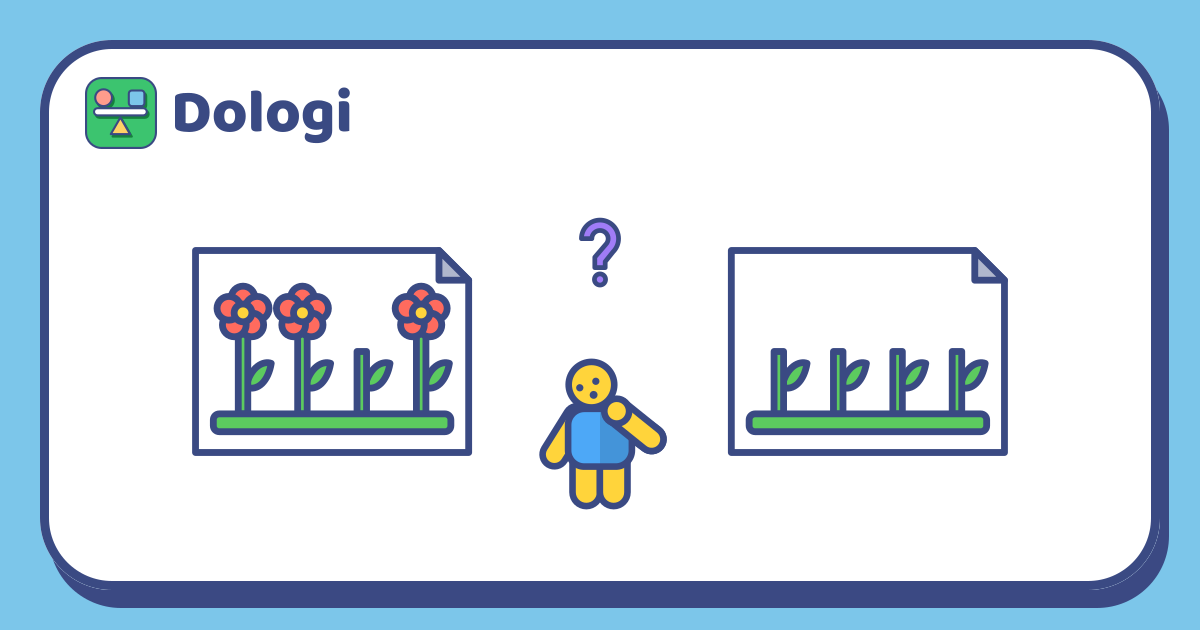
Your child picks a flower from the park flower bed. "It's only one," they say, and in a way they are right: nobody will notice a single missing flower. But what if everyone who walked past that day picked one too?
"What if everyone did that?" is a short question that helps children step back from their own small action and imagine it multiplied. It works on park flowers, candy wrappers and pushing into a line, and it gets children reasoning rather than just following a rule. This article shows how to use it with children aged roughly 6 to 11, with situations to talk about, a drawing activity and a way to let your child make their own rule.
Why one small action can add up
Many everyday rules exist not because one person's action causes a problem, but because many people's actions together do. One wrapper left on a bench is a small mess. A wrapper from every visitor turns the bench into a trash can. One child cutting in line saves a minute. If everyone cut in, there would be no line at all, just a crowd pushing.
Young children tend to judge an action by what they can see right now, and right now one flower or one wrapper looks like nothing. The question "what if everyone did it?" gives them a way to see what is hidden: the effect that only appears when the same small thing happens many times. It is the same kind of thinking children use in math when they go from "one" to "a hundred", applied to how people live together.
Everyday situations to talk about
Choose situations your child really meets. Ask two questions for each one: "What happens if one person does it?" and "What happens if everyone does it?"
| Situation | If one person does it | If everyone does it |
|---|---|---|
| Picking a flower in the park | One flower is missing, hardly noticeable | The flower bed is empty, nobody can enjoy it |
| Leaving a candy wrapper on a bench | One small piece of litter | The bench is covered, nobody wants to sit there |
| Pushing in front of someone in a line | One person waits a bit longer | The line falls apart and people argue |
| Leaving the faucet running while brushing teeth | A little water wasted | A lot of water wasted every day |
| Talking loudly in the library | One person is a bit distracted | Nobody can read |
Let your child fill in the last two columns themselves. Some children see the "everyone" side straight away, others need a nudge: "How many people walk through this park on a Sunday? About how many flowers would be left?" Rough numbers are enough. The point is the picture in their head, not the exact count.
Draw two pictures
Drawing makes the difference visible. Give your child two sheets of paper and ask them to draw the same place twice:
- Picture one: one person did it. The flower bed with just one flower missing, or the bench with one wrapper.
- Picture two: everyone did it. The same flower bed with only bare stems, or the bench buried in wrappers.
- Put them side by side and ask: "Which place would you rather visit? What made the difference?"
Children usually notice that each person did exactly the same small thing in both pictures. Only the number of people changed. That is the key idea, and it is better when your child says it in their own words than when you explain it.
Let your child make the rule
After the pictures, ask your child to turn what they found into a rule for everyone: "So what should the rule in the park be?" Then ask for the reason: "Why is that a good rule?"
A rule with a reason is easier to remember and easier to follow than one that is simply handed down. "Don't pick the flowers, so that everyone who comes later can see them too" holds together much better than "Don't pick the flowers, because I said so."
You can also test the rules together:
- Is the rule fair to everyone? Would it still make sense if it applied to the grown-ups too?
- Is there an exception? For example, picking flowers from your own garden, or a wildflower meadow where picking is allowed.
- Does the question always work? Try "What if everyone became a doctor?" Nobody would bake bread or drive buses, but that doesn't make being a doctor wrong. The question works best for actions that use up or spoil something people share, like a park, quiet or a line.
That last point matters for older children. "What if everyone did that?" is a tool for thinking, not an automatic verdict. Learning when it fits is part of reasoning well. It is also the reverse of the excuse "but everyone does it!", which children often use to argue that something must be fine.
Keep the talk light
This conversation works best as a puzzle to think about together, not as a lecture or a way to make your child feel guilty.
- Talk when things are calm, not right after your child has picked a flower and been told off. A real event can come up later: "Do you remember the flower bed? Let's think about it."
- Ask, don't announce. "What do you think would happen?" invites thinking. "If everyone did that the park would be ruined!" ends it.
- Include yourself. Look for things you do too: printing pages you don't need, leaving lights on. Children notice when the rule applies to everyone.
- Praise the reasoning, not only the "right" answer: "You thought about the people who come later, that's a good way to look at it."
If your child enjoys this kind of "what follows from what" thinking, the Logic topic in Dologi has short puzzles that practice the same habit: working out a rule and then checking that it holds in every case, not just the first one.
In short
- "What if everyone did that?" helps children see how small actions add up when many people repeat them.
- Use real situations, ask what happens with one person and with everyone, and let your child fill in the answers.
- Drawing two pictures, one person and everyone, makes the difference easy to see and talk about.
- Ask your child to make a rule and give the reason, then test it together, including when the question doesn't fit.
Read more: Flaws in arguments: helping children aged 9 to 12 spot "everyone does it", Accident or on purpose? Talking with your child about intentions and consequences, Is sharing equally the same as sharing fairly?