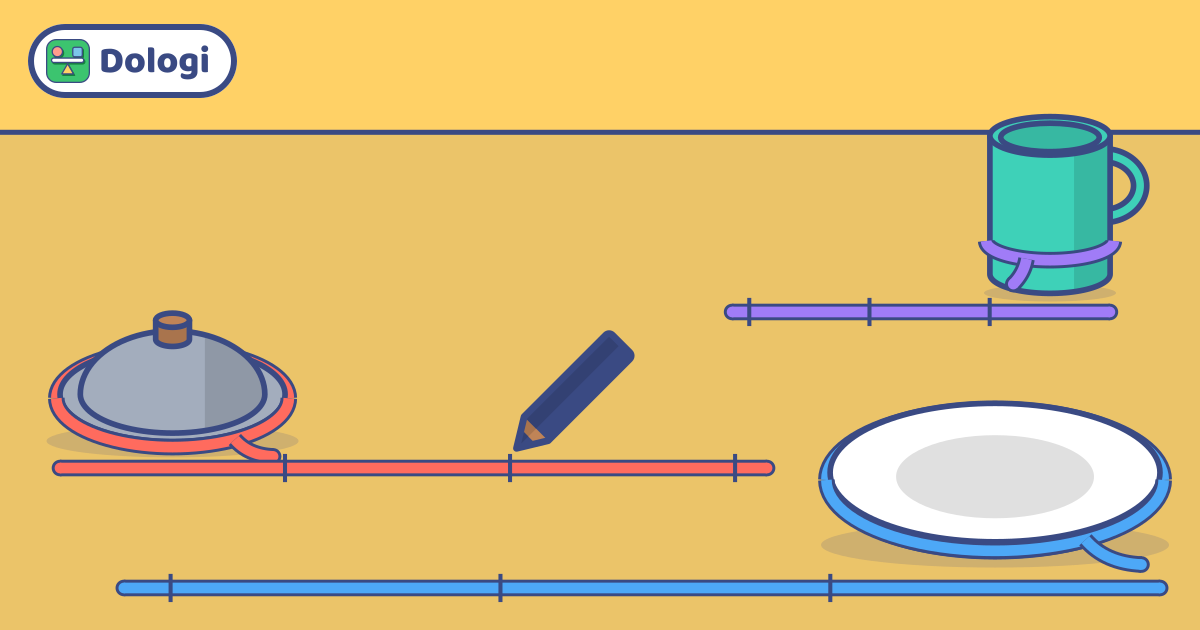
For many kids, pi is just a button on the calculator or "3.14, memorize it." But pi isn't a rule someone made up. It's something you can discover with a piece of string and a few round things from the kitchen. Wrap the string around a circle, measure across it, divide one by the other, and you'll get a little more than 3. Try a bigger circle and you'll get a little more than 3 again. That surprise is what makes pi stick.
This activity works well for ages 10 to 12, when children already know how to divide with decimals. Younger kids can still help with the measuring and enjoy the "it's always 3 and a bit" moment.
What you need
- Round objects of different sizes: a jar lid, a mug, a pot lid, a dinner plate. Anything with a clean circular edge works, including a can or a bike wheel.
- String that doesn't stretch: kitchen string or thin cotton cord. Yarn and elastic stretch, which throws off the measurement.
- A tape measure or ruler. A soft sewing tape measure is handy, and centimeters make the division easier than fractions of an inch. Inches work fine too.
- A pencil or marker, paper for a table, and a calculator for checking.
Step by step: wrap, mark, straighten
- Wrap. Have your child wrap the string snugly around the widest part of the object, once, until it meets the starting point. No slack, no overlap.
- Mark. Pinch the string where it meets the start, or mark that spot with a marker.
- Straighten. Lay the string out flat along the tape measure and read the length from the end to the mark. This is the circumference: the distance all the way around.
- Measure across. Measure the widest distance straight across the circle, through the center. This is the diameter. A trick for getting it right: stand two books upright on either side of the object so they touch its edge, take the object out, and measure the gap between the books.
A nice extra: cut a piece of string exactly as long as the diameter and lay it along the straightened circumference string. It fits three times, with a short piece left over. Your child can see pi before doing any arithmetic.
Fill in a table and divide
Write down each object, the distance around, the distance across, and then divide around by across. Here's what one family's measurements might look like, in inches:
| Object | Around (circumference) | Across (diameter) | Around ÷ across |
|---|---|---|---|
| Mug | 9½ in | 3 in | about 3.17 |
| Jar lid | 12½ in | 4 in | 3.125 |
| Pot lid | 28¼ in | 9 in | about 3.14 |
| Dinner plate | 31½ in | 10 in | 3.15 |
The objects are very different sizes, yet every answer lands just above 3. Ask your child: "If we measured a giant circle, like a merry-go-round, what do you think we'd get?" Then, if you can, go measure one.
The answers aren't exactly the same because no measurement is perfect: the string sags a little, the tape measure only shows quarter inches. Averaging the four results (add them and divide by 4) gives about 3.15, already very close to the real value.
From the table to the formula
That number, the same for every circle no matter its size, has a name: pi, written with the Greek letter π. It's about 3.14159, and its digits go on forever without repeating, so we usually round it to 3.14. Some kids enjoy knowing that March 14 (3/14) is celebrated as Pi Day.
Since circumference ÷ diameter = π, turning it around gives the formula children meet in middle school (in the US, circumference formulas are usually taught in 7th grade):
- Circumference = π × diameter, or C = πd
- The radius is half the diameter, so also C = 2 × π × radius
Real-life questions to try:
- A bike with 24-inch wheels: one full turn of the wheel moves the bike about 3.14 × 24 = 75.36 inches, a little over 6 feet.
- Going backwards: a tree trunk measures 157 cm around. How thick is it? 157 ÷ 3.14 = 50 cm across.
Another way to measure the circumference: put a dot on the edge of a can, line it up with a mark on paper, roll the can one full turn in a straight line and mark where the dot touches down again. The distance between the marks is the circumference. That's exactly the bike wheel question.
The Math topic in Dologi has a puzzle called Count the turns. Each gear shows its number of teeth, and children work out how many times the question-mark gear turns. The hint gives the key idea: gears that touch move the same number of teeth, so the smaller gear has to spin more times to cover the same distance along its edge. It's the same thinking as the bike wheel: what matters is the length around the edge.
Why the numbers aren't exactly 3.14
These are the most common mix-ups, and each one is a good conversation:
- Measuring across, but not through the center. A line that misses the center is shorter than the diameter, so the result comes out too big (3.4 or 3.5). The two-book trick fixes this.
- A loose or stretchy string. Slack adds length, so the answer climbs above 3.2. Pull it snug, and use string that doesn't stretch.
- Mixing up radius and diameter. If your child gets about 6.28, they divided by the radius. Double the radius, or use C = 2πr.
- Thinking π is exactly 3.14. 3.14 is a rounded value. It's close enough for homework, but a calculator's π key gives more digits.
- Mixing units. Measure around and across in the same unit, inches with inches or centimeters with centimeters.
In short
- Wrap a string around a round object, straighten it and measure: that's the circumference. Measure straight across through the center: that's the diameter.
- Circumference ÷ diameter is always a little more than 3, for a mug as much as for a plate. That number is π, about 3.14.
- So circumference = π × diameter, or 2 × π × radius.
- If the result is far from 3.14, check that you measured through the center and that the string was snug.
Read more: Perimeter and area for kids: going around the edge vs. covering the inside, Decimals for kids aged 9–11: start with a ruler and money