"What's the biggest number? A gazillion? Infinity plus one?" The question tends to pop up right after a child learns to count to a hundred, or the first time they hear someone say "infinity." Answering "there isn't one" is correct, but it hands your child a fact to remember instead of an idea to understand. It's more fun, and sticks better, when they see for themselves why there can't be one. This post suggests a few short games and activities, using nothing more than paper, scissors, and a pencil, for talking about infinity in a way that's mathematically honest and still kid-sized.
The "say a bigger number" game
Take turns saying a number. Each person has to beat the last one. Your child says "one hundred," you say "one hundred and one." They say "a thousand," you say "a thousand and one." They say "a million million," and you still just add one.
After a few rounds, most kids protest: "You just keep adding one, so you always win!" That's exactly the point. Ask them:
- "Is there any number you can't add one to?"
- "If you say the biggest number you know, can I say a bigger one?"
They'll work it out: every number has a bigger one, so there is no biggest number. The counting numbers 1, 2, 3, 4… go on forever and never run out. That's what infinite means: not a really, really big number, but "it never stops."
Expect the comeback: "Then infinity plus one!" You can explain gently that infinity isn't a number sitting at the end of the counting line, because the counting line doesn't have an end. It's a way of saying the numbers never finish.
Cutting a strip of paper in half forever
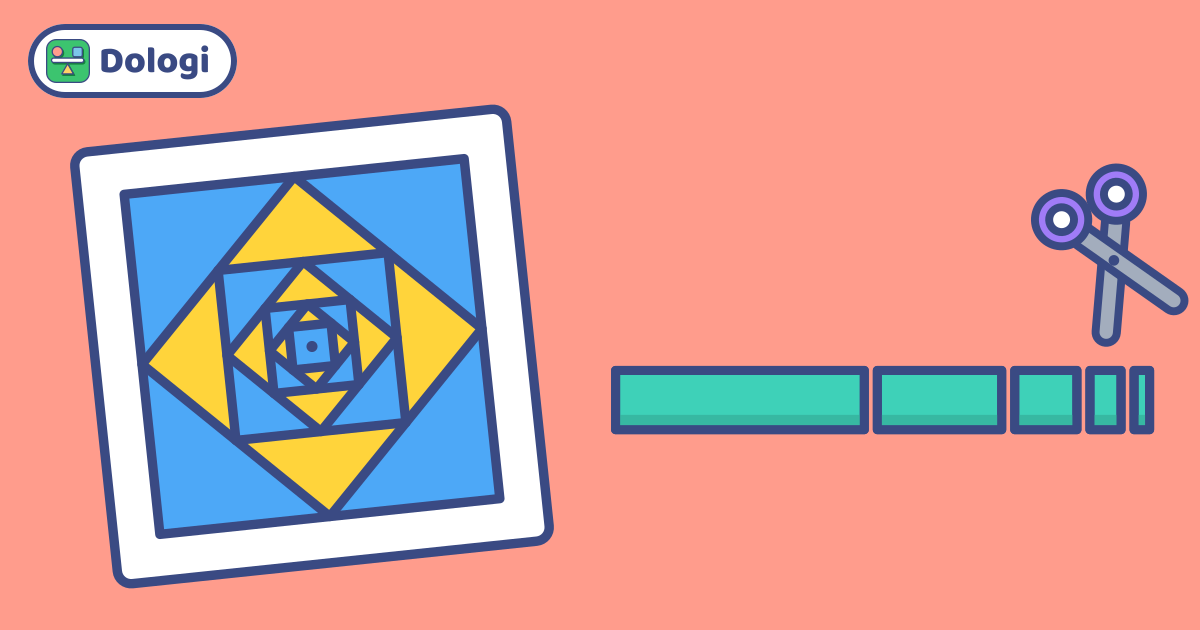
Infinity doesn't only go toward big numbers. Grab a paper strip about 12 inches long and some scissors. (A strip cut from the long side of a sheet of copy paper works well.)
- Cut the strip in half. Set one half (6 inches) aside.
- Cut the other half in half. Lay one piece (3 inches) next to the first.
- Keep cutting what's left in half: 1½ inches, ¾ inch…
After four cuts, the row of pieces is 6 + 3 + 1½ + ¾ = 11¼ inches long, and your child is holding the last ¾ inch. Ask: "When will we run out of paper to cut?"
With real scissors, a few more cuts and the scrap is too small to handle. But in your head, there's always a piece left to cut in half: three eighths of an inch, then three sixteenths, and smaller still. Two things your child can notice:
- The piece left over is always exactly as long as the piece you just cut off, so it never gets to zero.
- However many times you cut, all the pieces together are never longer than the strip you started with.
So you can do something forever inside one short strip of paper.
Squares inside squares
Draw a big square on paper. Mark the middle of each side and join the four marks: a new, tilted square appears inside. Mark the middles of the new square's sides and join them too. Color the squares in two alternating colors so they're easy to see.
Each square is smaller than the last, and they close in on a single point in the middle. Eventually the pencil line is thicker than the square and your child has to stop, but in their imagination there's always room for one more.
For older kids there's a neat check: cut out the big square and fold all four corners in to the center. The corners cover the inner square exactly, which shows the inner square has half the area of the outer one. The next square is half of that half, and so on forever.
For ages 10–12: the strange side of infinity
Write two rows of numbers:
| Counting numbers | 1 | 2 | 3 | 4 | 5 | … |
|---|---|---|---|---|---|---|
| Doubled | 2 | 4 | 6 | 8 | 10 | … |
Every counting number has a partner below it, its double, and every even number has exactly one partner above it, its half. Nobody is left over and nobody is missing a partner. When two collections pair up perfectly like this, mathematicians say they are "the same size."
Here's the strange part: the even numbers are only some of the counting numbers, since all the odd ones were left out. That can't happen with a limited collection: from 1 to 10 there are 10 numbers but only 5 even ones. With infinity, a part can be "as big as" the whole. If your child says "that makes no sense," that's a perfectly natural reaction to a genuinely surprising idea, and a good reason to keep talking.
A puzzle with the same idea: a hotel has infinitely many rooms, and every room is full. A new guest arrives. How can they fit in? (Hint: ask every guest to move to the room whose number is one higher. Room 1 is now free.)
Keeping the conversation kid-sized
- Ages 6–8: the bigger-number game, counting on from a big number ("what comes after nine hundred ninety-nine?"), cutting the strip in half. The goal is just "there's always more."
- Ages 8–10: cutting with a ruler, nested squares, and questions like "is there a biggest even number? What about odd?"
- Ages 10–12: pairing numbers with their doubles, the hotel puzzle, and "how many numbers are there between 0 and 1?" (Between any two numbers you can find their average, which sits right between them, so there's always another one.)
When your child asks something you're not sure about, it's fine to say "I don't know either, let's think about it together." Infinity puzzles grown-ups too.
In the Patterns topic in Dologi there's a puzzle called Next number: the numbers go up or down by the same amount each time, and your child finds the one that comes next. A sequence like that could be continued forever, just like the counting numbers that never reach an end.
In short
- There is no biggest number: you can always add one, and the "say a bigger number" game lets your child discover that.
- Infinity isn't a huge number; it means "never runs out."
- Cutting a strip in half forever or drawing squares inside squares shows infinity going smaller, too.
- For older kids, pairing each number with its double shows that part of an infinite collection can be "as big as" the whole.
Read more: What does a thousand look like? Helping children picture big numbers, Patterns in numbers: odd and even, counting in twos and skip counting, What is an average? Simple statistics for older kids, starting with stacks of blocks