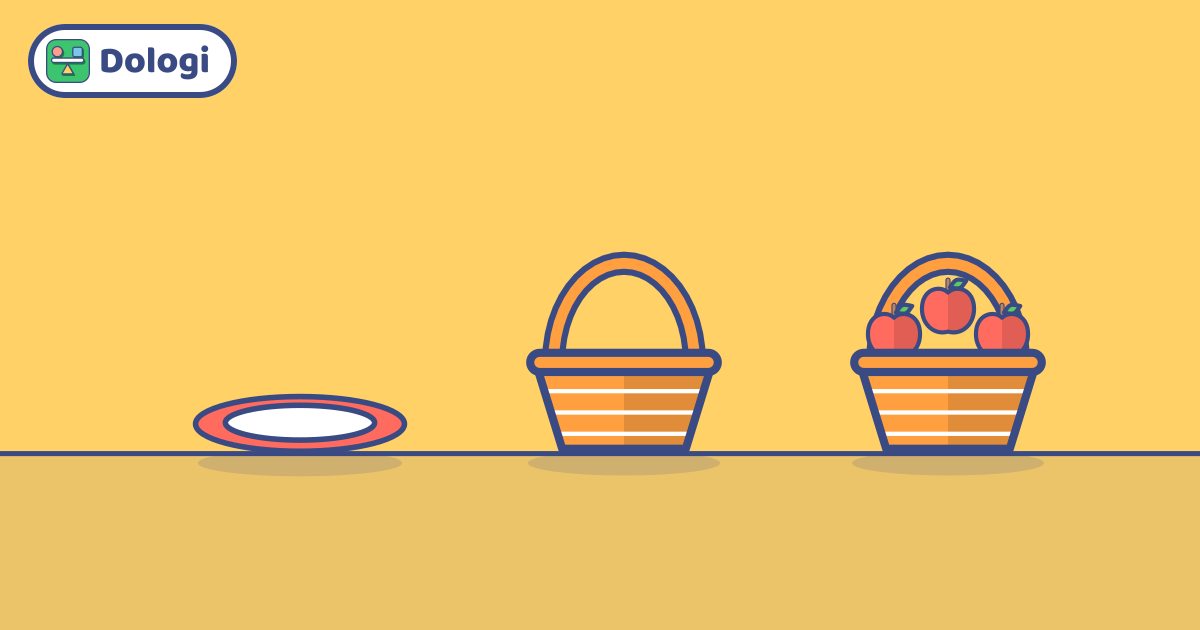
Your child can count to ten, to twenty, but ask "How many apples are in the basket?" when it's empty and they hesitate, or just say "none." Zero is trickier than it looks: children count from 1, and at zero there's nothing to count. Zero also has two jobs: it's a number (none of something), and a placeholder digit in 10 and 105. Here's a step-by-step path for children aged 4 to 8.
Why zero is hard
- Counting always starts at 1. Your child points at each apple and says 1, 2, 3. With no apples, there's nothing to point at.
- "None" doesn't sound like a number. Kids easily think zero is just a way of saying "all gone."
- The digit 0 looks like the letter O, so it gets mixed up in writing.
- A placeholder zero isn't said out loud: we say "one hundred and five," nobody says "zero tens," yet the 0 still has to be written.
Step 1: Zero means "none at all"
Start with real things:
- Put three apples in a basket and count together: 3. Take them out one by one: 2, 1. Take the last one: "How many are left?" "None left. Zero apples. We write it 0."
- Put a plate with two cookies next to an empty plate: "This plate has 2 cookies. How many does that one have?" The empty plate has a number too: 0.
- Count down like a rocket launch: "5, 4, 3, 2, 1, 0, blast off!" Zero is the moment it's over, which makes it easy to remember.
The important part: let your child say a full sentence with zero in it: "The plate has 0 cookies," not just "none."
Step 2: Zero comes before one
- A homemade number line: draw a long line on paper, write 0 at the start, then 1, 2, 3… Ask: "Which number is smaller than 1?" Zero.
- The ruler: show your child the 0 mark at the end of the ruler. To measure a pencil, line up the 0 mark with the tip of the pencil, not the edge of the ruler. This is exactly where many 6- and 7-year-olds go wrong when measuring.
- "Who has fewer?": everyone grabs a handful of dried beans, and sometimes you deliberately grab nothing. "I've got 0 beans. Who has the fewest?"
Step 3: Sums with zero
Use plates and baskets for each one, so your child sees it rather than just memorizing it:
| Calculation | With real objects | What your child notices |
|---|---|---|
| 3 + 0 = 3 | A basket of 3 apples, add 0 apples | Adding nothing changes nothing |
| 3 − 0 = 3 | A basket of 3 apples, take out 0 apples | Taking nothing away changes nothing |
| 3 − 3 = 0 | Take out all 3 apples | Take them all and 0 are left |
| 0 + 0 = 0 | Put two empty plates together | Nothing and nothing is still nothing |
| 5 × 0 = 0 | Five plates with 0 cookies each (ages 7–8) | Any number of empty plates still means 0 cookies |
A common slip: your child sees "3 + 0" and writes 0, mixing it up with "times 0 is 0." Go back to the basket of apples: adding no apples leaves 3 in the basket.
Step 4: Zero holds a place (ages 6–8)
Once your child meets two- and three-digit numbers, zero gets a second job: holding the place of a column that has nothing in it.
- The number 10: one bundle of ten sticks and no loose sticks. Write 1 in the tens column and 0 in the ones column. Without the 0, it's just 1.
- The number 105: draw a chart with three columns, Hundreds, Tens and Ones. Put down 1 hundred bundle, 0 ten bundles and 5 loose sticks. The empty tens column gets a 0: 105. Drop the 0 and you get 15, a completely different number.
- Saying and writing: we say "one hundred and five" without saying anything for the tens. Many children write "1005" because they hear "one hundred" and then "five." Having your child place sticks in the three-column chart before writing makes this mistake much rarer.
From around age 9, you can add: zero doesn't always mean "nothing." A temperature of 0 degrees doesn't mean there's no temperature; it's just one mark on the thermometer.
Games with zero
- A die with a blank face: cover one face of a die with paper. Roll the blank face and you take 0 beans. Whoever has the most beans after five turns wins. Your child gets used to 0 being a real result.
- Cups and guesses: hide 0 to 3 marbles under each upside-down cup; your child guesses and lifts. An empty cup means saying "0 marbles."
- Toy shop: set up a shop with prices, including one item that's free, costing $0.
Understanding zero by age
| Age | What children usually grasp |
|---|---|
| 4 | An empty plate or basket means "none"; counting down to 0 |
| 5–6 | Reading and writing 0; 0 is smaller than 1; adding and subtracting 0 with real objects |
| 6–8 | Zero as a placeholder in 10, 20, 105; the 0 mark on a ruler; multiplying by 0 |
The Math topic in Dologi has a puzzle called Number line hops: "From the dot, the rabbit hops along the arrows. Which number does it stop on?" At home, draw a number line that starts at 0 and let your child hop along it with a finger; they'll clearly see that 0 sits right before 1.
In short
- Zero is hard because there's nothing to count, and it's both a number and a placeholder digit.
- Start with an empty plate and basket, count down to 0, and have your child say "there are 0…".
- Do sums with 0 using real objects: adding or taking away nothing changes nothing; taking everything leaves 0.
- Zero holds a place in 10 and 105; place sticks in a Hundreds, Tens, Ones chart before writing to avoid "1005."
Read more: Tens and ones: teaching place value with bundles of sticks, Is it OK for children to count on their fingers?