Your child sits down to long division and gets lost by the second step. Or they can read a page aloud but can't tell you what it said. It's tempting to drill today's lesson harder, or to decide your child "just isn't good at it."
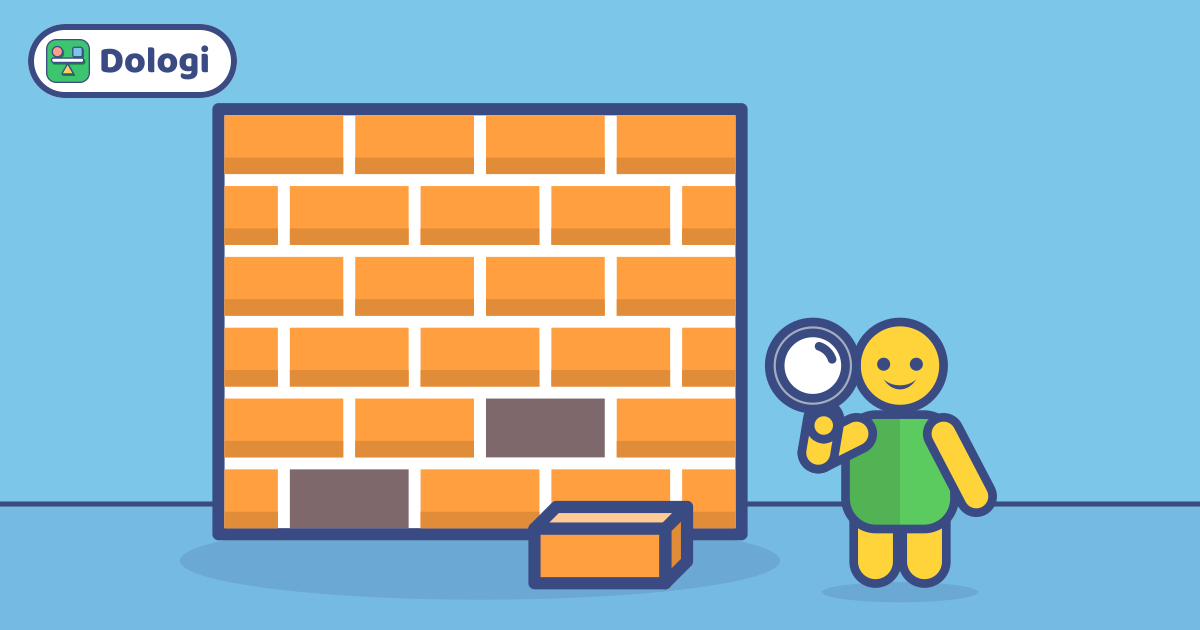
Often the trouble isn't today's lesson at all. School skills are built like a wall, each row resting on the one below. If a brick from a year or two ago never quite settled, everything on top of it wobbles. The good news: once you find that brick, a short daily fix can make the new work far easier.
What a gap looks like
A gap usually shows up as a pattern, not as one bad day:
- the mistakes in new work come from an old step (the division is set up right, but 6 × 7 comes out as 43),
- basic steps are very slow, so every problem feels endless,
- homework that should take 15 minutes takes an hour,
- your child says "I'm bad at math" or "I hate reading" about a whole subject.
None of this means your child is lazy or not smart. It means something underneath needs a little more time.
Trace back from the mistake
Start from a real piece of work your child got wrong, not from a guess.
- Look at the mistake itself. Is it the new idea, or a small step inside it?
- Ask your child to solve one problem out loud. "Tell me what you're doing." Listen without correcting.
- Find the first place where it breaks. That step, not the whole topic, is where to look further.
Skills come in a real order. In math, for example: place value (tens and ones), then adding and subtracting with carrying and borrowing, then multiplication facts, then division facts, then long division and fractions, which rely on all of these. In reading: letter sounds, then sounding out words, then reading smoothly, then understanding what was read. A child who reads word by word has little attention left for meaning, which is why comprehension questions can feel impossible.
Check each step with a few quick questions
Go down the ladder one step at a time with 3 to 5 short questions per step. No timer, no grades. Stop at the first step that feels solid: the gap is just above it.
| Step | Quick check | Answers |
|---|---|---|
| Long division | 96 ÷ 4 | 24 |
| Division facts | 28 ÷ 4, 36 ÷ 6 | 7, 6 |
| Multiplication facts | 7 × 4, 6 × 8 | 28, 48 |
| Subtracting with borrowing | 52 − 37 | 15 |
| Place value | In 352, what is the 5 worth? | 50 |
For reading, the steps look like this: Can your child retell a short paragraph? Can they read it aloud smoothly? Can they read the hard words in it one by one? Do they know the sounds of letter teams like sh, ch and ea?
Make it feel like a game ("Let's see which questions are easy for you"), and say clearly that the easy ones count too.
Fill from the root, 10 minutes a day
- Practice the shaky step, not the whole topic. Ten minutes most days beats a long weekend session.
- Go back to objects and drawings. Counters, a hundred chart, drawn groups for multiplication; reading short lists of words with the same letter team.
- Move up when it's solid, meaning correct and fairly quick on different days, not just once. Then practice the next step up.
- Keep up with current schoolwork in parallel. You're not pulling your child out of the class; you're strengthening the floor while they keep going.
- Explain it kindly: "This brick is a bit wobbly, so we're fixing it. It'll make the new stuff easier." Your child should hear that the gap is normal and fixable.
For multiplication facts, see times tables: memorize or understand first?. For slow reading, see building reading fluency at home, and then reading comprehension step by step. Word problems mix reading and math; helping your child understand word problems can help once both are steadier. Turning the fix into weekly steps with check marks keeps it visible; see small learning goals.
Talk with the teacher
Share what you found: "Division seems hard because the times tables aren't automatic yet." Ask what the teacher sees in class, whether they agree, and what to practice at home.
If the difficulty lasts for months even with regular practice, shows up in many areas, or your child is very upset about school, ask the teacher whether it's worth having the school or a specialist look more closely. You don't need to figure that out alone.
Dologi's puzzles follow a similar idea: in each topic, the puzzles adjust to how your child is doing and only get harder when the easier ones go well. At the end of a session, your child can also tap Too easy, Just right or Too hard.
In short
- Trouble with today's lesson often comes from a skill from earlier grades.
- Start from a real mistake, ask your child to think aloud, and find the first step that breaks.
- Check each step down with a few quick questions, then practice the shaky one 10 minutes a day while schoolwork continues.
- Share what you find with the teacher, and ask for more help if it stays hard for months.
Read more: Good at math but struggles with reading, Setting small learning goals, Building reading comprehension step by step