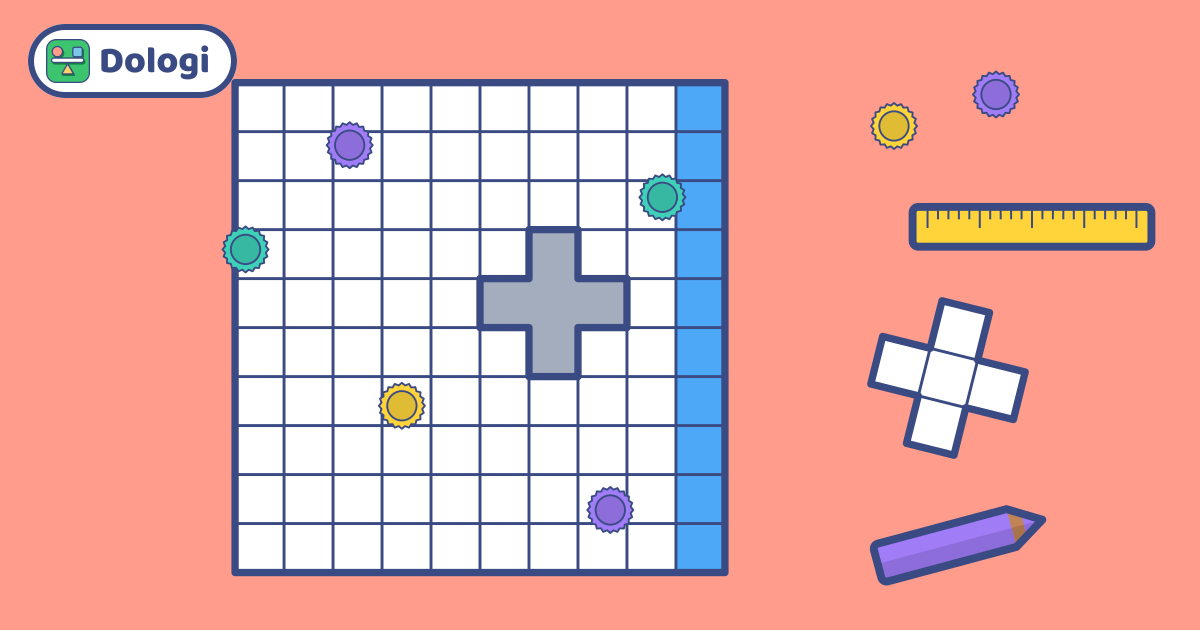
A hundred chart is a simple thing: the numbers 1 to 100 written in ten rows of ten. But it shows something children need to see again and again. Each row is one ten, going down a row adds ten, and the numbers follow a pattern you can actually point at.
You don't need to buy one. Drawing it together is part of the learning, and a homemade chart can be cut, covered and colored without worrying. This post shows how to make one and gives you five games of about five minutes each for children aged 6 to 9.
Draw the chart together
You need a big sheet of paper (poster board works well), a ruler, a pencil and a marker.
- Draw a square grid of 10 by 10. One-inch squares make a chart about 10 inches wide, big enough for small fingers and bottle caps.
- Your child writes 1 to 10 across the top row, then 11 to 20 on the next, and so on to 100. With a 6-year-old, you can write the numbers and let your child fill in a few, or stop at 50 the first day.
- Color the last column lightly: 10, 20, 30… 100.
Then ask: "What do you notice?" Children often spot that every number in a column ends in the same digit, and that the tens digit goes up by one each time you go down a row. Let them find it. That discovery is the point of the whole chart.
Some classrooms use a chart from 0 to 99 instead. The games below work the same way on either one.
Five games, five minutes each
1. Hidden numbers under bottle caps
While your child looks away, cover three to five numbers with bottle caps. Your child points at a cap, says which number is hiding, and lifts it to check.
The real learning is in the explanation: "It's right after 46, so it's 47," or "It's under 37, so it's 47." When this is easy, cover a whole row except one number, or cover a column.
2. Up ten, down ten
Put a finger on 47. Move one square at a time and say the new number:
| Move | New number | What happened |
|---|---|---|
| Down one | 57 | Added 10 |
| Up one | 37 | Took away 10 |
| Right one | 48 | Added 1 |
| Left one | 46 | Took away 1 |
Then turn it into adding and subtracting: "What's 47 + 20?" Down two squares: 67. "What's 64 − 30?" Up three: 34. Your child is adding tens without counting one by one.
3. Patch the hole
Draw a second, smaller grid and cut out a few pieces: a cross of five squares, an L shape, a row of three. Write one number on each piece, for example 47 in the middle of the cross. Your child fills in the rest: 37 above, 57 below, 46 to the left, 48 to the right.
For an extra challenge, cut a whole chart into six or seven big pieces like a jigsaw and put it back together. The numbers on the edges tell you which pieces fit.
4. Treasure hunt with directions
Hide a "treasure" (a sticker or a special bottle cap) under one number. Give the directions as a list: "Start at 23. Add 10. Add 10. Take away 1. Add 10." Your child follows along: 33, 43, 42, 52. Is the treasure under 52?
Then swap: your child hides the treasure and writes the directions for you. Watch for the edge of the chart. One more than 50 is 51, which is at the start of the next row, not to the right of 50. That's a great thing to talk about.
5. Color the counting patterns
Use a fresh chart, or a copy, for this one. Count by tens and color each number you land on: the last column lights up. Count by fives on another chart: two columns. Count by twos: every other column, like stripes.
For older children, try counting by elevens: 11, 22, 33… 99 makes a diagonal line going down to the right. Counting by nines from 9 makes a diagonal going down to the left, at least as far as 81. Ask: "Why does it go diagonally?" (Adding 11 is down one and right one; adding 9 is down one and left one.)
What to try at each age
- Around 6: a chart to 30 or 50, the bottle cap game, and moving right and left by one.
- Around 7 to 8: the full chart, up ten and down ten, patching pieces, and adding or taking away tens.
- Around 9: treasure hunts with longer directions, adding 9 or 11, and the diagonal patterns.
Every child is different, so follow what your child enjoys and stop while it's still fun.
Practice with Dologi
In Dologi's Patterns topic, the Next number puzzles say: "Each time, the same number is added or taken away. Which number comes next?" A sequence like 17, 27, 37 is a walk straight down a column of the hundred chart, so a child who has played these games sees the rule quickly.
In short
- Drawing the hundred chart together is part of the learning; ask "What do you notice?" before playing.
- Down a row is plus ten, up a row is minus ten, right is plus one, left is minus one.
- Five short games (hidden caps, up and down, patch the hole, treasure hunt, coloring patterns) cover counting, place value and adding tens.
- Keep each game to about five minutes and pick the ones that fit your child's age.
Read more: Tens and ones: teaching place value with bundles of sticks, Patterns in numbers: odd and even, counting in twos and skip counting, Prime numbers explained with blocks